Fred’s Funeral by Sandy Day

When an author contacts you about reviewing their book and the description sounds enticing it’s frustrating to know that it’s going to be several months before you’ll be able to get around to reading and reviewing their book.  Such is the case when Sandy Day contacted me about her book, Fred’s Funeral.    However, although it’s going to be a while until I get to read it, that doesn’t mean I should hide it away from followers of my blog who may not have such a large review pile as I do…

You can find an extract from the book below.  Also, click here to read an interview with Sandy in which she talks about the inspiration for Fred’s Funeral and her approach to writing.
Follow my blog with Bloglovin


Fred's FuneralAbout the Book

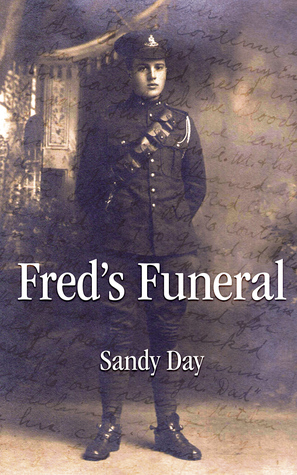
Fred’s Funeral is a short novel set in 1986. Fred Sadler, a WWI veteran, has just died of old age and his dismayed ghost now discovers that the arrangement of his funeral has fallen to his prudish sister-in-law, Viola. As Viola dominates the remembrance of Fred, he agonizes over his inability to set the record straight. Was Fred Sadler really suffering from shell shock? Why was he locked up most of his life in the Whitby Hospital for the Insane? Could his family not have done more for him? Fred’s memories of his life as a child, his family’s hotel, the War, and the mental hospital, clash with Viola’s version of events as Fred’s family gathers one rainy October night to pay their respects. Readers of literary historical fiction will enjoy Fred’s Funeral.

Format: eBook, paperback (129 pp.)       Publisher:
Published: 28th November 2017              Genre: Literary Fiction

Purchase Links*
Amazon.co.uk  ǀ  Amazon.com  ǀ Kobo ǀ iBook
*links provided for convenience, not as part of any affiliate programme

Find Fred’s Funeral on Goodreads


Extract from Fred’s Funeral by Sandy Day

1928, Ontario.

At his father’s repeated insistence, Fred finds work away from Lakeview House with a highway construction crew. It’s hot. Hotter than Arabia and dustier than a coal shed. He’d much rather be puzzling over a 36-degree gradient with a slide rule and graph paper, but jobs like that are for men with experience, and that, he has to admit he is a little short on. He detests physical labour – it gives his brain too much time to think. And it baffles him that the men around him don’t seem to mind the tedious digging and heaving and plodding in the heat he finds so torturous. They just toil away, humming, and talking, smoking their cigarettes.

Fred’s mind whirs like a radiometer as he works. He recalls the ass he made of himself when he last saw his cousins Pauline and Gertrude. He can never seem to catch Pauline alone. He is tongue-tied around her, and irritated by that nosy old Gertrude, whom he suspects laughs and makes fun of him behind his back. What is the point of it anyway? Pauline is his cousin for Chrissake. Why can’t he just leave her alone? Find another girl he likes?

And he replays the argument he had with Thomas on the weekend about the Chinese family their father hired to work in the hotel laundry. That one old Chinese lady scolded him for parking on the lawn where he always parks the car! And he told her to go fuck herself. Oh, that had been a mistake. Why did Thomas never lose his temper? Why was it always Fred getting into trouble?

His mind frets over the money he owes his father and how it keeps racking up and he never seems able to pay it back. He kicks himself for spending all his pay from the service – it had seemed like such a large sum at the time – he didn’t realize how quickly he’d fritter it away.

There must be something wrong with his nerves. This can’t be normal. He’s afraid he’s done permanent damage and reminds himself again to go pick up a bottle of vitamins at the drug store. That must be why his hands are so tremulous. He wonders if anyone notices. It can’t be something he’s doing to himself, can it? He needs an outlet for his pent up energy, but he could scarcely talk to a woman, which brings him back to Pauline, and the whole circus starts up again.

By the time the foreman blows the whistle, Fred has sweated off more pounds, which is no good whatever because his stomach is in such a knot these days he barely eats anymore. His belt is well past the last notch and hangs down the leg of his work pants. He should just cut it off. But what if he gains the weight back? He doesn’t want to go ruining a perfectly good belt.

Fred’s back is to him so he doesn’t know how or why the damn fool plunges his hand into a pail of boiling tar but Fred hears the man howl and the whole world goes black. The rat-a-tat-tat of guns shatters the air and missiles whistle past Fred’s head. He ducks and instinctively curls into a ball, pulling for his tin hat. The foreman shakes Fred by the shoulder. “Sadler! Sadler! What the hell’s the matter with you?” A sergeant is shouting. Fred can still hear the poor sod wailing. Slowly, and with growing mortification, Fred realizes the bawling is coming from his own throat and that he’s crouching on a dry dusty roadbed somewhere in Southern Ontario.

Fred’s pants are wet. He’s pissed himself.

He watches helplessly as the tar-scalded man is whisked away to the hospital. “You better go home, Sadler.” The foreman shakes his head.

Fred’s parents will be angry. He’s gone and messed up another perfectly good job, disgraced himself. What is wrong with his damn head?


Sandy DayAbout the Author

Sandy Day is the author of the soon to be released, Chatterbox, Poems. She graduated from Glendon College, York University, with a degree in English Literature sometime in the last century. Sandy spends her summers in Jackson’s Point, Ontario on the shore of Lake Simcoe. She winters nearby in Sutton by the Black River. Sandy is a trained facilitator for the Toronto Writers Collective’s creative writing workshops. She is a developmental editor and book coach.

Connect with Sandy

Website ǀ  Facebook  ǀ  Twitter  ǀ  Goodreads


Extract: The Circumstantial Enemy by John R. Bell

When an author contacts you about reviewing their book, it’s disappointing to have to decline the opportunity because of your already huge review pile.  Such is the case when John R. Bell contacted me about his historical fiction novel, The Circumstantial Enemy.    However, just because my review pile is approaching mountainous proportions doesn’t mean I should hide interesting sounding books from followers of my blog.

You can read an excerpt from The Circumstantial Enemy further down this post and, if it sparks your interest, you can find the relevant purchase links below.

Follow my blog with Bloglovin


The Circumstantial EnemyAbout the Book

The Circumstantial Enemy chronicles the trials and capers of a young Croat pilot who finds himself forcibly aligned with Hitler’s Luftwaffe. Unbeknownst to the hero, his sweetheart and best friend have taken the side of the opposing communist partisans. The threesome soon discovers that love and friendship cannot circumvent the ideals of this war. Downed in the Adriatic Sea, the protagonist survives a harrowing convalescence in deplorable Italian hospitals and North African detention stockades. His next destination is a POW camp on American soil. With the demise of the Third Reich, repatriation presents his next challenge. What kind of life awaits him under communist rule? Will he be persecuted as an enemy of the state? And then there is his sweetheart; in letters she confesses her love, but not her deceit… Does her heart still belong to him?

Based on a true story, The Circumstantial Enemy is an energetic journey to freedom through minefields of hatred, betrayal, lust and revenge. Rich in incident with interludes of rollicking humour, it’s a story about the strength of the human spirit, and the power of friendship, love and forgiveness.

Format: eBook (326 pp.)                   Publisher: Endeavour Press
Published: 12th October 2017          Genre: Historical Fiction

Purchase Links*
Amazon.co.uk  ǀ  Amazon.com
*links provided for convenience, not as part of any affiliate programme

Find The Circumstantial Enemy on Goodreads


Extract from The Circumstantial Enemy by John R. Bell

For Tony, the past days had been hazy. How long since they pulled him from the sea? And that Red Cross nurse that changed his dressings – fancy thinking she was Katarina. It must have been the morphine. The mind was playing him up. Could the dead man next to him on the floor boards of the rescue boat also have been an apparition?

Four days at Bari, and Tony was transported to the Santa Marta POW hospital in Catania, Sicily, where authorities either hadn’t read the Geneva Convention’s medical code of conduct, chose to ignore it, or simply were overwhelmed by the task of treating so many with so little. Hygiene was appalling, food and fresh gauze scarce, and staff levels low. Add to that a rash of malaria spread by mosquitoes from the marshlands which had left a trail of dead POWs and sick medics. Prisoners changed their own bandages, applied ointments, and scrounged chow. Infection, not wounds became the killer.

The cots in Tony’s ward were so close together that the wider nurses had to sidle between them to treat the patients. Now that it was October, the ward’s four windows remained closed to retain heat. They also retained the stench of excrement, urine, body odour, ammonia, and infection. Tony wasn’t sure which was worse – shivering in the cold, clean air or retching from the foulness he breathed.

The muscles of his swollen left leg had atrophied, and the puffiness encasing the knee had yet to recede. A young doctor, reputedly the best of an exhausted lot, eventually took out the slug, removed the dead tissue, and ordered that the gash be left without sutures or bandage in the hope that bleeding from an exposed wound would cleanse it.

But the bleeding stopped, and the skin surrounding the incision became red and feverish. By morning, red streaks ran beyond the swelling zone, and a yellow discharge collected inside the opening. The smell made Tony gag. A dutiful nurse swabbed the pus with antiseptic, but her efforts were futile – the tissue was rotting.

If the infection wasn’t stamped out, gangrene would take the leg. Tony’s body had rejected the antibiotic sulfa drugs. Penicillin was the answer, but an army short on the miracle drug would not waste it on the enemy. Santa Marta hadn’t seen a new vial in two weeks.

Thankfully, there was no shortage of morphine. A generous shot lulled Tony to sleep, but by three in the morning, chills, fever, and an entourage of dead men disrupted his slumber. The young Messerschmitt pilot he’d killed over Belgrade and the lanky red-haired fisherman from Korcula stood watch at his bedside, and in a crescent behind them, Major Kirilenko and all the others he’d met along the deadly way.

The delirium lasted three days. It was a tingling that startled him awake. The throb in the leg was gone, but what the hell was that itch? The knee felt as if it were hooked to a hundred hairline strands of low-voltage current. He started to shake. Was this how it felt? Christ, no! The bastards had promised not to amputate. He’d given countless warnings, but the staff made it clear he may have to trade the leg for his life. Tony had said he wouldn’t make that trade.

He couldn’t bring himself to raise his head and look. So instead, he studied the map of russet stains in the ceiling, following the contours as if the water lines were the shores of Dalmatian islands on the Adriatic Sea. He traced every cove, isthmus, and peninsula connected by dust-laden cobwebs draping the dangling light bulbs.

Damn itching.

Perspiration from his chest trickled down the furrow of his abdominal muscles to his navel. Let there be two. He squinted down his sopping chest. The bedsheet tented at the end of the cot. Wiggle them. The tent moved where his right foot should be. To see the left, he would have to sit up.

“Jesus Christ! Help! Help me-e-e-e-e-e-e!”

The man in the next cot asked what was wrong.

“Get them off! Get them off me!” Dozens of cream-colored maggots slithered and squirmed in the flesh in and around the uncovered wound. Tony whipped his head to his left and a stream of vomit splattered the floor and the legs of the next cot.

“Those grubs,” said his roommate, “are your best chance of saving that leg. They love rotting flesh – won’t bother with the healthy stuff. Feed them well.”


John R BellAbout the Author

John Richard Bell was born in Chigwell, UK and now resides in Vancouver, Canada. Before becoming an author of business books and historical fiction, he was the CEO of a Fortune 500 company and a global strategy consultant. A prolific blogger, John’s musings on strategy, leadership and branding have appeared in various journals such as Fortune, Forbes and ceoafterlife.com

Connect with John

Facebook  ǀ  Twitter  ǀ  Goodreads