
I’m delighted to welcome Jodie Morgan to What Cathy Read Next today. Jodie’s delightfully titled cozy mystery, Murder at the Summer Cheese Festival, was published on 17th September 2025. It’s described as ‘a delightful blend of friendship, food, and sleuthing’. So ideal for fans of cozy mysteries and, no doubt, cheese lovers. Murder at the Summer Cheese Festival is the first book in the Silver Springs Mysteries, with its follow-up, Murder At Goldenleaf Apple Farm, already published.
Murder at the Summer Cheese Festival is available to purchase now in all formats via Jodie’s website.
Read on as I chat to Jodie about creating her main character, how she went about her research for the book, and her writing heroes.
As a bonus, you can also read an excerpt from the first chapter of Murder at the Summer Cheese Festival in which Laura discovers the first sign that trouble is brewing…
About the Book
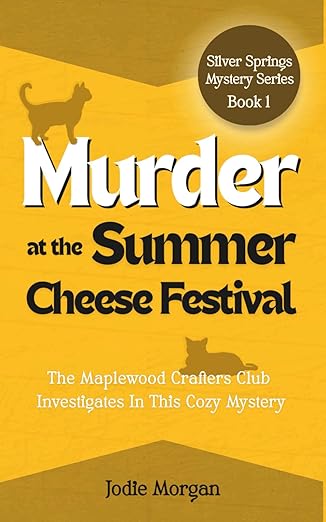
When cheese becomes deadly business, one woman must slice through lies to uncover the truth…
Laura Evans thought trading her high-stress Boston restaurant career for small-town Vermont charm would bring peace.
Instead, she finds herself knee-deep in cheddar and conspiracy when a body turns up at the General Store after a pre-festival cheese tasting ahead of the Summer Cheese Festival. And her boss Maggie is made the prime suspect.
The festival is less than two weeks away and with the store’s reputation threatened, Laura can’t stand by and watch her new life crumble.
With the help of her observant landlady, Evelyn Chan, she discovers beneath the town’s picture-perfect surface lies a complex web of rivalries, family secrets, and scandals.
And when there’s an entire festival’s worth of suspects, she must separate friend from foe before it’s too late…
Find Murder at the Summer Cheese Festival on Goodreads
Q&A with Jodie Morgan, author of Murder at the Summer Cheese Festival
Can you give us a brief pen picture of your main character?
While Laura Evans is much younger than I am (almost thirty-eight to my early fifties), she and I share a combination of professional competence and personal vulnerability.
After burning out from running kitchens in Boston’s cutthroat restaurant scene, she’s returned to the Vermont town where she spent summers with her Gran as a child. She seeks a slower pace, and if she’s honest, a reconnection with the person she used to be.
What I like about Laura is she’s observant in the way only hospitality workers are: she notices the tiny shifts in body language most people miss. It’s what made her excellent at managing teams, and a clever amateur sleuth, even though she’d deny it!
She’s also fiercely loyal. When her boss, Maggie, becomes a suspect, Laura doesn’t hesitate to investigate, even though she’s only been in town two weeks. She needs to protect what she cares about, probably because she lost so much of herself.
The book is set in present-day Vermont. What do you think is the secret of creating a strong sense of place?
For me, it’s all about the sensory experience and rhythms of daily life. I didn’t want Vermont to be just a pretty backdrop! I wanted readers to feel the General Store’s wooden floorboards under their feet, smell the maple syrup on pancakes, and hear the cadence of small-town conversations where everyone knows everyone’s business. I think the secret is specificity, and showing your readers those details. Real life is in the smallest things, which make up our day-to-day. And they often become big things!
I also paid attention to Vermont’s geography and culture. For everything I included in the book, before I even thought about writing it into the story, I researched it. Twice. You wouldn’t believe how much time I spent scouring books and the internet!
I’d like to think all that effort was worth it, because something readers have commented on in their reviews was how the book seemed well-researched. Learning so many new things about everything from Vermont to cheese production and from local produce to event planning, has been so good for my mind!
How did you go about your research for the book? Did you discover anything that surprised you during your research?
I approached this from two angles: cheese festivals and small-town Vermont.
For the cheese festival aspect, I went down a delightful rabbit hole researching everything from artisanal cheesemaking to the logistics of running food festivals. I learned about cheese competitions: there are judges who evaluate texture, aroma, appearance, and flavor with the same seriousness as wine sommeliers! As they should! I adore cheese! It’s heartening to know people care so deeply about it.
I also researched Vermont’s dairy industry, which gave me so many interesting insights. It inspired many aspects of the plot, which your readers will discover. For example, did you know Vermont has the highest number of cheesemakers per capita in the United States? Approximately 1 cheesemaker for every 13,000 people!
And the state itself. It’s a gem! The local tourism websites of various towns there were a surprising, yet super helpful resource. I learned Vermont produces over 2 million gallons of maple syrup annually. That’s more than any other state, accounting for about 50% of US production! They also have a rich tradition of all kinds of food production. They have the smallest state capital in the country, and most people live in small rural towns, no doubt where everyone knows each other! Perfect cozy mystery territory.
These fascinating facts are the perfect ingredients for a great story.
Murder At The Summer Cheese Festival is your first novel. Based on your experience, what advice would you give to other first time writers?
It is! It feels extraordinary to say that. I’ve still got lots to learn, but here’s a little of what I’ve learned from others that might be useful:
Write the book only you can write. I spent months second-guessing whether a cozy mystery set at a cheese festival was ‘too quirky’ but those specific, personal touches make a story memorable.
Give yourself permission to write a terrible first draft! My initial version had plot holes galore, characters who appeared without explanation, and clues that made no sense. But I had to write that messy draft to find the story! Revision is where the magic happens, so don’t expect too much from yourself too soon.
Who are your writing heroes?
For sheer plotting brilliance, I have to mention Agatha Christie. I’ve read Murder On The Orient Express several times, and I always notice new layers of misdirection. And Fiona Leitch and Robert Thorogood, authors of The Nosey Parker Mysteries and The Marlow Murder Club, never fail to impress with their plot twists.
Outside of mystery fiction, I’ve adored the works of Meg Bignell, Kate Morton, Joanna Lowell, Susan Cooper, and Philip Pullman. They’ve taught me so much about clever characterization, intricate plotting, heartwarming banter, intriguing settings, and attention to detail, respectively. The books some people write never cease to amaze me.
An excerpt from Murder at the Summer Cheese Festival
The annual Summer Cheese Festival looming in less than two weeks had stirred the town into a frenzy. Everyone had spilled into the café with questions and the latest gossip. Everywhere she looked, someone needed something. A question answered, an order clarified, a hand lent.
“It seems I’ve wiped out the clean mug supply,” Eli said, sidling up to the sink with an armful of dirty dishes. Today’s shirt—always a shade of green—contrasted well with his dark-brown skin.
“Leave it with me,” Laura said, pivoting and pushing up her sleeves. “I’m on it.”
It was good, being part of a team again.
Maggie Brook, the store’s co-owner and Laura’s boss, descended the stairs from her office on the upper level. She was a tall woman with pale, freckled skin who favored simplicity, which reflected in her all-black wardrobe and no-nonsense attitude.
“Is everything ticking along with your team?” Maggie asked Laura, managing a quick smile.
“Keeping pace so far!” Laura replied.
“Just!” Jesse O’Connor added with a grin, selecting pastries for a customer.
“Good, good.” Maggie’s eyes dimmed. “Now brace yourself. The festival week’s no picnic.”
She nodded at them all and spun on her heel, heading to the retail section which occupied the rest of the building’s first floor.
“Cinnamon roll and a latte? Caroline, yours is ready!” Jesse said.
“That’s it!” a woman who must have been Caroline said, grabbing her order.
Jasmine Williams, another General Store employee, emerged from the back rooms. Her red-tipped box braids were pulled back, and she had a Woodland Watch badge—a local land steward organization she belonged to—pinned to her apron. She carried a stack of glossy pamphlets.
“The festival brochures have arrived! I’ll put them on the table under the community notice board.” Jasmine held one up for Laura to see, her smile bright against her dark-brown skin and sharp cheekbones.
“That’s great, thank you!” Laura glanced at the proffered colorful foldout. It detailed event schedules, vendor profiles, and competition categories.
Jasmine smiled. “These are like reading the menu and thinking you’ve tasted the meal. Just wait till you see it in person.”
The kitchen bell behind Laura chimed, and she turned to see a plate of buttermilk pancakes waiting. Anton Reynolds, the General Store’s chef, nodded at her through the kitchen line. “Table three’s order is ready.”
Three golden-brown pancakes were topped with a pat of Whitman Family Creamery butter, a ceramic pitcher of local maple syrup beside them. Anton had added a fresh blueberry and raspberry compote and a light dusting of powdered sugar.
Laura thanked him and took the dish, transferring it to a tray before dropping it off to a delighted customer.
As the morning rush subsided, the café fell into an easy rhythm. Eli restocked cups by the espresso machine, Jesse arranged pastries in the display case, and Laura refilled sugar and salt shakers. The café hummed with conversation and the occasional hiss of the coffee machine.
“It’s hard to believe you left Boston for our patch of Vermont,” Eli said, reaching for another stack of ceramic mugs. “Are you still holding up okay? Two weeks in?”
Laura set down a just-filled shaker. “What can I say? There’s something special about this town. It’s all the thoughtful touches. The café has them too, like the little plant centerpieces. They always make me smile.”
“See?” Eli said proudly, glancing at Jesse. “She likes my succulents.”
Jesse grinned, the expression lighting up their pale face. “Alright, botanical prodigy. I’ll let you win this time…but only because I’m feeling generous.”
Eli rolled his eyes as he prepared a coffee, raising his voice over the hissing steamer. “Anyway, my grandpa always said it was the best little town this side of New England.”
Jesse snorted, adjusting a cinnamon roll in the display. “Of course. The noble lie of the lifelong local.”
“Says the arts school graduate who chose the country over city lights,” Eli said, grinning.
“That’s different,” Jesse said, straightening. “I spent four years in Providence among people who treated exhaustion like a badge of honor. I was unsure what came next.” They shrugged. “I visited here one October two years ago, and the entire valley looked like a painting. Two weeks later, I signed a lease.”
“I’ve heard the fall colors here are breathtaking,” Laura said, polishing water glasses. “My Gran always brought me in summer, so this’ll be my first fall in town. I can’t wait to see it for myself.”
“Let’s just survive the summer rush first,” Eli said. “The festival’s…a little chaotic.”
Laura paused, cloth in hand, glancing at the chalkboard where Jesse had added a festival-themed illustration—a wheel of cheese wearing a tiny crown. “I’ve managed my share of busy shifts, but this’ll be new.”
“New is an understatement,” Jesse said. “The whole town transforms. Every restaurant and café gets swamped with food writers, bloggers, and critics, all thinking they’re the next cheese taster extraordinaire.”
“Speaking of critics,” Eli said, “last year’s festival was something else. Remember that whole incident with Jeremy Blackwood? The poor guy looked as wilted as an over-watered plant when he lost his notebook!”
Jesse rolled their eyes as they passed. “It’s just as well you found his notes for him. He treats them like state secrets.” They must’ve seen Laura’s surprised look, because they continued with, “Once upon a time, his reviews could shutter a place. Now? He’s background noise. The last exposé worth mentioning was years back. Something about mislabeled halibut in Boston’s fine dining scene.”
About the Author
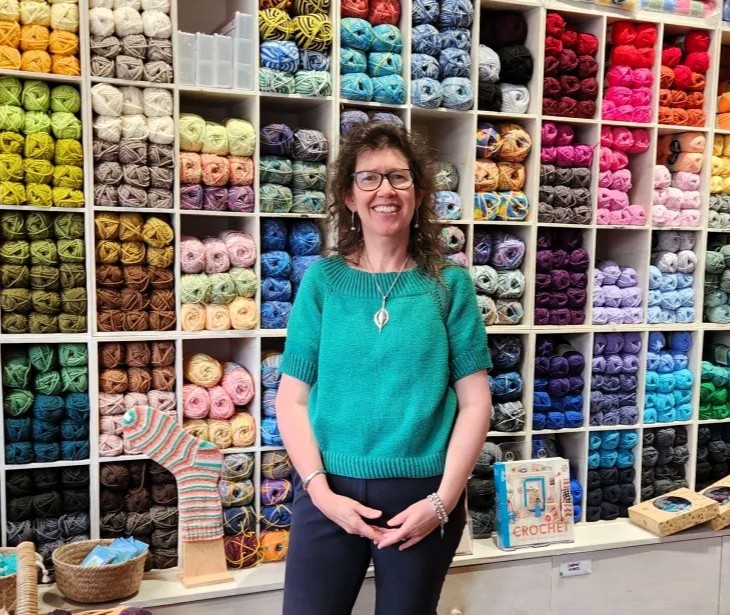
Jodie Morgan is an author & knitting blogger. Her books welcome readers to the charming Silver Springs Mysteries in Vermont, filled with intriguing puzzles, memorable characters, and the satisfying solutions readers love.
When she’s not plotting her next book, you’ll find her reading, savoring a coffee (always with cream!) or doing her latest knitting or crochet project. She loves to travel as it sparks ideas for her stories. Her most satisfying creative moments come from quiet evenings at home with her family.
Connect with Jodie
Website | Facebook | Instagram | TikTok | X/Twitter




 What Cathy Read Next...