

Today is the last day of this year’s Henley Literary Festival bringing to a close nine days of fantastic author talks, interviews and panel sessions as well as a full programme of children’s events.
Below are brief reviews of the events I attended either in person or virtually. Links from the book title will take you to the entry on Goodreads. You can read a full review of the first event I attended, with author Robert Harris here.
And finally, a date for you diary. Next year’s Henley Literary Festival will take place between 30th September and 8th October 2023.
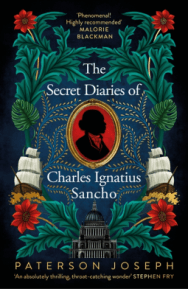 Tuesday 4th October – Paterson Joseph, author of The Secret Diaries of Charles Ignatius Sancho
Appropriately for an actor turned author, Paterson Joseph took to the stage of the Kenton Theatre, the fourth-oldest working theatre in the UK, to talk about his book The Secret Diaries of Charles Ignatius Sancho which was published on 6th October 2022. Based on Sancho’s diaries, the novel charts the life of a man who was born on a slave ship in 1729, orphaned at the age of three and sent to live with three spinsters in Greenwich but who, despite a series of hardships, became a leading figure in Georgian England, including being the first Black voter.
Paterson explained how he first came across Sancho’s story in 1999 and how it opened his eyes to the presence of people who looked like him further back in English history than he had imagined. Bringing Sancho’s story to a wider audience – including in a one man show performed in New York – has been a 20 year obsession and a real labour of love. Paterson gave two brilliant readings from the book – my favourite being a scene set in the Black Tar Tavern – in which, as you might expect from an actor of his stature, he really brought the character of Sancho to life. Paterson feels there is still much more to be discovered about Sancho’s life and, if there is, I’m pretty sure the author is the man to do it.
Paterson was asked if he intends to write more novels. He said he’s a ‘gadfly’ and has no plans, confessing writing this novel was the hardest thing he’s done. At the same time, he’d found it exciting because as an actor you’re always in the middle – between the playwright and the audience – whereas with a book the connection with the reader is direct. However, if he did write another book, it would most likely be based on his own family history. To me that sounds like a yes to the question.
I’m currently reading The Secret Diaries of Charles Ignatius Sancho and I’m going to put a marker down now for its appearance on the longlist for the Walter Scott Prize for Historical Fiction.
Thursday 6th October – Patrick Gale, author of Mother’s Boy & Sarah Winman, author of Still Life
 What a joy to have these two brilliant authors came together to talk about their books with writer and translator, Daniel Hahn. Asked about the inspiration for their books, Patrick explained Mother’s Boy arose out of a kind of panic that the poet Charles Causley was ‘slipping from public view’, his work having been removed from the National Curriculum. As a Patron of The Charles Causley Trust, Patrick felt the need to rescue Causley and that his novel is an ‘act of missionary work’ that would introduce readers to the real Charles Causley.
 For Sarah, the inspiration was a trip to Florence and learning about the floods that affected the city, the traces of which can be seen today in the form of flood markers, and seeing photographs of young people from all over the world who travelled to Florence to help restore the artwork.
Both authors touched on how war enabled individuals to travel to new places, experience different cultures, different foods and escape the conventions of life at home, that it could be quite liberating.
Both books centre on relationships between two individuals. In the case of Still Life, it’s young soldier Ulysses Temper and Evelyn Skinner, a middle-aged art historian, who meet by chance at a roadside inn in Italy 1944. Sarah joked that in this period there are always English spinsters who turn up in the most unexpected places. In Patrick’s book it’s the relationship between Charles and his mother, Laura. Patrick explained he decided to include Laura because he thought there needed to be someone who loved Charles, because he could come across as quite hard to love. Laura never gives up on him and that means, Patrick hopes, the reader won’t either.
Both authors gave readings from their books: Patrick from a section of the book which describes a touching episode from Charles’ childhood; and Sarah from a scene in which art historian Evelyn attempts to formulate and introduction to still life paintings.
Those who have read Still Life won’t perhaps be as puzzled as those of us who haven’t by a question from an audience member about how she wove a sentient animal into the story. Sarah said it started as a bit of a joke, amusing herself with playful moments as she was writing, but the character just stuck.
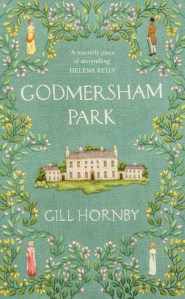 Thursday 6th October – Gill Hornby, author of Godmersham Park
Gill’s latest historical novel, the follow-up to Miss Austen, focuses on Anne Sharpe who arrived at Godmersham Park in January 1804 to take up the position of governess to Fanny Austen, one of Jane Austen’s many nieces. Asked by interviewer, fellow author Ayisha Malik, about the process of writing the book, Gill explained very little is known about Anne’s life other than the period of two years she spent there as governess, references to which are found in Fanny’s journal. Gill has been able to take advantage of the unknown parts of Anne’s life – the circumstances which led to her taking a position as a governess and the reason for her summary dismissal two years later – to craft her novel. What is known, Gill explained, is that Anne became a very close friend of Jane Austen. Indeed, the last letter Jane wrote before she died was to Anne and she also gave her a presentation copy of her novel, Emma (sold at auction in 2008 for £180,000).
Ayisha asked about the nature of the relationship between Jane and Anne; could it have been more than platonic? Gill thought it unlikely Jane was gay although there was undoubtedly deep affection between them. As she remarked, there might have been ‘sex and drugs and rock’n’roll’ taking place in Georgian London, but not in Hampshire.
Gill explained the role of governess was a uniquely difficult one. (It was also one of the only three options, along with companion or prostitute, that was open to an unmarried woman without financial support.) As governess, Anne is neither one of the family, nor one of the servants. One wrong move might result in instant dismissal, which is what happened in Anne’s case although the reason put forward in the book comes from Gill’s imagination and a few clues in Fanny’s journal.
Gill was asked by an audience member if her husband Robert Harris’s claim (mentioned at his own event earlier in the week) that he completes a book in six months is true and she confirmed it was. Gill is currently working on another Austen-related historical novel, about a marriage which started out as an elopment, which she also intends will take her six months to write.
 Thursday 6th October – ‘Book Club Thursday’ with Mike Gayle, author of The Museum of Ordinary People, Justin Myers, author of The Fake-Up and Clare Pooley, author of The People on Platform 5
Jo Finney, Books Editor at Good Housekeeping, chaired this panel session comprising three successful authors of what is known in the publishing world as ‘commercial fiction’ or, as Clare observed, books that sell loads. Jo asked about the inspiration for their latest books with answers ranging from Adele’s divorce, to items found in a skip, to what extreme event it might take for regular commuters on a train to talk to one another.
All three authors have written non-fiction: Mike, about his year spent completing the items on his To-Do list; Justin, about his experiences as a gay man of dating; and Claire, about her journey to sobriety.
The three authors shared their views on social media, acknowledging that although some aspects of it can be toxic, it now has an important role in promoting their books, especially since ‘commercial fiction’ seems to get less serious coverage than, say, literary fiction. Mike was particularly generous about the role of book bloggers in sharing their love of the sort of books he, Justin and Clare write.
 Friday 7th October – Alan Johnson, author of One of Our Ministers Is Missing
Prompted by fellow author Craig Brown, Alan recalled his switch from writing memoir to fiction. Now the author of two crime thrillers (and working on a third), he had initially planned to write historical fiction based on the history of the area in which he lives, on the Isle of Axholme in Lincolnshire. (He might still do, as he conceded whilst he signed my copy of his book.) Alan has always paid tribute to the English teacher who encouraged him to write and shaped the kind of books he read, introducing him to authors such as Wilkie Collins, Arnold Bennett and Anthony Trollope. Alan read a section from This Boy, his first volume of memoirs, which illustrates this. Craig observed that this introduction to literature was one of just a series of ‘What If?’ moments in Alan’s life, another being the intervention of a social worker, Mr Pepper, who ensured Alan and his sister were not separated after their mother’s death. For this reason, he’s a man they ‘venerate’.
Craig asked if it was important to be very organised when writing a thriller because of the requirement to brings lots of threads together. Alan said for him it starts with the characters and a sense of the general direction the story will take but his philosophy is very much ‘Set sail and see where it takes you’. He loves every bit of writing his crime novels, especially the opportunity to mislead people which he couldn’t do when he was a Member of Parliament. Cue, lots of laughter from the audience.
A regular visitor to Henley Festival, Alan’s seemingly endless supply of anecdotes, the majority of which involve self-deprecating humour, make him an engaging speaker. His books are great too.
These reviews are based on notes I took during the event and are my own recollections. Any errors in recording views expressed during the discussions are my own.

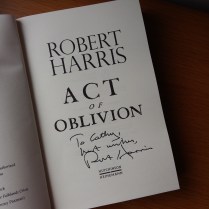 I know I’m not alone in having thoroughly enjoyed hearing Robert talk about his book. One advantage of attending the event in person was leaving clutching your very own copy of the book. The line to get your book signed was long but Robert was still thanking people for coming until the very end of the queue.
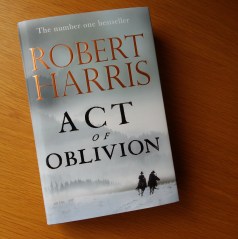 About the Book
 About the Author
 What Cathy Read Next...