
This is a longer version of a review that first appeared on the Henley Standard website.
A J Pearce, author of Dear Mrs. Bird, and Anne Youngson, author of Meet Me at the Museum, are both debut novelists whose books have the reading and writing of letters at their heart. Journalist and author, Hannah Beckerman, opened the event in the Festival Hub by asking A J and Anne what their first few months of being published authors had been like.
Anne said a wonderful part for her had been meeting readers at events like this, getting their feedback and being asked questions about her book she hadn’t considered before. Her experience was readers often have different interpretations of the book or point out influences of which she wasn’t aware. A J said the experience had been wonderful but a bit mad! She joked that she’d had to make herself practice saying ‘I am an author’. People had been lovely and she enjoyed chatting about her book and particularly loved discovering mothers and daughters or best friends who had enjoyed the book together. The authors then read short passages from their books.
Hannah observed that both novels use letter writing as a central idea. She asked Anne why she had decided to write Meet Me at the Museum as an epistolary novel. Anne explained the starting point was the book, The Bog People by P. V. Glob, and its dedication in the form of a letter that turned into a whole book. The same thing happened to her essentially. She’d originally thought it would be a short story that started with a letter. However a letter demands a reply, that reply demands another, and so on. Anne wondered if she might reach a point in the story where what she wanted to say couldn’t be expressed in letter format but she never did. She felt a more ‘conventional’ format would have created distance between her characters and the reader. In fact, as a writer, she’d found the letter format easy as it had a momentum of its own.
A J Pearce’s novel Dear Mrs. Bird involves letters written to an agony aunt on a range of subjects. A J explained they were inspired by actual letters from a wartime edition of Woman’s Own. Reading them had opened up a whole new world, allowing her to see a different era but through a familiar medium. Some of the letters were about subjects similar to contemporary problems; everything from queries about fat ankles to worries about being in love with the wrong person. Others were very particular to the war, involving separation and heartbreaking decisions. Dear Mrs. Bird is A J’s version of those stories. Hannah asked if anonymity perhaps created a safe space for the letter writers? A J felt, on the positive side, the correspondents clearly trusted the person they were asking for advice. On the other hand, they were serious questions and she felt it a little sad they needed to confide in a complete stranger, especially since Mrs. Bird would no doubt either ignore them or tell them to ‘buck up and carry on’.
Anne felt the act of letter writing involves careful consideration of the words used and there are still occasions when thoughts and feelings can more be easily expressed in a letter than face-to-face. Hannah observed that in Anne’s book reading and writing letters becomes a form of self-discovery. Anne agreed but felt this was manifested in different ways for each character. Initially, Anders, the museum curator, is more formal and pedantic whereas Tina really ‘puts herself out on the page’. Later, Anders begins to let go of his emotional tension.
Hannah wondered if, in both books, the exchange of letters acts as form of joint therapy. A J felt the main character in her book, Emmy, learns about herself from reading the letters written to Mrs. Bird. She begins to see that through her answers she can contribute to morale and help with real heartache. The letters also merge into her own life experiences.
Both authors believe that writing letters may be becoming a lost art and we risk losing a rich archive for the future as a result. Anne said she felt that, in writing the book, to a certain extent she was trying to make sense of these changes for herself and contributing to the debate. A J felt that modern communication can still offer encouragement but there is a greater sense of immediacy and expectation of a speedy response.
Hannah observed both books deal with history in different ways. Anne explained how Seamus Heaney’s poem ‘The Tollund Man’ had led her to read Professor Glob’s book, The Bog People, providing the inspiration for the novel. (How stories start is the focus of her current study for her PhD.) From the point of view of research, the Iron Age is a time before written records so evidence of how people lived can only be gained from artefacts.
When it came to researching wartime London for Dear Mrs. Bird, A J said she wished she’d had the foresight to ask her grandparents more about their own experiences. She’d used old photographs to ‘cast’ the characters in the book, giving her a sense of responsibility to ‘do a good job for the characters’. A J confided that she’d never intended to write a historical novel being slightly nervous about the need to get historical facts right.
Hannah remarked that Emmy in Dear Mrs. Bird has a distinct voice and asked if she came fully formed as a character? A J said she found writing the dialogue between Emmy and best friend Bunty came easily. Emmy’s back story, that she was the daughter of the suffragette generation, made her consider how this would influence someone’s thinking. Hannah observed the characters in Meet Me at the Museum are unsure of themselves to begin with but blossom as the book progresses. Anne said Tina’s voice was clear in her head but both characters revealed themselves to her as she was writing. As she got near the end, there were aspects of their lives she felt they might share as their relationship developed. Hannah asked Anne about the creative challenge of having only two characters. Anne said it had been an intimate process spending a year and a half with them existing only in her head, as she never spoke about them to other people. A sort of double life!
A J confessed writing is a slow process for her. Although the book starts cheerfully, it gets darker. Knowing that there must be conflict, she’d had to stop writing occasionally, even finding herself crying, because she’d known that rotten things were going to happen to some of her characters. It had felt, she said, like ‘carrying a knife you can’t see’.
Other themes the two books share are friendship, the need to be courageous and to be open to new opportunities throughout life. Anne observed that, in her book, Tina represents a generation of women who weren’t able to reach their full potential, partly because they never realised what their potential was. Similarly, Emmy in A J’s book, finds herself on a path she never expected but which turns out to be better in the long run. She learns never to give up on people and to keep going.
As someone who loved Dear Mrs. Bird and Meet Me at the Museum, I was delighted to learn that both authors are working on second novels. It would be lovely to see them make return visits to Henley Literary Festival to talk about their next books. After the event, I was thrilled to meet both Anne and A J in person and have Anne sign my copy of her book.
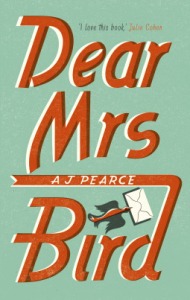 About the Book – Dear Mrs. Bird
London, 1940. Emmeline Lake is Doing Her Bit for the war effort, volunteering as a telephone operator with the Auxiliary Fire Services. When Emmy sees an advertisement for a job at the London Evening Chronicle, her dreams of becoming a Lady War Correspondent suddenly seem achievable. But the job turns out to be working as a typist for the fierce and renowned advice columnist, Henrietta Bird. Emmy is disappointed, but gamely bucks up and buckles down.
Mrs. Bird is very clear: letters containing any Unpleasantness must go straight in the bin. But when Emmy reads poignant notes from women who may have Gone Too Far with the wrong men, or who can’t bear to let their children be evacuated, she is unable to resist responding. As the German planes make their nightly raids, and London picks up the smouldering pieces each morning, Emmy secretly begins to write back to the readers who have poured out their troubles.
Format: ebook, hardcover (320 pp.) Publisher: Picador
Published: 5th April 2018 Genre: Historical Fiction
Purchase Links*
Amazon.co.uk ǀ Amazon.com ǀ Hive.co.uk (supporting UK bookshops)
*links provided for convenience, not as part of any affiliate programme
Find Dear Mrs. Bird on Goodreads
 About A J Pearce
AJ Pearce grew up in Hampshire and studied at the University of Sussex. A chance discovery of a 1939 women’s magazine became the inspiration for her ever-growing collection and her first novel Dear Mrs Bird. She now lives and writes in the south of England.
Connect with A. J. Pearce
Facebook ǀ Twitter ǀ Goodreads
 About the Book – Meet Me at the Museum
In Denmark, Professor Anders Larsen, an urbane man of facts, has lost his wife and his hopes for the future. On an isolated English farm, Tina Hopgood is trapped in a life she doesn’t remember choosing. Both believe their love stories are over.
Brought together by a shared fascination with the Tollund Man, subject of Seamus Heaney’s famous poem, they begin writing letters to one another. And from their vastly different worlds, they find they have more in common than they could have imagined. As they open up to one another about their lives, an unexpected friendship blooms. But then Tina’s letters stop coming, and Anders is thrown into despair. How far are they willing to go to write a new story for themselves?
Format: Hardcover, ebook (224 pp.) Publisher: Doubleday
Published: 17th May 2018 Genre: Literary Fiction, Contemporary Fiction
Purchase Links*
Amazon.co.uk ǀ Amazon.com ǀ Hive.co.uk (supporting UK bookshops)
*links provided for convenience, not as part of any affiliate programme
Find Meet Me at the the Museum on Goodreads
About Anne Youngson
Anne Youngson worked for many years in senior management in the car industry before embarking on a creative career as a writer. She has supported many charities in governance roles, including Chair of the Writers in Prison Network, which provided residencies in prisons for writers. She lives in Oxfordshire and is married with two children and three grandchildren to date. Meet Me at the Museum is her debut novel, which is due to be published around the world.
Connect with Anne


 The evening ended with an opportunity to purchase a copy of In My Life: A Music Memoir from Festival partner,
  About the Author

