
This is a longer version of a review that first appeared in the Henley Standard on 9th October 2019 and on the Henley Standard website. It is based on notes I took during the event and my own recollections. Any errors in recording views expressed during the discussion are my own.
A rapturous reception greeted acclaimed actor David Suchet as he arrived in the Finlay Suite at Phyllis Court to discuss his recently published book, Behind the Lens: My Life, with theatre journalist Al Senter.
 Al started by asking David why he’d decided to ‘let his photographs do the talking’. Describing Behind the Lens as a photo memoir rather than an autobiography, David said he’d always had an aversion to writing about himself. He’s played many different characters in his career – including Poirot, for which he always gets a round of applause when he drops into character (and did on this occasion too) – but in his words, “That’s not me”. David explained the aim of the book is for people get to know the man behind the characters. Firstly, through his photographs by showing the way he sees things. Secondly, by speaking directly to the reader (the book was recorded and then converted to text) about important things in his life – family, music, what makes him choose roles.
Al asked David how he first became interested in photography. David said it was through his grandfather, the Fleet Street photographer James (Jimmy) Jarché, who took the first photograph of Wallis Simpson with Edward VIII. David said in many ways his grandfather was a more important figure in his life than his father. Born in Rotherhithe, Jimmy was ‘a man for all people’ who photographed royalty but would also chat to and photograph homeless people. David explained his grandfather taught him about technique and would then send him out to take photographs. Having developed the film, his grandfather would go over each frame with him, critiquing the images. David said his grandfather told him the most important lens he’d ever have was the eyes God gave him and the most important skill ‘learning to look’.
David is never without his camera (he had it on the table in front of him) and his photographs are always an emotional reaction to something. As he put it, something that makes him go ‘Ooh’, whether a person, an object or a landscape. Although there are pictures in the book of people he’s worked with, they’re included because there’s something about them that caught his eye. He talked about how he goes for ‘mindful photographic walks’ where he just walks until he sees something that provokes an emotional response.
Al said he got the sense from the book it was not inevitable that David would become an actor. David explained his earliest ambition was to become a doctor (his father was a surgeon). As someone who dislikes tension, disharmony and arguments, David said he’d always found himself drawn to the idea of healing. Then he wanted to become a documentary filmmaker. He joked that he was nearly lots of things. After being cast in the school play as the ‘Scottish King’ (out of theatrical superstition he avoided naming Shakespeare’s play), he was encouraged to audition for the National Youth Theatre. He recalled one time at the end of a performance when he’d watched the lights being lowered, looked around the auditorium, remembered the audience laughing and thought to himself, ‘This is how I want to spend my life’.
David also talked about his early career, how he discovered his forte as a character actor and learned how to transform himself into someone else. Commenting that people have rarely seen him playing himself, he quipped ‘This is probably the first time….you’re very lucky!’ Al said he understood David’s father was hostile to the idea of him becoming an actor. David said it upset him in the beginning as his father pretty much cut him off, only really coming round when he joined the Royal Shakespeare Company in 1973.
Naturally, David couldn’t escape talking about a certain Belgian detective. Al wondered if he’d thought about playing the role when he appeared as Inspector Japp alongside Peter Ustinov as Poirot in the TV film Thirteen at Dinner (an adaptation of Agatha Christie’s Lord Edgware Dies). David exclaimed it was one of the two worst performances of his career. (He later revealed, in answer to a question from an audience member, that the other one is the film Wing Commander). He explained it was one of the very few occasions in which he took a job purely for the money as it enabled him to accept a stage role as Iago. However, making the film did allow him to meet Peter Ustinov whom he described as ‘a great man’. In Peter’s trailer one day, David said he’d confessed he’d like to play Poirot one day and Peter had replied, ‘I think you might be very good’.
In 1988 he was contacted by a producer and offered the role of Poirot in a TV series comprising ten one-hour adaptations of the short stories. Unsure whether to accept it, David contacted his older brother who advised him ‘not to touch it with a barge pole’, which goes to show, he said, that you should never listen to advice from your siblings.
Al commented that many actors don’t want to play the same role for any length of time for fear of being typecast and wondered if that had been a concern for David. David explained that he was only ever offered a one year renewable contract to play Poirot which enabled him to fit in other work in the theatre. He commented, ‘I’m an actor for hire; that’s how I like to spend my life.’
Al asked if David had any interest in the ‘golden age’ of detective fiction. David confessed he’d never been a great reader as his life has been all about reading scripts and research. He rarely reads fiction. As he said, ‘My life is fiction…I play fiction.’ He does however have a keen interest in theology and the early history of the Christian church.
David went on to talk about dealing with rejection (an occupational hazard for an actor), how he goes about preparing for roles and his admiration for the work of playwright Arthur Miller. In a fascinating insight, he explained how he likes to read through a script several times and then read it again minus the character he’s playing to find out what’s missing and what the playwright intended his character to contribute to the work overall.
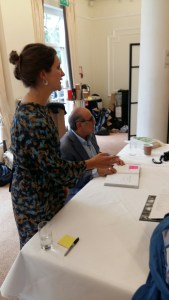 Audience questions included David’s favourite photographs in the book and his feelings about an age where just about everyone has a camera on their phone. Responding to the latter, he said, ‘If you’ve always got a camera with you, you’ve got a chance of turning banality into something artistic and special’. An answer characteristic of this thoughtful, eloquent and fascinating speaker.
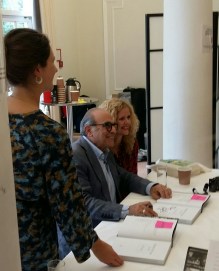 Afterwards audience members rushed to purchase the book and, like me, joined the long queue of people waiting to have David sign their copy, to exchange a few words with him, and, for a lucky few, to have their photograph taken with him.
All royalties from David’s book will go to The Tuberous Sclerosis Association, an incurable condition from which his grandson suffers.
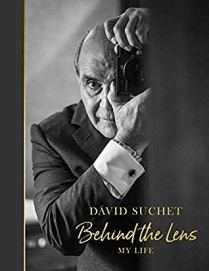 About the Book
A stalwart of stage and screen, David has wowed thousands of fans with his committed performances and is rarely seen without his camera. In Behind the Lens, he shares evocative photographs from his personal archives that capture the finest moments from his glittering 50-year career alongside musings on his life experiences.
He talks about growing up in his beloved London and reveals how his Jewish roots have influenced his career. He also discusses the joys and perils of fame, his love of photography and music and reflects on the changing nature of the acting industry.
Format: Hardcover (320 pp.) Publisher: Constable
Publication date: 3rd October 2019 Genre: Memoir, Photography, Nonfiction
Find Behind the Lens: My Life on Goodreads
About the Author
David Suchet, CBE is an English actor best known known for his work on the stage and British television for which he has earned international praise.

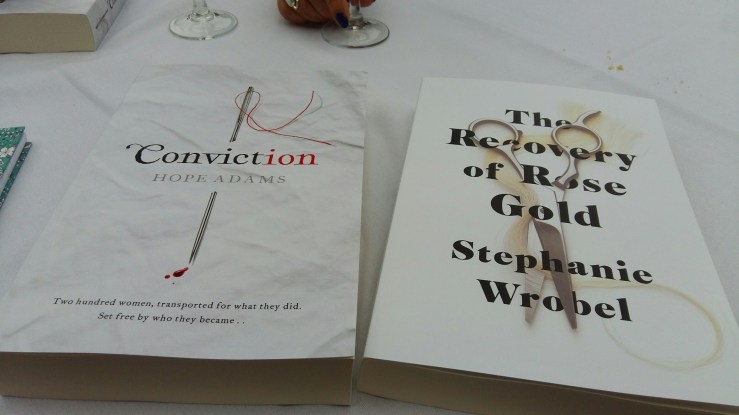
 Those of us lucky enough to attend the event left with proof copies of both books. Other readers will have to wait until next year to get their hands on copies. However, on the evidence of today, it will be well worth the wait.
 What Cathy Read Next...