
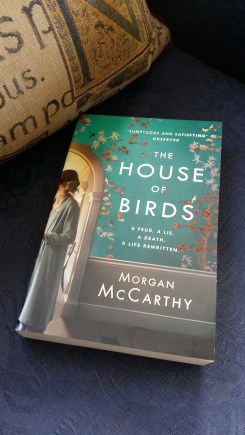
 About the Book
Oliver has spent years trying to convince himself that he’s suited to a life of money making in the city, and that he doesn’t miss a childhood spent in pursuit of mystery, when he cycled around the cobbled lanes of Oxford, exploring its most intriguing corners.
When his girlfriend Kate inherits a derelict house – and a fierce family feud – she’s determined to strip it, sell it and move on. For Oliver though, the house has an allure, and amongst the shelves of discarded, leather bound and gilded volumes, he discovers one that conceals a hidden diary from the 1920s.
So begins a quest: to discover the identity of the author, Sophia Louis. It is a portrait of war and marriage, isolation and longing and a story that will shape the future of the abandoned house – and of Oliver – forever.
Format: Paperback (464 pages) Publisher: Tinder Press
Publication date: 1st June 2017 Genre: Dual Time
Find The House of Birds on Goodreads
Purchase links
Bookshop.org
Disclosure: If you buy a book via the above link, I may earn a commission from Bookshop.org, whose fees support independent bookshops
Hive | Amazon UK
Links provided for convenience only, not as part of an affiliate programme
My Review
It will come as no secret to regular followers of this blog that I sometimes find dual-time novels problematic, often finding myself more drawn to the past timeline than the present. However, in The House of Birds, the author manages to pull off the feat of making the two timelines both equally interesting and, indeed, interdependent.
The book moves between the present day story of Oliver, who finds himself rather adrift having quit a job he never really liked but not sure exactly what he wants to do next, and that of Sophia Louis whose life is documented in a journal Oliver discovers when clearing out the old house inherited by his girlfriend, Kate, who is off in New York pursuing a promotion opportunity. What starts as a project to fill a gap between jobs becomes something more as Oliver begins to feel a connection with the house, an obligation to save it even. Unravelling the mystery of just who Sophia Louis was and what became of her provides Oliver with something to focus on, to draw him out of his apathetic state.
I liked the way Sophia’s story is revealed in instalments, in a way that is akin to a puzzle. Indeed, at one point, Oliver becomes irritated that her journal ends suddenly and, seemingly, unfinished. ‘Oliver was baffled and outraged. He felt keenly that Sophia – so aware of her reader had treated him unfairly.’ I also loved Sophia’s witty, teasing style of writing, often addressing her reader directly. But just who is Sophia’s intended reader? And why did she feel the need to hide the journal?
The story Sophia tells is one of disappointment, sadness, forbidden love, thwarted ambition, and the cruel and longlasting legacy of war, in this case the First World War. The latter is embodied in a character who is a tragic figure – ‘the grim king of a grim land’ – imprisoned in self-imposed silence and seeing the world as full of danger, of ‘black and smoking chaos’.
But how much of the story Sophia tells is true? Could her journal be fiction rather than fact? Indeed, Oliver ponders, ‘What if Sophia were a character in someone else’s novel?’ (I bet the author had a little chuckle to herself when she wrote that.)
As Oliver follows the trail Sophia has left, puzzling it out alongside the reader, it causes him to reflect on his own life. As he observes, ‘It’s ironic really. [Sophia] knew exactly what she wanted, but she couldn’t have any of it. I’ve had the opportunity to do whatever I want to do, and it seems like in almost thirty years I’ve only just managed to work out what that might be’. Oliver undergoes a kind of epiphany as he realises it’s not too late to pursue his childhood ambition, a path he was dissuaded from taking by his parents. In a way, he comes to feel he owes it to Sophia.
There is some beautiful descriptive writing, full of clever metaphors, such as this passage in which Oliver, as a young boy, first glimpses the rather neglected ‘House of Birds’ and its overgrown garden.
‘The darkly varnished ivy was tussling with the white bindweed over ownership of a sagging fence, while not far away, a honeysuckle, unchallenged, had claimed a garden table and swallowed a small tree. The lawn was an army massing under high spears, its regiments filing into the cracks between the paving stones to do battle with the dandelions. Above them the wisteria maintained a lordly rule over the house itself, loaded with it spectacular purple flowers, hundreds of fluttering confetti showers clamouring for the friskings of the bees.’
The House of Birds is the first novel I’ve read by Morgan McCarthy and, although she has written three previous novels, none of them appear to have been as positively received by readers as this one, and she has written nothing since. That’s a shame because I really enjoyed The House of Birds. I found the story enthralling, romantic without being sentimental and with some really clever touches. In fact, I imagined Sophia laughing to herself at an inspired one that occurs towards the end of the book.
In three words: Tender, intriguing, assured
Try something similar: The House at Helygen by Victoria Hawthorne
 About the Author
Morgan McCarthy lives in Berkshire, and has been writing since primary school. She is the author of four novels: The Other Half of Me, The Outline of Love, Strange Girls and Ordinary Women, and The House of Birds. (Bio/photo: Publisher author page)
Connect with Morgan
Website | Goodreads

 About the Book
 About the Author
 What Cathy Read Next...