
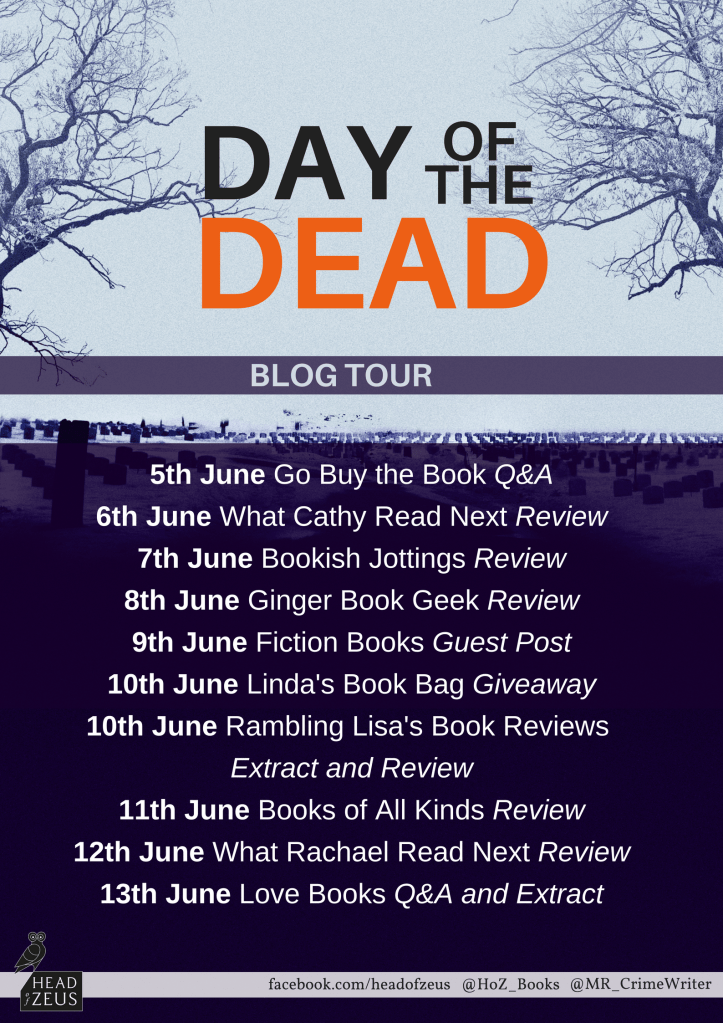
I’m delighted to be today’s host on the blog tour for Day of the Dead by Mark Roberts, the latest crime mystery featuring DCI Eve Clay. I’m also excited that Mark has agreed to answer some questions about Day of the Dead, the inspiration for it and his approach to writing.
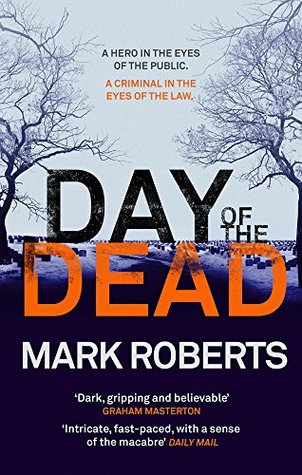 About the Book
Publisher’s description: Vindici is a hero to many. He is also the nation’s most dangerous criminal… The man who calls himself Vindici broke out of prison last year. Now he’s filmed himself torturing and killing paedophiles in Liverpool’s affluent suburbs. Half the city are celebrating: the streets are safer for their children. But for DCI Eve Clay and her team at the Merseyside Police, it’s a nightmare. Their job is to solve the crimes and lock up the killer – hard enough without being despised by the public they are trying to protect. And now, just when they think they’ve cracked the case, they receive a photo of Vindici, at a Day of the Dead parade in Mexico. So if Vindici is 5,000 miles away, who are they hunting in Liverpool? DCI Eve Clay must draw on all her cunning to unmask a killer who is somehow always one step ahead…
Book Facts
Format: Hardcover Publisher: Head of Zeus No. of pages: 464
Publication: 4th May 2017 Genre: Crime, Mystery
To purchase Day of the Dead from Amazon.co.uk, click here (link provided for convenience, not as part of any affiliate programme)
Find Day of the Dead on Goodreads
Interview: Mark Roberts, author of Day of the Dead (Eve Clay #3)
Mark, welcome to What Cathy Read Next. Day of the Dead is the third book in your DCI Eve Clay series. What are the challenges of writing a series compared to a standalone novel?
In writing a series, one has to be consistent with the journey taken by all the recurring characters. For instance, DCI Eve Clay, the lead character, has a son. With each book he ages a year. Also, in unfolding Eve’s back story of her childhood, when she thinks back to her early life and how that impacts on the present as new information is revealed, everything has to tie up and be consistently interlinked. In managing the challenges of consistency across a series, it presents opportunities to develop each and every character in this way: as in life as in fiction. We are all the same people we were a year ago, but we have changed because experience makes us change, and so it is with characters in a series of novels
Without giving too much away for readers who haven’t yet discovered the series, can you tell us a bit about Day of the Dead?
A paedophile has been murdered in his home. A week later, another paedophile is murdered in his home and his wife has been tortured and had her eyelids hacked off. DCI Clay suspects it is either the work of Justin Truman aka Vindici, a serial killer who targeted paedophiles in the south of England years earlier and who has escaped from prison or the work of a copy cat killer. For once the public are not behind Clay and her team and are, in fact, openly hostile to the investigation. And to make matters worse for Clay she suspects someone on the inside of Merseyside Constabulary is feeding information to the killer. It is her most complex case to date.
The two earlier DCI Eve Clay books were set in Liverpool. What made you decide to inject an international flavour into Day of the Dead?
I’m proud of Liverpool for many reasons but top of my list is the fact that as it has been a major port, we’ve had the world come to us for a long time. It is a really multi-cultural society and we have links all across the world. I wanted to reflect that side of Liverpool. Also, the Mexican Day of the Dead festivities are fascinating. I was intrigued by the complex image system and wanted to explore the meaning behind the rituals.
How has Eve developed as a character over the series?
She has learned more about herself and those around her. Eve becomes more passionate about her family and her work with each new book. And with this growing passion, she becomes more vulnerable. I wanted to have a lead character who detected not only crimes but also learns about her mysterious childhood. As her self-awareness grows, she learns more about the world around her, and her vision of all situations becomes more complex and multi-dimensional.
You’ve also written two books featuring DCI Rosen (The Sixth Soul and What She Saw) set in London. What prompted you to start a new series featuring a new central character?
I wanted to write a female lead detective in a city I know that I both love and have an in-depth knowledge of. I often go exploring and find new places that I haven’t seen before. With each new Eve Clay novel, I learn more about Liverpool and apply this to the novels. We have a wealth of atmospheric and interesting places like the Williamson Tunnels, the two Cathedrals, the Littlewoods Building. I could go on.
How do you approach the research for your books? Do you enjoy the process of research?
I love reading and I love researching. For Day of the Dead I did extensive research on the Mexican Festival. For Dead Silent, I had to research King Psamtik I (Egyptian king five centuries BC). I can’t go further on that one as it would give too much away. I work full time as a teacher in a special school and have spent the last fourteen years with disabled teenagers. That gave me a great insight into how to portray people with learning difficulties. For Blood Mist I had to go fourteen metres underground into the Williamson Tunnels. Each new book demands new research. Thankfully. For Black Sun my current work, I went to the Mortuary at the Royal Liverpool University Hospital, and will be going back again no doubt. At the mortuary I received massive help from Barbara Peters, the manager, and her team.
Do you have a special place to write or any writing rituals?
I think constantly about my writing, developing and reshaping material as I move through my daily life. When I get home from school, I set about the physical task of writing in my study. I have monthly targets that I have to achieve through daily and weekly targets. I don’t listen to music, I just stay at the laptop until I hit my daily target. Saturdays and Sundays are big target days, as are the school holidays. I think of the actual physical process writing as being the end of a much longer conscious and subconscious journey.
I do a lot of work when I am running along Otterspool Promenade, on the banks of the River Mersey heading out for the Irish Sea. Also I swim each day and my mind goes into improvisational mode when I’m in the water. Often, I will wake up at two in the morning and head to my study to try out some idea that has seized me somewhere between waking and sleeping. I believe in Max Ernst’s view of creativity as being one eye open and one eye shut. Ernst also said, ‘When an artist finds himself he is lost…’. Hence, I never carry maps or a torch as my ambition is to remain permanently lost.
What is your favourite and least favourite part of the writing process?
I love the whole process. There is nothing I dislike about it.
Which other writers do you admire?
Samuel Beckett, Thomas Harris, Edgar Allan Poe (boyhood hero), Captain Beefheart (amazing lyrics), Dostoyevsky, Gitta Sereny, Graham Masterton, Jimmy McGovern, Joyce Carol Oates, Franz Kafka, Colin Schindler…
What are you working on next?
The new book is called Black Sun. It is set in Liverpool and has DCI Eve Clay as the lead character. As it’s a work in progress, I can’t say much more than that because it would feel like walking on virgin snow.
Thanks, Mark, for those fascinating answers and for the good news that there will be another case for Eve Clay coming soon!
 About the Author
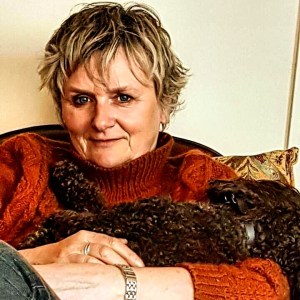
Mark Roberts was born and raised in Liverpool. He was a teacher for twenty years and now works with children with severe learning difficulties. He is the author of What She Saw, which was longlisted for a CWA Gold Dagger.
Connect with Mark
Twitter Facebook Goodreads
Connect with Head of Zeus
Website Twitter Facebook Instagram

 About the Book
 Book Facts
 About the Author

 What Cathy Read Next...