Blog Tour: District VIII by Adam LeBor

District VIII Tour Banner

I’m delighted to host today’s stop on the blog tour for District VIII, by Adam LeBor and to bring you a fascinating article by Adam about the inspiration for the book, the first volume in his ‘Budapest noir’ crime series.

Follow my blog with Bloglovin


DISTRICT VIIIAbout the Book

Life’s tough for a Gypsy cop in Budapest. The cops don’t trust you because you’re a Gypsy. Your fellow Gypsies, even your own family, shun you because you’re a cop.

The dead, however, don’t care.

Balthazar Kovacs of the Budapest murder squad is in the middle of his first cup of coffee when a mysterious text message arrives. There were three words: ’26, Republic Square’, and a photograph. The photo shows a man in his early thirties, lying on his back with his eyes open, half-covered by bricks and dust. The address, the former Communist Party headquarters, was once the most feared building in the country. But when Kovacs arrives at Republic Square, the body has gone and his only lead is the word of a Gypsy kid who saw the corpse bundled into an unmarked van…

Kovacs’ investigation will take him deep into Budapest’s shadows, an underworld visitors never get to see: the gritty back-alleys of District VIII; the people smuggling networks around Keleti Station; the endemic corruption of a country still haunted by the ghosts of history. And when the leads point to the involvement of his brother Gaspar, the city’s most powerful pimp, Kovacs will be forced to choose between the law and family loyalty.

Format: eBook (305pp.), Hardcover (400pp.)   Publisher: Head of Zeus
Published: 2nd November 2017                           Genre: Thriller, Crime

Pre-order/Purchase Links*
Amazon.co.uk ǀ Amazon.com
*links provided for convenience, not as part of any affiliate programme

Find District VIII on Goodreads


Guest Post: ‘The roots of District VIII’ by Adam LeBor

I started writing District VIII, the first volume of my Budapest noir crime series featuring Balthazar Kovacs, a Gypsy detective, a couple of years ago. But the book’s roots go much deeper. I have reported on Hungary and its neighbours since 1990 when Communism collapsed across central and Eastern Europe. I have always been fascinated by the Roma and the near parallel society in which many live, alongside wider society but not fully part of it. Centuries of prejudice and exclusion have forged fierce bonds of blood and family that united them against a frequently hostile outside world.

Hungary and its neighbours are now part of the European Union and theoretically committed to providing equal rights and opportunities for all their citizens. But from the Baltics to the Balkans, many Roma families live in extreme poverty, in settlements on the outskirts of towns and villages with no proper water or electricity or sewage systems. Roma children are often wrongly classified as being mentally handicapped and so are deprived of a proper education. I reported on a wall in a town in the Czech Republic that served no purpose other than to divide Roma people from their neighbours. I travelled to a remote area in eastern Slovakia and interviewed young Roma women who told their heart-rending stories of being sterilised against their will. I reported on the horrific series of murders in Hungary in 2008 and 2009, while six Roma people, including a five year old child, were killed in a series of highly organised and planned racist attacks. I learnt Roma history and how, during the Second World War, the Roma too suffered a Holocaust which they call the ‘Poraymus’ or ‘Devouring’. In the camps parents refused to be separated from their children. They fought so hard to stay together that the Nazis allowed them their own section at Auschwitz, called the ‘Zigeuner Lager’, or Gypsy camp. The Gypsy camp existed for seventeen months until 1944 when its residents were gassed.

Nowadays there is good news as well. A new generation of young Roma people is passing through the education system, finding its voice as activists and politicians or simply as professionals – including the police. The Balthazar Kovacs series was also inspired in part by a reception I attended some years ago at the British embassy in Budapest, in honour of the Hungarian Roma Police Union. There I met several Roma police officers who told me their personal stories. It’s not easy being a Gypsy police officer. Friends and relatives – especially those who live on the margins of legality – are suspicious of the authorities. Other police officers can be wary of their Roma colleagues.

District VIII opens in the summer of 2015 when Hungary was the epicentre of the refugee crisis. District VIII is the area of Budapest with the city’s largest Gypsy quarter. A Syrian refugee is murdered at Keleti station and his body disappears. As Balthazar investigates, and discovers that his brother Gaspar is somehow connected to the killing, he is soon pulled between two worlds: his duty as a police officer and his loyalty to his family. Those bonds of family and of blood, Balthazar realises, may have to be broken. Unless he can find a way out.


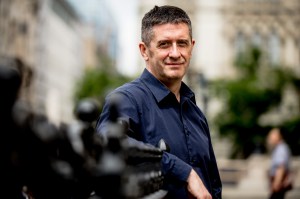
2017.05.25. Adam LeBor portraitAbout the Author

Adam LeBor is a veteran foreign correspondent who has covered Hungary and Eastern Europe since 1990. He is the author of thirteen books, including Hitler’s Secret Bankers, which was shortlisted for the Orwell Prize and City of Oranges. He writes for the Economist, Financial Times and Monocle. He divides his time between Budapest and London.

Connect with Adam

Website ǀ Facebook ǀ Twitter ǀ Goodreads


District VIII Tour Banner

#BookReview Cuz by Danielle Allen

9781784708122About the Book

Aged 15 and living in LA, Michael Allen was arrested for a botched carjacking. He was tried as an adult and sentenced to thirteen years behind bars. After growing up in prison Michael was then released aged 26, only to be murdered three years later.  In this deeply personal yet clear-eyed memoir, Danielle Allen reconstructs her cousin’s life to try and understand how this tragedy was the end result. We become intimate with Michael’s experience, from his first steps to his first love, and with the events of his arrest, his coming of age in prison, and his attempts to make up for lost time after his release. We learn what it’s like to grow up in a city carved up by invisible gang borders; and we learn how a generation has been lost.  With breathtaking bravery and intelligence, Cuz circles around its subject, viewing it from all angles to expose a shocking reality. The result is both a personal and analytical view of a life that wields devastating power. This is the new American tragedy.

Format: eBook, paperback (256 pp.)   Publisher: Vintage
Published: 6th September 2018            Genre: Non-Fiction, Biography

Purchase Links*
Amazon.co.uk ǀ Hive | Amazon.com
*links provided for convenience, not as part of any affiliate programme

Find Cuz on Goodreads


My Review

Part memoir of her cousin, Michael, part devastating analysis of the US justice and penal system, I found Danielle Allen’s book, Cuz, utterly fascinating and thought-provoking. I don’t read a lot of non-fiction (although I think perhaps I should) but this book jumped out at me on NetGalley because of the intriguing story and the author’s personal connection with its subject.  (A note on the book’s title – Michael was Danielle’s cousin, of course, but we also learn that ‘cuz’ was a term used by a particular gang in Los Angeles.)

In the first section of the book, one quickly recognises the author’s feeling of regret that her attempts to help Michael make a new life for himself on his release from prison in 2006 ultimately ended in failure. She questions whether she could have done more but perhaps Michael’s rehabilitation could never have been managed in the manner of a task list. What the author and the family didn’t know at the time was that there were always people and connections pulling Michael back in the direction of the criminal subculture.

The author’s academic rigour is evident in her assembling of the available evidence and her analysis of the systemic issues raised by Michael’s life and death.  Allen examines the complex web of factors that led to Michael’s involvement in the original carjacking for which he was convicted, his sentencing and his imprisonment. Her descriptions of the soulless and depressing experience of visiting him in prison are especially powerful.  There are also particularly interesting sections on the concept of the ‘parastate.’

I’ll be honest and say that, at first, I found the structure of the book, with its frequent changes of timeline, a little distracting. The author has chosen not to tell Michael’s story in a linear, chronological fashion but to start with his murder interspersed with his release from prison, only addressing his childhood and upbringing towards the end of the book. However, in a way, I can now see this structure mirrors the author’s own journey of discovery about Michael.  He was perhaps never the person he seemed from the outside; instead he was troubled, lacking in direction, open to being manipulated by others and tempted by easy options.

The book contains wonderful photographs of Michael and his family, including many from his childhood. I found the contrast between the happy, smiling child in the photographs and the troubled adult described in the book very sad and quite moving. Sadly, one gets a sense of someone always on a trajectory to the untimely death that eventually awaited him.

Reading Cuz gave me a fascinating, if troubling, insight into many of the social issues facing the Western world today: gang culture, drugs, racial inequality, the effectiveness (or rather, ineffectiveness) of the justice and penal system. The author proposes a particular solution to the problems she outlines but I was left wondering if there will ever be the political will to pursue such a course. I somehow doubt it in the current political environment.

I received a review copy courtesy of Random House UK via NetGalley.

Follow my blog with Bloglovin

In three words: Moving, detailed, thought-provoking


Danielle AllenAbout the Author

Danielle Allen, James Bryant Conant University Professor at Harvard University, and Director of Harvard’s Edmond J. Safra Center for Ethics, is a political theorist who has published broadly in democratic theory, political sociology, and the history of political thought. Widely known for her work on justice and citizenship in both ancient Athens and modern America, Allen is the author of The World of Prometheus: The Politics of Punishing in Democratic Athens (2000), Talking to Strangers: Anxieties of Citizenship since Brown vs. the Board of Education (2004), Why Plato Wrote (2010), Our Declaration: A Reading of the Declaration of Independence in Defense of Equality (2014), Education and Equality (2016), and Cuz: The Life and Times of Michael A. (2017). She is the co-editor of the award-winning Education, Justice, and Democracy (2013, with Rob Reich) and From Voice to Influence: Understanding Citizenship in the Digital Age (2015, with Jennifer Light). She is a Chair of the Mellon Foundation Board, past Chair of the Pulitzer Prize Board, and a member of the American Academy of Arts and Sciences and the American Philosophical Society.

Connect with Danielle

Website ǀ Twitter ǀ Goodreads