#BookReview A Three Dog Problem by S. J. Bennett @ZaffreBooks

A Three Dog ProblemAbout the Book

In the wake of a referendum which has divided the nation, the last thing the Queen needs is any more problems to worry about. But when an oil painting of the Royal Yacht Britannia – first given to the Queen in the 1960s – shows up unexpectedly in a Royal Navy exhibition, she begins to realise that something is up.

When a body is found in the Palace swimming pool, she finds herself once again in the middle of an investigation which has more twists and turns than she could ever have suspected. With her trusted secretary Rozie by her side, the Queen is determined to solve the case. But will she be able to do it before the murderer strikes again?

Format: Hardcover (388 pages)              Publisher: Zaffre
Publication date: 11th November 2021 Genre: Crime, Mystery

Find A Three Dog Problem on Goodreads

Purchase links
Bookshop.org
Disclosure: If you buy a book via the above link, I may earn a commission from Bookshop.org, whose fees support independent bookshops

Hive | Amazon UK
Links provided for convenience only, not as part of an affiliate programme


My Review

A Three Dog Problem proved to be the perfect contrast to the run of rather serious books I’ve read lately. It’s a delightful, charming mystery in which Her Majesty proves herself to be just as astute and no-nonsense as we always imagined. As one of her staff observes, ‘She was a hell of a lot sharper than she looked. Mistakes were picked up on. Dry comments were made. Eyes were rolled.’

Ex-soldier Rozie, the Queen’s Assistant Private Secretary, is a great character and a force to be reckoned with. As she reminds herself, when the enquiries she has set in train take an unexpectedly risky turn, ‘her regimental specialism had been “find, strike, destroy, suppress”‘.

I loved the humorous elements in the book such as Prince Philip’s petname for his wife being Cabbage, the idea of the Queen googling herself on her iPad to find out where she was on a particular date, and that she spent some of her time at Balmoral binge-watching Murder She Wrote.

I also enjoyed the ‘behind the scenes’ look at life in a royal palace, an increasingly dilapidated one as it turns out in the case of Buckingham Palace. And, as Rozie observes, at night its character changes. ‘The majority of staff went home, the flood of tradesmen, craftsmen and daily visitors slowed to a trickle, and the place was reclaimed by those who lived there or habitually worked late. The buildings stopped trying to impress and their occupants got on with the task of working as efficiently as they could in a rabbit warren of corridors that ceased to make sense two hundred years ago.’

External events such as the fallout from the Brexit referendum and the US Presidential election provide a subtle backdrop to the main storyline. The Queen muses about women who have achieved things or may do so in the future, such as Hilary Clinton, whilst underplaying her own role in world affairs. And there is a moving scene in which the Queen attends the annual Remembrance Day ceremony at the Cenotaph; it’s especially poignant as ill-health meant she was unable to attend the ceremony for only the seventh time in her long reign this year.

And, of course, at the heart of the book is an ingenious mystery involving amongst other things an unexplained death, poison pen letters, Renaissance art, and some murky goings-on in the bowels of Buckingham Palace.  Definitely a three dog problem.

I know many readers have fallen in love with this series, which commenced with The Windsor Knot in 2020, and I can now understand why. The good news is the author promises there’s another book on the way next year.

I received an a review copy courtesy of Zaffre and Readers First.

In three words: Engaging, witty, lively

Try something similar: The Vanishing Bride by Bella Ellis

Follow this blog via Bloglovin


S J BennettAbout the Author

S. J. Bennett wrote several award-winning books for teenagers before turning to adult crime novels. She lives in London and has been a royal watcher for years, but is keen to stress that these are works of fiction: the Queen, to the best of her knowledge, does not secretly solve crimes. (Photo: Goodreads author page)

Connect with Sophia
Website | Twitter | Instagram

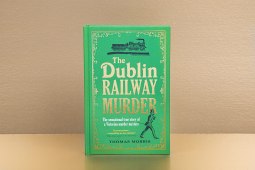
#BlogTour #BookReview The Dublin Railway Murder by Thomas Morris @HarvillSecker @VintageBooks @RandomTTours

Dublin Railway Murders BT Poster

Welcome to today’s stop on the blog tour for The Dublin Railway Murder by Thomas Morris. My thanks to Anne at Random Things Tours for inviting me to take part in the tour and to Vintage for my digital review copy.


Dublin Graphic 1About the Book

Dublin, November 1856: George Little, the chief cashier of the Broadstone railway terminus, is found dead, lying in a pool of
blood beneath his desk.

He has been savagely beaten, his head almost severed; there is no sign of a murder weapon, and the office door is locked, apparently from the inside. Thousands of pounds in gold and silver are left untouched at the scene of the crime.

Augustus Guy, Ireland’s most experienced detective, teams up with Dublin’s leading lawyer to investigate the murder. But the mystery defies all explanation, and two celebrated sleuths sent by Scotland Yard soon return to London, baffled.

Five suspects are arrested then released, with every step of the salacious case followed by the press, clamouring for answers. But then a local woman comes forward, claiming to know the murderer….

Format: Hardcover (384 pages)             Publisher: Harvill Secker
Publication date: 11th November 2021 Genre: True Crime, Mystery

Find The Dublin Railway Murder on Goodreads

Purchase links
Bookshop.org
Disclosure: If you buy a book via the above link, I may earn a commission from Bookshop.org, whose fees support independent bookshops

Hive | Amazon UK
Links provided for convenience only, not as part of an affiliate programme


My Review

In The Dublin Railway Murder, the author pieces together the story of an 1856 murder mystery that gripped the population of Dublin, and beyond.  The book is a meticulously researched true crime story based on contemporary accounts, original police interviews and other documents unearthed from the archives by the author.

The murder of George Little is in essence a locked-room murder mystery that could have come straight off the pages of an Agatha Christie novel, but didn’t because it actually happened. However, don’t expect a ‘whodunnit’ because a definitive outcome is not necessarily the way things happen in real life.

The book contains a massive amount of detail, not just about the course of the investigation and the trial, but also about life in Victorian Dublin. Although the social history was fascinating, at times it did threaten to dominate the unfolding story. Having said that, I did learn an awful lot about the operation of a Victorian railway, a seemingly much more complicated and bureaucratic process than simply transporting people and goods from A to B.

The book has a large cast of characters (listed at the beginning of the book) some of whom make only a brief appearance and, although forming part of the investigation, don’t contribute much to the eventual outcome.  What I did find astonishing was the initially slapdash approach to the investigation, such as not securing the crime scene and allowing members of the public and press to wander in and out. On the other hand, I was amazed at the efforts the police went to in the attempt to recover key items of evidence, including having a canal drained and searching in some extremely unsalubrious places.

My favourite parts of the book were the chapters describing the trial of the individual charged with the crime. There was a real sense of the frenzied atmosphere around the proceedings with the press and public jostling for places in the gallery, as well as the barristers for the defence and the prosecution competing with each other to uncover – or mitigate – the more damaging revelations, even to make the most amusing quip. These sections also highlighted aspects of the legal process we would find quite puzzling today, such as the absence of a witness box and the item that was used instead.

The Dublin Railway Murder has been likened to Kate Summerscale’s The Suspicions of Mr Whicher and in fact Whicher does make a fleeting appearance in the book. I felt I would have liked to get to know some of the main characters, such as Superintendent Augustus Guy, just a little bit more, and perhaps see things from their point of view. And, as the author acknowledges towards the end of the book, the emotional impact of the murder on the victim’s family, which would be much more of a focus in a similar situation today, was largely ignored at the time.

The Dublin Railway Murder will definitely appeal to fans of historical true crime and those who like to immerse themselves in the atmosphere of past times.

In three words: Detailed, meticulous, absorbing

Try something similarThis Mortal Boy by Fiona Kidman

Follow this blog via Bloglovin


Thomas Morris_Credit Charlotte Machin (cleared for jacket and publicity)About the Author

Thomas Morris is a writer and historian. His first book, The Matter of the Heart (Bodley Head, 2017), a critically-acclaimed history of cardiac surgery, won a Royal Society of Literature Jerwood Award for non-fiction. He is also the author of The Mystery of the Exploding Teeth (Bantam, 2018). He was previously a BBC radio producer for 18 years, and his freelance journalism has appeared in publications including The Times, The Lancet and the TLS.

Connect with Thomas
Website | Twitter | Goodreads

Dublin Graphic 5