
I’m delighted to welcome brothers Michael and Zack Urlocker, authors of The Man From Mittelwerk, to What Cathy Read Next today. It’s particularly special as it’s publication day of their debut novel. The Man From Mittelwerk is available to purchase now from Amazon.
So, as Michael says, “Sit down my friends, pour yourself a Scotch (or a cold, bitter cup of Joe) and let me take you on a tour of some of the Cold War noir novels and themes that influenced our book The Man from Mittelwerk“.
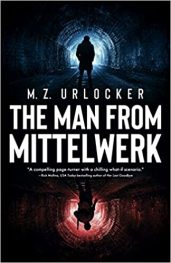 About the Book
1950. The Cold War simmers, and ex-GI Jack Waters is called in to investigate a fatal accident at a research lab in California.
When Waters recognizes the victim, he realizes he must revisit his hidden past in World War II to solve a murder and prevent Nazi scientists from creating a terrible, new weapon in America.
Blending noir detective fiction with post-WWII history, The Man from Mittelwerk builds from the facts of Operation Paperclip, the US government’s secret recruitment of 1,600 top Nazi scientists, to pose a dark what-if scenario.
Format: Paperback (362 pages) Publisher: Inkshares
Publication date: 6th September 2022 Genre: Historical Fiction, Thriller
Find The Man from Mittelwerk on Goodreads
Guest Post – Six Cold War Noir Novels You Will Love by M. Z. Urlocker
Cold War Noir
Growing up as teenagers in the 1970s my brother and I became fans of Cold War fiction before we even knew it was a genre. Our parents had original Pan paperback copies of Ian Fleming’s James Bond series that we read until the bindings dried out and the pages fell loose.
 From Russia With Love stood out among Fleming’s work. Agent 007 doesn’t even make an appearance until a third of the way into the story, instead Fleming takes you behind the Iron Curtain in a detailed exploration of the dark operations of the MGB (precursor to the KGB) and SMERSH, Stalin’s counter-intelligence agency. Fleming wrote the book at the start of the Cold War, as Britain and the United States were coming to grips with a new, dangerous enemy. It was a new era, where the old rules no longer applied. It wasn’t the black and white world of earlier noir fiction or war novels, it was a world where you no longer knew who you could trust. Fleming isn’t always given his due as a writer but he opened the door for a broad range of Cold War novels which reflected the growing tension between East and West for decades.
Pulp Fiction
Early pulp noir is often built around a “lose lose” situation. Take a down-on-his luck protagonist, beaten by the world and paint him (or her) into a corner where there are only bad choices. Classic works by Ed McBain, Lawrence Block and Jim Thompson fit this bill; these are gritty books of terrible consequences.
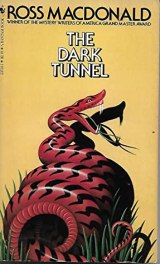 One of the best first novels is The Dark Tunnel (originally published in 1944 under the name Kenneth Millar) but later reissued under the more well-known pseudonym, Ross MacDonald. MacDonald was influenced by Raymond Chandler and John Buchan, but he puts his own twist on things. The book is set in the early days of WWII in a university town, not unlike Ann Arbor where MacDonald taught. It’s a fast-paced tale with protagonist Professor Robert Branch fighting for his life against a German spy conspiracy as well as petty crooks, rural rednecks, Union men and university politics. What makes the book especially tense is the conspiracy going on that’s bigger than Professor Branch realizes, and it just keeps getting darker. The pacing is a bit uneven compared to MacDonald’s later works but there’s a level of paranoia MacDonald never captured in his more famous Lew Archer PI series.
 Conspiracy and paranoia are two themes that also come out in Mickey Spillane’s fourth Mike Hammer novel, One Lonely Night (1951). Hammer is a US government-trained killer from WWII trying to adapt to life stateside as a private investigator.
“Twice I looked in the mirror and saw me. I didn’t look like me at all. I used to be able to look at myself and grin without giving a damn how ugly it made me look. Now I was looking myself the same way those people did back there. I was looking at a big guy with an ugly reputation, a guy who had no earthly reason for existing in a decent, normal society.”
Hammer, an avowed anti-communist (as was Spillane) stumbles upon a communist conspiracy in New York, a conspiracy that goes to the highest levels and threatens the American way of life. Spillane captures the tension of Senator Joseph McCarthy’s communist witch hunt. The larger-than-life conspiracy is a theme that emerges time and again in Cold War noir.
Gritty Realism
 Len Deighton’s The Ipcress File (1962) is the definitive noir Cold War novel. Its unnamed hero was christened Harry Palmer and portrayed by Michael Caine in the 1965 adaptation and follow-on films. In this remarkable first novel, Deighton created the ultimate noir protagonist trying to survive in a system set against him. Palmer’s a street-smart working-class punter who is pulled into a game he cannot win. Assigned to track down a top military scientist who is being sold to the Soviets, Palmer is kidnapped, whisked behind the Iron Curtain and electronically brainwashed by Chinese captors. When he manages to escape, he finds a much more sinister interpretation that calls into question the nature of Cold War alliances. If you can’t trust your allies, who can you trust? Coming off the “special relationship” between Franklin Roosevelt and Winston Churchill in WWII and the brainwashing of US troops by the Chinese in the Korean War, this was pretty shocking stuff.
 John le Carré, pen-name for former intelligence officer David Cornwell, published his third novel The Spy Who Came In From The Cold in 1963 at the height of the Cold War. (My brother and I joke that virtually any novel set between 1957 and 2022 can be said to be “at the height of the Cold War” as global tensions continued to escalate.) The Spy Who Came In From the Cold became an immediate bestseller. Its protagonist, WW2 veteran Alec Leamas, takes on one last case in order to avenge the death of a colleague. It involves a descent into the underworld of working-class trade unions and local communist party reps in order to infiltrate East Germany and bring down his nemesis. As with the best noir fiction, Leamas succeeds, but pays the ultimate price.
Along with Deighton, le Carré redefined espionage, taking it from Fleming’s upper-class black and white world of playboys in casinos with exploding devices into the gritty world of spooks and petty criminals against a shifting landscape of grey where no one could be trusted. Le Carré’s later novels transcend the espionage genre. But the underpinnings are never far from the cold, bleak setting of his early books.
 Walter Mosley’s first novel, Devil in the Blue Dress (1990), brought about a resurgence in the noir genre. His hard-boiled detective Easy Rawlins (who deserves an entire article to himself) like many noir protagonists before him, is a WWII veteran up against a system meant to keep him down. Rawlins, manages to survive and even win despite the institutional racial discrimination against him, a topic as relevant today as it was in the 1950s.
Modern Noir
The good news is there are many authors continuing to write modern takes on this important era. For example, Joseph Kanon (Leaving Berlin, The Berlin Exchange), Paul Vidich (The Coldest Warrior, The Matchmaker) and Dan Fesperman (The Double Game, Winter Work) have continued the tradition of putting tough men (and women) against the backdrop of hard choices in politically charged settings.
If you yearn for the classics, I can recommend the James Bond continuation novels by Anthony Horowitz as well as Max Allan Collins’ completions of unfinished manuscripts by Mickey Spillane. Both managed the tricky prospect of ‘honouring the canon’ while also besting their originators. I’d argue Complex 90 is the best Mike Hammer novel and A Mind to Kill is even better than From Russia With Love.
 About the Authors
Twin brothers Michael Urlocker and Zack Urlocker write under the name M. Z. Urlocker. The Man from Mittelwerk is their first novel. (Photo: Author website)
Connect with Michael and Zack
Website | Twitter | Goodreads

 Welcome to today’s stop on the blog tour for Sometimes People Die by Simon Stephenson. My thanks to Sofia at Midas PR for inviting me to take part in the tour and for my digital review copy. Do check out the posts by my tour buddies for today, Joanna at
 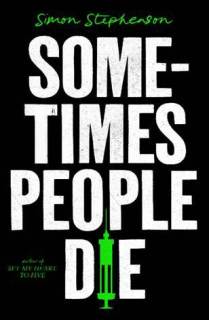 About the Book
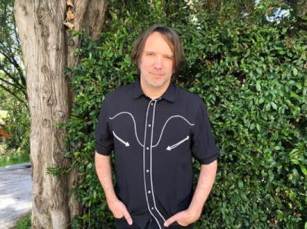 About the Author


 What Cathy Read Next...