Book Review – Where the Wind Calls Home by Samar Yazbek, translated by Leri Price @WorldEdBooks

About the Book

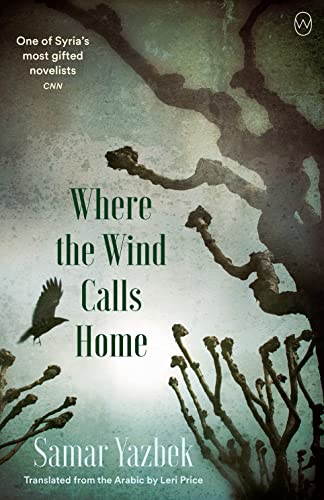
Book cover of Where the Wind Calls Home by Samar Yazbek

Ali, a nineteen-year-old soldier in the Syrian army, lies on the ground beneath a tree. He sees a body being lowered into a hole – is this his funeral? There was that sudden explosion, wasn’t there … While trying to understand the extent of the damage, Ali works his way closer to the tree. His ultimate desire is to fly up to one of its branches, to safety.

Through rich vignettes of Ali’s memories, we uncover the hardships of his traditional Syrian Alawite village, but also the richness and beauty of its cultural and religious heritage. 

Format: ebook (150 pages) Publisher: World Editions
Publication date: 6th February 2024 Genre: Contemporary Fiction, Translated Literature

Find Where the Wind Calls Home on Goodreads

Purchase Where the Wind Calls Home from Bookshop.org [Disclosure: If you buy books linked to our site, we may earn a commission from Bookshop.org, whose fees support independent bookshops]


My Review

In my review of Planet of Clay, Samar Yazbek’s previous novel set in war-torn Damascus, I noted that the book’s narrator, a young girl called Rima, has a very different view of the world from those around her. She senses things in colours, expressing the things she experiences through drawings rather than in words. Ali, the protagonist of Where the Wind Calls Home, also sees the world differently having formed from early in his life an intense relationship with nature, particularly trees. ‘Trees were simple, unlike people.’

As a boy, one particular oak tree became his sanctuary, a place from which he observed the clouds, and the mountains that surrounded his village. As he lingers between life and death, injured – probably fatally – by a bomb dropped in error on its own soldiers, his sole objective becomes to reach a nearby tree in search of that familiar sanctuary. He sees the tree’s presence as a sign that it will take care of him, that it is no coincidence he finds himself close to it.

Hallucinating because of his injuries, he relives moments from his life: the death of his brother, an arduous trek to a shrine with his mother Nahla, a visit to the palace of a local chief whose lavish lifestyle demonstrates how power and wealth has been concentrated in the hands of a few. These episodes give an insight into life in a rural village whose peaceful, albeit harsh, existence has been transformed by war: its menfolk killed leaving grieving families without fathers, sons, brothers.

Although any loss of life in war is devastating, it seems particularly tragic that a gentle soul like Ali, who harboured ambitions to follow a religious life, should be caught up in a violent conflict – ‘one of the many wars that humans are so busy inventing’. In fact, as we learn, his involvement results from an act of sacrifice. Ali recalls his mother’s anguish at not being able to view the body of Ali’s brother, so devastating were his injuries, and is determined she not should not suffer in the same way again. ‘Ali reflected that even if he didn’t survive, at the very least, he had to keep this promise to himself: to make sure his body stayed whole, so Nahla could see it and say goodbye to him…’

Where the Winds Calls Home has a dreamlike quality as Ali’s thoughts move, often imperceptibly, between past and present. There is striking imagery, particularly the presence of a mysterious ‘Other’ whose movements seem to mirror Ali’s own struggles to achieve his objective. It’s a heartbreaking story of the destructive impact of war and a reminder that seemingly intractable conflicts persist in many parts of the world.

My thanks to Christine at World Editions for my digital review copy via NetGalley.

In three words: Lyrical, moving, powerful
Try something similar: Held by Anne Michaels


About the Author

Samar Yazbek is a Syrian writer, novelist, and journalist. She was born in Jableh in 1970 and studied literature before beginning her career as a journalist and a scriptwriter for Syrian television and film. Her novel Planet of Clay, also published by World Editions, was a finalist for the National Book Award and longlisted for the Warwick Women in Translation Prize. Her accounts of the Syrian conflict include A Woman in the Crossfire: Diaries of the Syrian Revolution and The Crossing: My Journey to the Shattered Heart of Syria. Yazbek’s work has been translated into multiple languages and has been recognized with numerous awards – notably, the French Best Foreign Book Award and the PEN-Oxfam Novib, PEN Tucholsky, and PEN Pinter awards. She was recently selected to be part of the International Writers Program with the Royal Society of Literature.

About the Translator

Leri Price is an award-winning literary translator of contemporary Arabic fiction. She has twice been a Finalist for the National Book Award for Translated Literature, in 2021 for her translations of Samar Yazbek’s Planet of Clay, and in 2019 for Khaled Khalifa’s Death is Hard Work. Her translation of Khalifa’s Death is Hard Work also won the 2020 Saif Ghobash Banipal Prize for Arabic Literary Translation.

Book Review – History of Wolves by Emily Fridlund

About the Book

Book cover of History of Wolves by Emily Fridlund

Fourteen-year-old Linda lives with her parents in an ex-commune beside a lake in the beautiful, austere backwoods of northern Minnesota. The other girls at school call Linda ‘Freak’, or ‘Commie’. Her parents mostly leave her to her own devices, whilst the other inhabitants have grown up and moved on.

So when the perfect family – mother, father and their little boy, Paul – move into the cabin across the lake, Linda insinuates her way into their orbit. She begins to babysit Paul and feels welcome, that she finally has a place to belong.

Yet something isn’t right. Drawn into secrets she doesn’t understand, Linda must make a choice. But how can a girl with no real knowledge of the world understand what the consequences will be?

Format: ebook (223 pages) Publisher: Weidenfeld & Nicolson
Publication date: 3rd January 2017 Genre: Contemporary Fiction

Find History of Wolves on Goodreads

Purchase a copy of History of Wolves from Bookshop.org
(Disclosure: If you buy book via this link, I may earn a small commission from Bookshop.org, whose fees support independent bookshops.)


My Review

‘It was nothing. I was nothing.’

An unsettling feeling permeates this book, the author’s debut novel. It starts with Linda’s home life: a mother who barely acknowledges her and a father who is absent most of the time. Their cabin is remote and spartan, hidden away in the forest reached by a track that you could miss if you didn’t know where to look. Having said that, the forest is where Linda probably feels most at home. She has a detailed knowledge of its flora and fauna, its quiet places and ancient trees. A little of a ‘lone wolf’ herself, it’s perhaps the reason she instinctively chooses ‘history of wolves’ as the topic for a school project.

Given her solitary life, it’s not surprising she is drawn to anyone who gives her attention, such as the male teacher who encourages her studies but whose motives are suspect. Strangely, she maintains a connection with this man for many years afterwards, compelled for some reason to follow his progress in life, even after his true nature becomes apparent. Lily, a fellow pupil Linda is drawn to, seems to be as equally troubled as she is.

Linda becomes fixated by the house across the lake and the family who inhabit it, observing it covertly to begin with and then contriving a meeting with Patra and her young son, Paul. Linda spends more and more time in the house, vaguely aware there is something unusual about the frequent absences of Leo, Patra’s husband, and about his attitude to his son, but unable to understand fully the import of the things she sees or overhears. It’s this sense that there’s something not quite right about the family that contributes to the unsettling atmosphere I mentioned earlier. And indeed, there is something very not right about the family, as events – which are tragic in nature – will demonstrate.

The book’s structure sees Linda looking back at these teenage experiences, recognising now the things she failed to comprehend at the time and regretting the things she failed to do. We also get glimpses of Linda’s adult life. This movement back and forth in time became quite confusing and I really craved getting back to the earlier events. However, I enjoyed the wonderful writing which conjures up the natural beauty – as well as the harshness – of northern Minnesota. ‘Winter collapsed on us that year. It knelt down, exhausted, and stayed.’


About the Author

Author Emily Fridlund

Emily Fridlund grew up in Minnesota. She holds an MFA from Washington University in St. Louis and a PhD in Literature and Creative Writing from the University of Southern California. Her collection of stories, Catapult, was chosen by Ben Marcus for the Mary McCarthy Prize.

She lives in the Finger Lakes region of New York. (Photo: Goodreads author page)