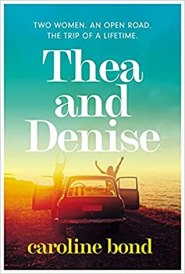
#BookReview Thea and Denise by Caroline Bond

Thea and DeniseAbout the Book

Two women. An open road. The trip of a lifetime.

Thea is confident, sorted, determined to have fun, but there are sorrows beneath the surface of her life. Denise is struggling under the weight of her many commitments and in desperate need of some excitement.

When these polar opposites meet, and unexpectedly become friends, they realise they’re both looking to escape. So begins a road trip that leads them far from home and yet closer to their true selves.

But they can’t outrun their pasts forever and when things start to get complicated, both women have an important decision to make. Do they give up or keep going? Turn around or drive on?

Format: Hardback (368 pages)    Publisher: Corvus
Publication date: 2nd June 2022 Genre: Contemporary Fiction

Find Thea and Denise on Goodreads

Purchase links
Bookshop.org
Disclosure: If you buy a book via the above link, I may earn a commission from Bookshop.org, whose fees support independent bookshops

Hive | Amazon UK
Links provided for convenience only, not as part of an affiliate programme


My Review

As might be guessed from the title, Thea and Denise is inspired by the author’s favourite film, Thelma and Louise. In the Acknowledgements, Caroline describes her book as ‘a very English take’ on that film. It’s a film I haven’t seen myself but I’m guessing it doesn’t include a lot of swimming in the cold North Sea or wearing one of your mother’s old nighties.

Denise and Thea’s friendship develops following a series of coincidences, one of which is a meeting that takes place in the ladies’ toilet in the Grosvenor Hotel. They seem unlikely friends with Thea initially taking the upper hand and Denise following her lead, prompted as much as anything by an incident involving an exploding freezer drawer.  However, the dynamic subtly changes as their road trip progresses. Suddenly it’s Denise who is taking charge as a result of a new-found confidence and who encourages Thea to open up about her true reasons for making the trip.   As Lillian, Denise’s mother, later observes, ‘They were chalk and cheese but somehow the combination worked’.

I found Thea’s motivation for embarking on the road trip easier to understand. She’s running away from things she can’t – or doesn’t want to – face, trying to persuade herself that what she’s doing is for the good of others and not just a reaction to her own fears. It’s an act of desperation whereas with Denise it felt more like an act borne out of a general discontent.

The road trip includes some fun scenes. My favourite was their trip to a Rage Room, the existence of such a thing being completely new to me.

The three women in the book – Denise, Thea and Lillian – are all interesting, well-developed characters. I particularly liked the portrayal of Lillian as an older woman living an independent lifestyle. The men in the book – Thea’s ex-husband, Marc, and Denise’s husband, Simon, play minor roles and neither are particularly attractive characters. Simon, in particular, seems to want a wife who will fulfil the role of housekeeper and administrator rather than that of life companion or lover.

Although I wasn’t completely convinced the epilogue was necessary, I enjoyed the way the book deftly explored the nature of female friendship and tapped into that feeling we’ve probably all had at some point – wouldn’t it be great to just run away?

I received a review copy via Readers First.

In three words: Engaging, insightful, heart-warming

Try something similarThree Women and a Boat by Anne Youngson


Caroline BondAbout the Author

Caroline Bond was born in Scarborough and studied English at Oxford University before working as a market researcher for 25 years. She has an MA in Creative Writing from Leeds Trinity University. She lives in Leeds with her husband. Caroline has three adult children. Thea and Denise is her fifth novel. (Photo: Twitter profile)

Connect with Caroline
Twitter | Goodreads

#BookReview Best of Friends by Kamila Shamsie

Best of FriendsAbout the Book

Fourteen-year-old Maryam and Zahra have always been the best of friends, despite their different backgrounds. Maryam takes for granted that she will stay in Karachi and inherit the family business; while Zahra keeps her desires secret, and dreams of escaping abroad.

This year, 1988, anything seems possible for the girls; and for Pakistan, emerging from the darkness of dictatorship into a bright future under another young woman, Benazir Bhutto. But a snap decision at a party celebrating the return of democracy brings the girls’ childhoods abruptly to an end. Its consequences will shape their futures in ways they cannot imagine.

Three decades later, in London, Zahra and Maryam are still best friends despite living very different lives. But when unwelcome ghosts from their shared past re-enter their world, both women find themselves driven to act in ways that will stretch and twist their bond beyond all recognition.

Format: Hardback (336 pages)               Publisher: Bloomsbury
Publication date: 27th September 2022 Genre: Literary Fiction

Find Best of Friends on Goodreads

Purchase links
Bookshop.org
Disclosure: If you buy a book via the above link, I may earn a commission from Bookshop.org, whose fees support independent bookshops

Hive | Amazon UK
Links provided for convenience only, not as part of an affiliate programme


My Review

This was a book of two halves for me. I really enjoyed the first section set in Karachi in 1988 in which we meet Zahra and Maryam as teenagers.

Although close friends, there are already signs of differences between them: social, financial and in terms of outlook on life.  As part of a wealthy and influential family, Maryam’s future path seems clear, whereas Zahra’s future will depend on her gaining a scholarship through her own efforts.  And where Maryam tends to see things in absolutes, Zahra possesses a more thoughtful and enquiring outlook. ‘There were things Zahra wanted from the world that Maryam didn’t understand’. What they do share is a growing awareness of their own physicality and sexual allure. However they live in a society in which, as Maryam observes, ‘Men strode, owning the world. Women walked with smaller steps, watched and watchful’.  The event that occurs after a party may seem relatively trivial to us but it has serious repercussions for Maryam and Zahra, a shameful breach of social conventions. It changes the path Maryam has confidently expected her life to take and also sows a little seed of resentment about Zahra’s role in how events played out that evening. For Zahra, the feeling of terror she experienced is an unwelcome reminder of the fears she has for her father’s safety from the dictatorial government of General Zia.

The politics of Pakistan play an interesting role in this part of the book. The death of General Zia in a plane crash relieves Zahra’s fears for her family but also gives her a sense of empowerment and of new possibilties as a result of the election of Benazir Bhutto as Prime Minister. ‘She’d felt different since Benazir’s inauguration. A woman was in power.’

Teenage Maryam asks Zahra, ‘What do you think we’ll be doing at forty?’ The second part of the book, set in London in 2019, answers that question. Two newspaper interviews with each woman describe events in their life in the intervening years. Maryam, a millionaire at 26, is now the head of a venture capital firm with a financial interest in, amongst other things, a video and photo sharing application making use of ‘face tagging’ technology. Zahra, formerly a successful barrister, is now head of the Centre for Civil Liberties. Maryam is optimistic about the new (we presume Conservative) government. Zahra opposes government policies, including around the use of facial recognition technology. For me, the potential for conflict between them felt a little too contrived. It seemed strange they should have stayed friends given their views and values differ so fundamentally.  Perhaps the most resilient link between them is Maryam’s daughter, Zola, who is Zahra’s goddaughter.

When the event that occurred in Karachi all those years ago raises its head once more it introduces an element of drama. Both women seem to view the event as a pivotal, defining moment in their lives. ‘All that shame and fear we carry around from childhood.’ This felt an over-exaggeration to me given both women have achieved success in their lives subsequently. Their responses to this perceived new ‘threat’ are markedly different. Maryam’s response is to use her power and influence to rid herself of the problem using ‘older forms of justice’. Zahra’s response is rather bizarre, akin to an act of emotional self-harm. Confronting the issue and the way they have each responded to it, brings out deep-seated and long hidden resentments that seem likely to destroy the friendship for ever. ‘It was so easy, too easy, for each of them to draw blood; they knew all the exposed places, the armour chinks and the softness of the belly beneath.’

Early in the book when Zahra detects that Maryam has told her a lie, she observes, ‘A drift had begun, which would only grow as the years went on. Deep down they both knew that no one had the kind of friendship when they were forty that the two of them had at fourteen’. Essentially the second part of the book is the playing out of that drift, a rather slow playing out it has to be said.

Even if I wasn’t enamoured with the second part of the book, I acknowledge there is some great writing. For example, I loved the early scenes in Karachi which gave a great sense of what life there was like in the 1980s. And a scene towards the end of the book in which Zahra visits a detention centre for people refused leave to remain stands out because of the way it reveals the harsh realities of the UK immigration system and the malign power of political influence.

I received a proof copy courtesy of Bloomsbury via Readers First.

In three words: Insightful, assured, intimate


Kamila ShamsieAbout the Author

Kamila Shamsie was born and grew up in Karachi, Pakistan. Her most recent novel Home Fire won the Women’s Prize in 2018. It was also longlisted for the Man Booker Prize 2017, shortlisted for the Costa Best Novel Award and DSC Prize, and won the London Hellenic Prize.

She is the author of six previous novels: In the City by the Sea (shortlisted for the John Llewelyn Rhys Prize); Salt and Saffron; Kartography (also shortlisted for the John Llewelyn Rhys Prize) Broken Verses; Burnt Shadows, shortlisted for the Orange Prize for Fiction and winner of the Premio Boccaccio (Italy) and the Anisfield-Wolf Award (US); and A God in Every Stone, shortlisted for the Women’s Baileys Prize, the Walter Scott Prize and the DSC Prize. Three of her novels have received awards from Pakistan’s Academy of Letters and her work has been translated into over 25 languages.

Kamila Shamsie is a Fellow of the Royal Society of Literature and was named a Granta Best of Young British Novelist in 2013. She is a professor of creative writing at the University of Manchester and lives in London. (Photo: Twitter profile)

Connect with Kamila
Twitter