A publication day interview with Micah Thorp, author of Aegolius Creek @TypeEighteenBks

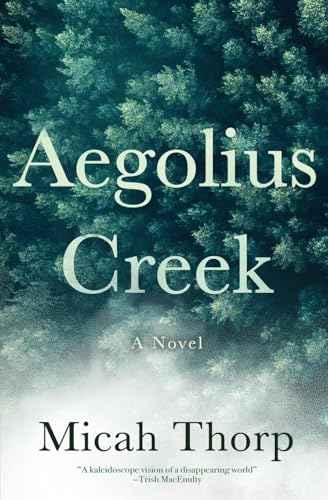
My guest today is Micah Thorp whose novel, Aegolius Creek is published today by Type Eighteen Books. Congratulations, Micah! Read on as I chat with Micah about Aegolius Creek and the inspiration behind it.


About the Book

Don Karlsson has lived on his family’s Oregon homestead for most of his life. The timber on his land is his greatest asset—planted and replenished by his hand, maintained with his labor and sweat, and harvested for income at his discretion.

After a new species of voles is discovered living in those trees, authorities step in to protect the creatures, and Karlsson fights back. No one can tell him what to do with his property. He enlists the help of his children: Billy, a local who understands his father’s connection to the land; Stacy, a fierce attorney from Boston determined to represent her father’s interests—even if they go against her own; and the beloved and sensitive youngest, Zeke, who organizes local environmentalists to make sure his father does not win.

The impending confrontation engulfs the community and competing interests—local businesses and political groups, infiltrators seeking profit—with the Karlsson family at the center, still trying to reconcile the loss of Don’s wife and their mother, Marlene. Tempers flare, desperate acts are taken, and the courtroom battle spills over into protests and riots, leading to a riveting and stunning conclusion.

Format: Paperback (198 pages) Publisher: Type Eighteen Books
Publication date: 16th September 2025 Genre: Contemporary Fiction

Find Aegolius Creek on Goodreads

Purchase Aegolius Creek from Amazon UK or Type Eighteen Books


Interview with Micah Thorp, author of Aegolius Creek

What was the inspiration for the story?

The most famous book about western Oregon, Sometimes a Great Notion, was written by Ken Kesey in the 1960s. He was well known for One Flew Over a Cuckoo’s Nest (and a rather eccentric bus ride he took with the Grateful Dead), but Sometimes a Great Notion is considered by many to be his best work. It’s a story about a rural Oregon family running a small timber company in the mid twentieth century.

I grew up not far from where Kesey lived and had relatives in the area described by his Oregon novel. There was a certain culture that existed in the mid twentieth century in rural western Oregon; rugged and very independent, that I understood well. During my youth that culture dramatically changed. Conflict over harvesting timber on public lands pitted the environmental community against local blue-collar workers. The subsequent changes led to the dismantling of much of the industry. I wanted to write about the effect those changes had on the people and communities that went through them.

Why did you particularly want to explore the conflict between individual rights and environmental concerns?

Aside from the conflict that surrounded my upbringing, I think the topic is prescient. We are in the midst of a period in which concerns about climate change are going to be confronted by groups that must give something up to slow global warming. Understanding and resolving these conflicts is necessary to bring about change.

A central problem in these confrontations is a level of certainty that pervades different groups which often undermines the very position they advocate. In Aegolius Creek I tried to carefully balance the differing points of view and let the reader empathize with all of them. This particular conflict (land rights vs environment protection) isn’t particularly unique in the sense that the problem is complicated, while the arguments about it are simplistic. Only when you dig into the details are you confronted by implications of completely adopting one point of view – which is generally destructive. Dialectical thinking isn’t easily adapted by most, but it makes great fodder for a writer.

How important to the story is the book’s setting?

Very. The book is about place, both as a concept and a reality. Aegolius Creek is a fictional place, but quite similar to a number of different rural areas up and down the Willamette Valley. In order to make Aegolius Creek feel real, I devoted a short soliloquy about the Aegolius Creek Valley at the beginning of each chapter, a number of which are based on the real characteristics of real communities.

How did you go about creating your main character, Don Karlsson?

I had family members that could be a pretty easily substitute for Don – hard working, intense and remarkably reflective. He doesn’t change much through the course of the book – he’s an anchor for the story and the other characters revolve around him.

One of the important things I knew I needed to do with Don was detail the complexities of his point of view. It would be hard to empathize with him without his backstory or appreciating his point of view in some detail. With a pretty quiet, austere personality it was important to get inside his head a bit.

Were there any scenes that were particularly challenging to write? If so why?

The climactic scene in the book (which I won’t spoil) was difficult because I wanted to write it from a number of different perspectives all at once without losing any of the emotional punch. It made the sequencing difficult.

One of the things I was aware of as I was writing was juxtaposing point of view and tense. The prologue and epilogue are in first person past tense, from the point of view of a character that isn’t in the rest of the book. In the body of the story I primarily use third person present tense, but there are places where Don’s point of view is italicized in first person present or past tense.

The book has been described as ‘a vision of a disappearing world’. Do you agree with this assessment?

Yes and no….

There were a number of changes that occurred between the 1970s and 2000’s that affected the timber industry and all the communities built around it. The inability to cut timber on public lands obviously had an effect as did the subsidizing of Canadian logging. Automation reduced the number of loggers and millworkers needed. The lost tax revenues timber communities needed to support their public services were initially offset by funding from the federal government, but eventually the lack of jobs led to their decline.

With all these difficulties, the timber industry is still alive, if only a shell of its former self. At its peak Oregon timber harvests were around 10 billion board feet a year. By 2010 they had declined to less than a quarter of that.

Timber communities haven’t gone away, but many are a shell of what they once were.

Thank you, Micah, for such fascinating answers to my questions.


About the Author

Micah Thorp is a physician, writer, and lifelong Oregonian. His research has been published in numerous medical journals, and his short fiction has appeared in various literary journals. His first novel, Uncle Joe’s Muse, won a 2022 Next Generation Indie Book Award and a Foreword Indies Book of the Year Award. His sequel, Uncle Joe’s Senpai, was a finalist for the Foreword Indies Book of the Year Award. Micah’s novel, Aegolius Creek, is the recipient of a 2025 IPPY Independent Publisher Book Award: West-Pacific Best Regional Fiction.

Connect with Micah
Website | Instagram | Goodreads

Book Review – Secrets of the Bees by Jane Johnson @HoZ_Books

Welcome to today’s stop on the blog tour for Secrets of the Bees by Jane Johnson especially given it’s publication day! My thanks to Eleanor and Sophie at Ransom PR for inviting me to join the tour and to Head of Zeus for my review copy via NetGalley. Do check out the review by my tour buddy today, bookstagrammer cosylittlereadingcorner.

About the Book

Time has forgotten this remote corner of West Cornwall, and left its many secrets undisturbed. Until now…

Ezra Curnow has lived in the little cottage on the Trengrose estate all his life. He was born there, as was his father, and his grandfather before that. It is his own little Cornish paradise.

Then the mistress of the estate, Eliza, dies without leaving a will, putting the cottage’s ownership into question. London financier Toby and his wife Minty are soon enticed by Trengrose’s charm and, worse still, see a lucrative rental opportunity in Ezra’s cottage.

But Ezra is prepared to battle to save his beloved home, and has a number of secret weapons in his armoury. What Ezra doesn’t know is that Eliza also took some secrets to her grave – and she doesn’t intend to rest quietly until they come to light…

Format: Hardcover (336 pages) Publisher: Head of Zeus
Publication date: 5th June 2025 Genre: Contemporary Fiction

Find Secrets of the Bees on Goodreads

Purchase Secrets of the Bees from Bookshop.org [Disclosure: If you buy books linked to our site, we may earn a commission from Bookshop.org, whose fees support independent bookshops]

My Review

Ezra epitomises someone who is ‘in tune’ with nature in a way people once were but are sadly less so these days. He grows his own fruit and vegetables (and some other things as well), tends to the bees in their hive and uses herbal remedies. He doesn’t see humans as superior to animals. Although he has a cat companion, he doesn’t own him; Bucca comes and goes as he pleases. The same with the jackdaw who pecks mealworms from Ezra’s pocket.

Ezra has few material possessions and his cottage doesn’t have the things we might consider essential today, like electricity, a telephone line or an inside bathroom. But that doesn’t matter to him. He’s happy living in the cottage where he was born and the only way he intends to leave is, in his own words, feet first.

The sale of Trengrose House threatens to upend everything because its new owners, the Hardmans, see only its financial potential. They represent everything Ezra is not. They’re not interested in preserving the estate with its orchards and meadows. To them the Celtic cross in the lane is merely an obstacle not a sacred monument that’s stood there for centuries. And they’re definitely not interested that Ezra’s lived in the cottage all his life, they just want him out. Unfortunately they haven’t counted on Ezra’s determination, resourcefulness, and ingenuity. And his capacity for mischief making.

There’s quite a contrast between the more lighthearted moments and what we learn about Ezra’s experiences as a young man.

The landscape, culture and history of Cornwall is an essential element of the book, reflecting the author’s own attachment to the county. The story also incorporates some of the social and economic issues Cornish people face today, such as a lack of affordable housing, but in a way that never feels like a political tract. There is though a strong ecological message that runs throughout the book. ‘Everywhere humans go, they wreck it. Pillage the land for whatever profit they can make out of it, without giving a thought to the consequences for any other living thing.’

It seems to me all the characters learn something in the course of the book, leading them to a sense of fulfilment. With Ezra’s help, Mindy and Toby’s son Dominic learns to identify the local flora and fauna, whilst their daughter Miranda comes to appreciate the wild landscape around Trengrose with the help of Ezra’s great-nephew Sam. Mindy becomes absorbed in discovering the history of Trengrose House and its previous occupants, uncovering some long hidden secrets in the process. Toby? Well, the only thing he learns is that there are some things money can’t buy. (The description of him as an ‘encysted pustule’ is spot on.)

The reader learns quite a bit as well about Ezra, including some things I certainly didn’t see coming.

Secrets of the Bees is a heartwarming story that has woven into it a message about the risk we run if we lose our connection with nature and value things purely in monetary terms. ‘You can’t buy birdsong, or the sight of your bees visiting your own flowers, or the sun through the leaves of the apple trees, or the smell of ripe tomatoes you’ve grown from seed…’ Add a whiff of the supernatural, a touch of mystery and an element of melodrama and you have all the ingredients for an entertaining read.

In three words: Engaging, tender, intriguing

About the Author

Jane Johnson is a novelist, historican and publisher. She is the UK publisher of many bestselling authors, including George R.R. Martin. She has written for both adults and children, including the bestselling novels The Tenth Gift and The Salt Road. Jane is married to a Berber chef she met while climbing in Morocco. She divides her time between London, Cornwall and the Anti-Atlas Mountains.

Connect with Jane
Twitter/X | Facebook | Instagram