
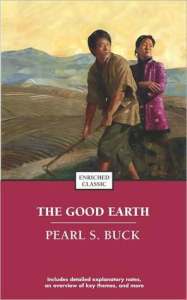
 About the Book
This Pulitzer Prize-winning classic tells the poignant tale of a Chinese farmer and his family in old agrarian China. The humble Wang Lung glories in the soil he works, nurturing the land as it nurtures him and his family. Nearby, the nobles of the House of Hwang consider themselves above the land and its workers; but they will soon meet their own downfall. Hard times come upon Wang Lung and his family when flood and drought force them to seek work in the city. The working people riot, breaking into the homes of the rich and forcing them to flee. When Wang Lung shows mercy to one noble and is rewarded, he begins to rise in the world, even as the House of Hwang falls
Format: Hardcover (339 pp.) Publisher: Methuen
Published: 1948 [1931] Genre: Literary Fiction, Modern Classics
Purchase Links*
Amazon.co.uk ǀ Amazon.com
*links provided for convenience, not as part of any affiliate programme
Find The Good Earth on Goodreads
My Review
The Good Earth is the book from my Classics Club list that I drew in the latest Classics Club spin. My edition was published by Methuen in 1948 and is a copy I picked up in a second-hand bookshop.
I’ve been reading the book over Christmas and initially I thought that the terrible struggles of Wang Lung and his family for food and a livelihood didn’t make for a very Christmassy read. But then I’m lucky enough to be in the situation (shared I hope by a lot of you) that the most agonising decisions I have to make this festive season are whether there are enough mince pies to go round or if I can really get away with offering turkey sandwiches again. Thinking about it some more, however, it struck me that of course there are people in the world – right now – having to make agonising decisions similar to those Wang Lung faces in the book. They also are wondering where their next meal will come from, worrying about how to keep a roof over their heads, trying to eke out a living from the land, battling disease, violence or environmental disaster. In fact, this was the perfect time to read The Good Earth and remind myself of all the people in the world less fortunate than me. If that isn’t a message suitable for Christmas, I don’t know what is.
Although The Good Earth contains many moments of tragedy and hardship, I found its theme of the importance of the land, the unchanging nature of the land and its capacity for nurturing life, quite hopeful and uplifting. For instance, this description of Wang Lung and O-Lan working together in their fields:
‘He had no articulate thought of anything; there was only this perfect sympathy of movement, of turning this earth of theirs over and over to the sun, this earth which formed their home and fed their bodies and made their gods. Sometimes they turned up a bit of brick, a splinter of wood. It was nothing. Some time, in some age, bodies of men and women had been buried there, houses had stood there, had fallen, and gone back into the earth. So would also their house sometime return into the earth, their bodies also. Each had his turn at this earth.’
Although when famine comes the family are forced to leave their farm and flee to the city to work, to beg, to steal even, the pull of the land remains strong for Wang Lung.
‘…Standing thus he felt upon his face the mildness of the evening wind and there arose within him a mighty longing for his fields.
“On such a day as this,” he said aloud to his father, “the fields should be turned and the wheat cultivated.”
“Ah,” said the old man tranquilly, “I know what is in your thought. Twice and twice again in my years I have had to do as we did this year and leave the fields and know that there was no seed in them for fresh harvests.”
“But you always went back, my father.”
“There was the land, my son,” said the old man simply.’
In pursuit of a return to their farm, Wang Lung and his wife, O-Lan, contemplate the most awful act imaginable. But surely no-one who reads this book can fail to pity O-Lan. Stolid and uncomplaining about the subservient role she is expected to adopt, she is mostly silent but when she utters they are usually words of immense wisdom. However she displays a pragmatism that is chilling at times but proves essential to the family’s survival. For modern day readers, the treatment of women depicted in The Good Earth is difficult to accept. Sons are welcomed but daughters are considered ‘slaves’, a curse on a household not a blessing since ‘daughters […] do not belong to their parents, but are born and reared for other families’.
Wang Lung is a character it’s difficult to like because although he works hard and sacrifices a lot in order to build a sustainable livelihood for his family, he also acts with appalling selfishness at times, particularly towards the long-suffering O-Lan. However, his belief that ownership of land is the key to the survival and prosperity of his family never leaves him.
Usually, once I’ve acquired a book I don’t read other’s reviews before I’ve written my own. I may well have read some before I purchased it but this is often months before I get around to reading the book and I’ve mostly forgotten the content of the reviews by then. In addition – thankfully – most of the reviewers I follow know better than to give too much away about a book and definitely avoid spoilers. However, I made an exception in this case because there was a 1-star rating and review from the author Celeste Ng that really intrigued me.
Her review starts, “It’s difficult for me to explain how much I hate this book, and even harder to explain why.” Her main objections are that it perpetuates a lot of stereotypes about the Chinese and seems to have influenced a lot of people’s perceptions of China and the Chinese. I’m not sure the book deserves the criticism she heaps on it but I accept she has a point…to a point. I’m not such a naïve reader that I confuse a work of fiction with straight history and I think I’d need to read a lot more about Chinese history to make a plausible argument either for or against the views she expresses. However, she does admit that ‘as a story of love, partnership, and sacrifice in a marriage and family, this book does well’ and I’d certainly agree with that sentiment.
In three words: Powerful, dramatic, tragic
Try something similar…Sunset Song by Lewis Grassic Gibbon (because a connection to the land is a feature of this book also)
 About the Author
Pearl Sydenstricker Buck was a bestselling and Nobel Prize–winning author. Her classic novel The Good Earth (1931) was awarded a Pulitzer Prize and William Dean Howells Medal. Born in Hillsboro, West Virginia, Buck was the daughter of missionaries and spent much of the first half of her life in China, where many of her books are set. In 1934, civil unrest in China forced Buck back to the United States. Throughout her life she worked in support of civil and women’s rights, and established Welcome House, the first international, interracial adoption agency. In addition to her highly acclaimed novels, Buck wrote two memoirs and biographies of both of her parents. For her body of work, Buck was awarded the Nobel Prize for Literature in 1938, the first American woman to have done so. She died in Vermont in 1973.

 About the Book
 About the Author
 What Cathy Read Next...