
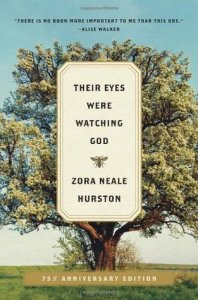
 About the Book
Their Eyes Were Watching God is the best known work by African-American writer Zora Neale Hurston. The novel narrates main character Janie Crawford’s “ripening from a vibrant, but voiceless, teenage girl into a woman with her finger on the trigger of her own destiny.” As a young woman, who is fair-skinned with long hair, she expects more out of life, but comes to realize that people must learn about life ‘fuh theyselves’ (for themselves), just as people can only go to God for themselves.
Set in central and southern Florida in the early 20th century, the novel was initially poorly received but today, it has come to be regarded as a seminal work in both African-American literature and women’s literature. TIME included the novel in its 2005 list of the 100 best English-language novels published since 1923.
Format: ebook (202 pp.) Publisher: Harper Collins
Publication date: 2013 [1937] Genre: Modern Classics
Purchase Links*
Amazon.co.uk | Amazon.com | Hive (supporting UK bookshops)
*links provided for convenience, not as part of any affiliate programme
Find Their Eyes Were Watching God on Goodreads
My Review
Their Eyes Were Watching God is one of those books that you feel you ought to love because it occupies such an iconic position in 20th century literature. I can’t say I found it an easy read for the reasons I’ll set out shortly but I certainly admired it and felt more kindly towards the book in the second half.
The main thing I found difficult about the book was that much of Janie’s story is rendered in vernacular. This does give it a fantastic sense of authenticity but, initially, I found it difficult to get to grips with and found myself having to re-read sentences to ensure I understood what was being said.
Janie is a young woman who instinctively wants more from life (although she doesn’t know quite what) and snatches the opportunities that arise although more often than not, sadly, they don’t work out. A recurring theme of the book is the silencing of women, in particular by men but more generally by society. When Janie finally meets someone who seems to want her to be herself and not be constrained, it ends in tragedy.
I did find it strange that at certain points in the book the author chooses to switch from Janie articulating her story directly to the third person. The Afterword included in my edition (an essay by Henry Louis Gates, Jr.) describes this as the author shifting ‘back and forth between her “literate” narrator’s voice and a highly idiomatic black voice found in wonderful passages of free indirect discourse’. In one section, the book even switches to the point of view of Janie’s second husband, Jody. And towards the end of the book, when Janie is on trial accused of a serious crime, the reader doesn’t get to hear her defence in her own words.
The author’s writing craft is demonstrated by some imaginative turns of phrase. For example, when Janie wakes up in time to see ‘the sun sending up spies ahead of him to mark out the road through the dark’ or, sitting on her porch one evening she watches the moon rise. ‘Soon its amber fluid was drenching the earth, and quenching the thirst of the day.’ And there is real drama created in the scenes set in the Everglades during which Janie, Tea Cake (her third husband) and others flee the flood water created by the passing hurricane. (It is during this section that the book’s title appears.)
Their Eyes Were Watching God was the book from my Classics Club list chosen for the latest Classics Club Spin.
In three words: Thought-provoking, intense, emotional
Try something similar: The Colour Purple by Alice Walker
About the Author
Zora Neale Hurston (January 7, 1891 – January 28, 1960) was an American author, anthropologist, and filmmaker. She portrayed racial struggles in the early-20th-century American South and published research on Haitian Vodou. The most popular of her four novels is Their Eyes Were Watching God, published in 1937. She also wrote more than 50 short stories, plays, and essays.
Hurston was born in Notasulga, Alabama, and moved with her family to Eatonville, Florida, in 1894. She later used Eatonville as the setting for many of her stories. It is now the site of the Zora! Festival, held each year in her honor. In her early career, Hurston conducted anthropological and ethnographic research while a student at Barnard College and Columbia University. She had an interest in African-American and Caribbean folklore, and how these contributed to the community’s identity.
She also wrote fiction about contemporary issues in the black community and became a central figure of the Harlem Renaissance. After moving back to Florida, Hurston wrote and published her literary anthropology on African-American folklore in North Florida, Mules and Men (1935), and her first three novels: Jonah’s Gourd Vine (1934); Their Eyes Were Watching God (1937); and Moses, Man of the Mountain (1939).
Hurston’s works concerned both the African-American experience and her struggles as an African-American woman. Her novels went relatively unrecognized by the literary world for decades. Interest was revived in 1975 after author Alice Walker published an article, “In Search of Zora Neale Hurston”, in the March issue of Ms. magazine that year. (Bio courtesy of Wikipedia)

 How time flies because it’s time for another Classics Club spin.


