My Buchan of the Month for July is The Gap in the Curtain, John Buchan’s only full-length novel with a supernatural element. Written between March 1930 and February 1931, it was published in the UK by Hodder & Stoughton on 7th July 1932 and in the US by The Riverside Press on 27th July 1932. The book is dedicated to his friends, Sybil and Lambert Middleton.
Featuring Sir Edward Leithen as narrator, the book is a series of interconnected stories in which a group of guests at a country house party are each given a glimpse of the future by way of an item in The Times dated a year hence. The guests, who include a politician and a financier, react in different ways to the foreknowledge they are granted.
Buchan scholar, David Daniell describes The Gap in the Curtain as a ‘satirical’ book in which Buchan takes aim at the world of international finance and politics. Ursula Buchan, the author’s granddaughter and his latest biographer, suggests the “brilliant, lengthy and disillusioned description of British politics at that time” reflects Buchan’s own experiences as a Member of Parliament.
Andrew Lownie feels that, although the idea of being able to look into the future was not new, Buchan was able to give it a new spin. He also finds it significant that the action of the book takes place at Easter citing its exploration of the redemptive power of love, the nature of Free Will and the concept of predestination.
The book received some warm reviews upon publication, notably from J.B. Priestley who praised Buchan’s “gallant versatility” and recommended it as a book that could be read “with excitement and profit”. Janet Adam Smith, Buchan’s first biographer, reports that The Gap in the Curtain had sold 78,000 copies up to 1960. Look out for my review of the book later this month.
Handheld Press will be publishing a new edition of The Gap in the Curtain in October 2021, available for pre-order now from their website. Pre-orders will be posted as soon as the book is received from the printer which is likely to be two to three months ahead of the publication date.
Sources:
Janet Adam Smith, John Buchan: A Biography (OUP, 1985 [1965])
Ursula Buchan, Beyond The Thirty-Nine Steps: A Life of John Buchan (Bloomsbury, 2019)
David Daniell, The Interpreter’s House: A Critical Assessment of John Buchan (Nelson, 1975)
Kenneth Hillier and Michael Ross, The First Editions of John Buchan: A Collector’s Illustrated Biography (Avonworld, 2008)
Andrew Lownie, John Buchan: The Presbyterian Cavalier (Constable, 1995)
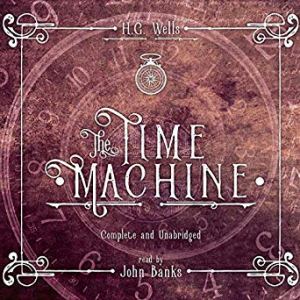
When a Victorian scientist propels himself into the year 802,701 AD, he is initially delighted to find that suffering has been replaced by beauty, contentment and peace.
Entranced at first by the Eloi, an elfin species descended from man, he soon realises that this beautiful people are simply remnants of a once-great culture – now weak and childishly afraid of the dark. But they have every reason to be afraid: in deep tunnels beneath their paradise lurks another race descended from humanity – the sinister Morlocks.
And when the scientist’s time machine vanishes, it becomes clear he must search these tunnels, if he is ever to return to his own era.
Purchase links* Audible UK| Hive
*links provided for convenience not as part of an affiliate programme
My Review
The Time Machine (1960)
The Time Machine is a story I realised I knew mainly from the 1960 film version starring Rod Taylor. I was interested, therefore, to see how much of the original book made it through the adaptation process. The answer is a surprising amount.
Although in the book the lead character is never named but instead referred to throughout as ‘the Time Traveller’, in both versions he gives an account of his experiences to a group of (mostly disbelieving) friends gathered for a weekly dinner. He describes how, far from the utopia hoped for, in the time period to which he travelled humankind has evolved into two distinct races: the degenerate, underground-dwelling Morlocks; and the indolent, rather childlike, surface-dwelling Eloi.
In the film there is no discussion about how the change in society might have come about but in the book the Time Traveller gives a lot of thought to the cause of such a marked stratification of society. His initial theory positions the Eloi as the superior, aristocratic race given they live a life of leisure, engaging in no work to feed or clothe themselves. The Morlocks on the other hand are the workers toiling beneath the surface. This probably reflects Wells’s own socialist views and life experiences. It was common at the end of the 19th century for workers to live ‘below stairs’ or work in basements and the idea of the ‘haves’ exploiting the ‘have nots’ easily transfer to the book.
However, the Time Traveller becomes perplexed and a little frustrated by the passivity and lack of curiosity of the Eloi. In his view, humanity cannot make progress or innovate without struggle. In addition, the Eloi seem to have little care for one another or any fear of danger – until nightfall, that is. The reason for the latter gradually becomes apparent and eventually the awful truth of the relationship between the two races is revealed.
In the book, the Eloi are described as short, pale, and elfin-like whereas in the film they are blonde and beautiful. The Weena of the book, the only member of the Eloi who engages with the Time Traveller, is definitely not the glamorous character played by Yvette Mimieux in the film. In fact, the Time Traveller’s relationship with the childlike Weena in the book felt a little uncomfortable. The Morlocks in the book are albino and spider-like and I found the scenes in which they appear much scarier than I remember from watching the film.
Events towards the end of The Time Machine mean it is left to the reader to imagine what direction – past or future – the Time Traveller’s adventures will take him and when, or if, he might return to his own time. In the film, it seems fairly obvious.
There are aspects of The Time Machine that now seem distinctly prophetic. For example, the Time Traveller notes the temperature in the future is much higher than in his own century. When he ventures even further ahead in time, what he sees is a vision of a dying Sun and apocalyptic climate change. (The film version sees the Time Traveller witnessing events in the much more immediate future.)
It’s amazing to think how many of the concepts associated with time travel in modern fiction and film are owed to The Time Machine, a book written in 1895. It’s a testament to the fertile imagination of H.G. Wells.
The audiobook version I listened to was narrated by John Banks who did a good job throughout but especially in communicating the Time Traveller’s sense of fear in some of the more dramatic scenes.
In three words: Inventive, thought-provoking, chilling
Try something similar: The War of the Worlds by H. G. Wells
Herbert George Wells was a novelist, teacher, historian and journalist, who has become known as the “father of science fiction.” His works have been adapted countless times, and provided the basis for many literary and theatrical productions.
About the Narrator
John Banks is one of the UK’s most prolific audiobook narrators, working for the likes of Big Finish, Audible, Random House and Games Workshop. He is a true multi-voice, creating everything from monsters to marauding aliens. He is also an accomplished stage and TV actor.

 My Buchan of the Month for July is The Gap in the Curtain, John Buchan’s only full-length novel with a supernatural element. Written between March 1930 and February 1931, it was published in the UK by Hodder & Stoughton on 7th July 1932 and in the US by The Riverside Press on 27th July 1932. The book is dedicated to his friends, Sybil and Lambert Middleton.


 About the Book


