#BookReview The Magic Walking Stick by John Buchan #ReadJB2020


About the Book

A young boy, Bill, buys a walking stick from a roadside peddler. He discovers that it’s a magic stick that will take the owner to anywhere he wishes. Adventures ensue…

My Review

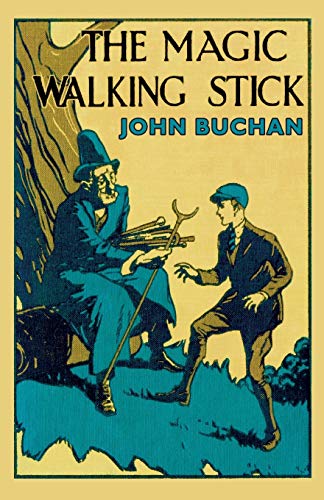
My Buchan of the Month for September was The Magic Walking Stick, one of the few books John Buchan wrote for children. It was published in the UK by Hodder & Stoughton on 24th October 1932. You can read my earlier blog post introducing the book here.

The central idea of a magic walking stick which can transport its possessor anywhere they wish is a charming one. However, Buchan rather complicates matters by introducing the concept that there are actually two magic walking sticks – one called Beauty and the other Bands – and Bill doesn’t know which one he possesses. Beauty is “for gallivanting about the earth for your amusement” and Bands for things like “battles and rescues and escapes” and if either is used for the wrong purpose serious consequences will follow.

Having acquired the walking stick from a peddler, young Bill sets off on a series of adventures. The best of these include arranging a surprise Christmas feast for a group of villagers and the rescue from the desert of Bill’s adventurous uncle. Some of the episodes I thought were a rather strange choice of subject matter for children, such as Bill’s visit to a gruesome elephants’ graveyard. Bill’s obvious enjoyment of hunting and shooting seemed a little out of place too as did his choice of a rifle as a suitable present for a boy of a similar age to himself. The boy in question is Prince Anatole, heir to the throne of Gracia, whose accession is threatened by a group of republicans. Bill’s attempts to rescue Anatole and deal with his enemies take up most of the latter part of the book.

Buchan has a rather ambitious notion of a child’s vocabulary. Phrases such as ‘an aureole of virtue’ or ‘a vivacious colloquy’ perplexed even me and I reckon I’m well above the target age group for the book. I think the book would be more successful if he had used simpler language and confined Bill’s adventures to innocent mischief rather than political intrigue.

October’s Buchan of the Month is The Free Fishers.

About the Author

John Buchan (1875 – 1940) was an author, poet, lawyer, publisher, journalist, war correspondent, Member of Parliament, University Chancellor, keen angler and family man.  He was ennobled and, as Lord Tweedsmuir, became Governor-General of Canada.  In this role, he signed Canada’s entry into the Second World War.   Nowadays he is probably best known – maybe only known – as the author of The Thirty-Nine Steps.  However, in his lifetime he published over one hundred books: fiction, poetry, short stories, biographies, memoirs and history.

You can find out more about John Buchan, his life and literary output by visiting The John Buchan Society website.
#BookReview A Prince of the Captivity by John Buchan #ReadJB2020

A Prince of the CaptivityAbout the Book

Adam Melfort is an officer and a gentleman with a brilliant career ahead of him until he is imprisoned for a crime he did not commit.

Afterwards, he embarks on daring missions in the service of his country including espionage and dangerous work behind enemy lines in World War One.

Format: Hardcover (464 pages)  Publisher: Nelson
Publication date: September 1935 [1933] Genre: Fiction, Adventure, Classics

Find A Prince of the Captivity on Goodreads


My Review

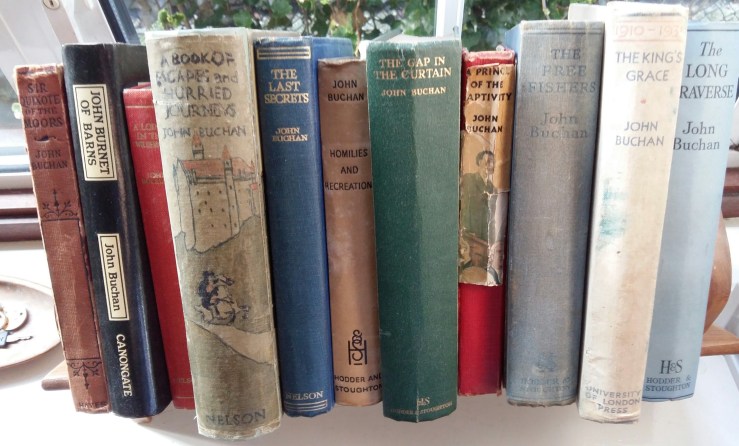
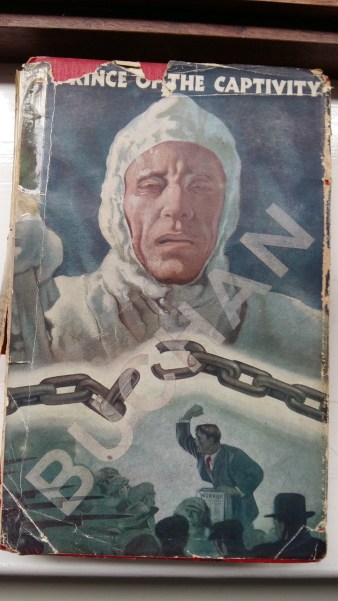
My Buchan of the Month for August is A Prince of the Captivity which was published by Hodder & Stoughton in 1933. My own copy is a later Nelson edition from September 1935 with its rather tatty dust jacket. You can read my earlier blog post introducing the book here.

The book opens in one of Buchan’s oft-used settings – a gentleman’s club – with a group of its members discussing the trial of Adam Melfort for forgery. Despite his defence counsel being none other than Sir Edward Leithen (first introduced in The Power House), Adam is found guilty and sent to prison. It means the end of a brilliant military career. The group cannot understand why Melfort should do something so out of character and, moreover, seem to welcome the punishment meted out to him.

When the point of view switches to Adam, the reader learns the motive behind his actions: a combination of misplaced guilt, chivalry and grief. As he languishes in prison, his one comfort is a repeated dream in which he revisits the Scottish island owned by his family where he spent childhood holidays. However, his sense of guilt is such that he feels the need to earn the right to go back there once his sentence is served. This leads him to embark on a series of adventures, seemingly heedless of the danger involved.

The first of these sees him go undercover in occupied territory during the First World War, gathering information useful to the Allies but also spreading misinformation. It’s no doubt informed by John Buchan’s own wartime roles as Director of Intelligence and Minister of Information. Next, Adam embarks on a mission to rescue Falconet, an American millionaire, lost in the frozen wastes of the Arctic. The scenes in which the two men over-winter in a small cave are brilliantly described.

Adam comes back from that experience convinced his role is to seek out the leadership the world needs in order to avoid another war, to be a “midwife to genius” as a character puts it. It is at this point he meets Warren Creevey who, like other Buchan villains, is possessed of a superlative intellect but not the moral scruples to go with it. As one character observes, “Tonight two remarkable men for the first time saw each his eternal enemy”. Unfortunately, the story then gets rather bogged down for a time as Adam explores contemporary politics and trade unionism in the city of Birkpool.

Things pick up again when the focus moves to Germany. Adam once more uses his remarkable linguistic skills and his ability to assume different identities to protect the Chancellor of Germany (a man he first met in very different circumstances during the war) from enemies who seek to prevent his attendance at a conference that might mean the difference between peace or another European war.

A Prince of the Captivity is at its best in the episodes of adventure, culminating in the final climactic scenes in the Alps, in which an earlier prophecy that “somewhen, somewhere, somehow you will do battle with him” becomes reality. The end of the book features familiar Buchan themes of sacrifice and duty. The less successful and, frankly, somewhat tedious parts of the novel are, as some critics have observed, a case of Buchan trying to cram too many ideas into one book. I wish also that he had relied less on racial stereotypes in his depiction of some of the characters. Nevertheless, the bits that are good are very good.

Next month’s Buchan of the Month is something quite different, The Magic Walking Stick. Published in 1932, it’s a children’s book and therefore will be a first time read for me.

Follow this blog via Bloglovin


John BuchanAbout the Author

John Buchan (1875 – 1940) was an author, poet, lawyer, publisher, journalist, war correspondent, Member of Parliament, University Chancellor, keen angler and family man.  He was ennobled and, as Lord Tweedsmuir, became Governor-General of Canada.  In this role, he signed Canada’s entry into the Second World War.   Nowadays he is probably best known – maybe only known – as the author of The Thirty-Nine Steps.  However, in his lifetime he published over one hundred books: fiction, poetry, short stories, biographies, memoirs and history.

You can find out more about John Buchan, his life and literary output by visiting The John Buchan Society website.