

Throwback Thursday is a weekly meme hosted by Renee at It’s Book Talk. It’s designed as an opportunity to share old favourites as well as books that we’ve finally got around to reading that were published over a year ago. If you decide to take part, please link back to It’s Book Talk.
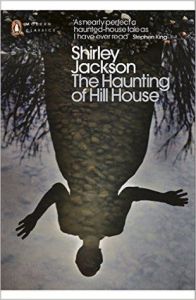
This week I’m sharing my review of a book from my Classics Club Challenge list – The Haunting of Hill House by Shirley Jackson, first published in 1959. I’ve not been making much progress with the challenge lately – too many shiny new books to tempt me – so I’m grateful to have Throwback Thursday to motivate me to read something from my list.
 About the Book
Alone in the world, Eleanor is delighted to take up Dr. Montague’s invitation to spend a summer in the mysterious Hill House. Joining them are Theodora, an artistic ‘sensitive’, and Luke, heir to the house.
But what begins as a light-hearted experiment is swiftly proven to be a trip into their darkest nightmares, and an investigation that one of their number may not survive.
| Format: | Paperback | Publisher: | Penguin | Pages: | 246 |
| Publication: | 1st Oct 2009 | Genre: | Horror |
Purchase Links*
Amazon.co.uk ǀ Amazon.com ǀ Barnes & Noble
*links provided for convenience, not as part of any affiliate programme
Find The Haunting of Hill House on Goodreads
My Review
The Haunting of Hill House is one of the books on my Classics Club Challenge list. This is why I love taking part in reading challenges because it motivates you to read outside the literary equivalent of your comfort zone or get around to reading authors and books you’d always meant to read. For the Classics Club Challenge, I’ve chosen to focus on women writers. Although I’d heard praise for Shirley Jackson’s writing and was aware of a couple of her books – The Haunting of Hill House being one and We Have Always Lived in the Castle being the other – I’d never got around to reading anything she’d written. I’m so glad I’ve now rectified that omission.
I’m not a fan of horror fiction and I’d never watch a film like The Haunting (based on Jackson’s book) – I’m too much of a scaredy-cat. But I found The Haunting of Hill House pleasantly creepy (if something creepy can be pleasant) and much more of a psychological study than an all-out scare-fest. That’s not to say there weren’t a couple of scenes that gave me the chills and I did refrain from reading it in bed. Bright sunshine is best for me with a book like this although I suspect Hill House would be capable of exerting a malevolent atmosphere over even the sunniest day.
The story is told from the point of view of Eleanor, emotionally damaged by the death of her mother for whom she was long-term carer, socially awkward, introspective and lacking in self-confidence. From the moment of her arrival at Hill House, the author brilliantly conveys Eleanor’s sense of something malign and unsettling about the house.
‘The house was vile. She shivered and thought, the words coming freely into her mind, Hill House is vile, it is diseased; get away from here at once.’
Eleanor’s feeling that there is something evil about the house is not helped when Dr Montague recounts the unhappy history of Hill House, describing it as ‘disturbed, perhaps. Leprous. Sick. Any of the popular euphemisms for insanity’. As they explore the house, it is small things such as doors that close of their own volition that start to give the group a sense of an almost human presence: ‘The house. It watches every move you make.’
I liked how the sprightly, witty exchanges between the group at mealtimes possessed an undercurrent of malice and bitchiness – or did they? Perhaps this was just a manifestation of Eleanor’s sensitivity, interpreting any comment as directed at her in a disparaging manner. Despite her initial feelings of friendship toward Theodora, Eleanor begins to be suspicious of her motives and doubt Theodora’s friendly overtures. Eleanor starts to feel unsettled by Theodora’s seeming ability to sense her moods and even, Eleanor suspects, her thoughts. Luke forms the rather hapless, to my mind, third side of this triangle, creating an unsettling tension between the two women.
The only character I felt who really comes out with any credit is Dr. Montague. Although the creator of the whole experiment, he is the first to recognise the potential danger posed to fragile minds by the atmosphere in the house. On the other hand, his wife is an awful creature who, although she fervently believes in the supernatural, seems immune to the malign atmosphere of the house perhaps because she lacks imagination.
I won’t describe what happens next but safe to say the creepy, unsettling atmosphere continues to build towards its climax. Shirley Jackson leaves the reader to decide whether the events experienced by the group are indeed the result of supernatural activity, are fuelled by some form of group hysteria or just the product of Eleanor’s feverish imagination and unstable mental state.
I really enjoyed this introduction to Shirley Jackson’s work.
In three words: Creepy, unsettling, dark
Try something similar…The Yellow Wallpaper by Charlotte Perkins Gilman (click here to read my review)
 About the Author
A popular writer in her time, Shirley Jackson’s work has received increasing attention from literary critics in recent years. She has influenced such writers as Stephen King, Nigel Kneale, and Richard Matheson. She is best known for her dystopian short story, “The Lottery” (1948), which suggests there is a deeply unsettling underside to bucolic, small-town America. In her critical biography of Shirley Jackson, Lenemaja Friedman notes that when Shirley Jackson’s story “The Lottery” was published in the June 28, 1948, issue of The New Yorker, it received a response that “no New Yorker story had ever received.” Hundreds of letters poured in that were characterized by, as Jackson put it, “bewilderment, speculation and old-fashioned abuse.”
Jackson’s husband, the literary critic Stanley Edgar Hyman, wrote in his preface to a posthumous anthology of her work that “she consistently refused to be interviewed, to explain or promote her work in any fashion, or to take public stands and be the pundit of the Sunday supplements. She believed that her books would speak for her clearly enough over the years.” Hyman insisted the darker aspects of Jackson’s works were not, as some critics claimed, the product of “personal, even neurotic, fantasies”, but that Jackson intended, as “a sensitive and faithful anatomy of our times, fitting symbols for our distressing world of the concentration camp and the Bomb”, to mirror humanity’s Cold War-era fears. Jackson may even have taken pleasure in the subversive impact of her work, as revealed by Hyman’s statement that she “was always proud that the Union of South Africa banned The Lottery’, and she felt that they at least understood the story”.
In 1965, Jackson died of heart failure in her sleep, at her home in North Bennington Vermont, at the age of 48.

 About the Book
 About the Author
 What Cathy Read Next...