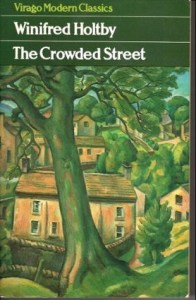
Book Review: The Crowded Street by Winifred Holtby

The Crowded StreetAbout the Book

This is the story of Muriel Hammond, at twenty living within the suffocating confines of Edwardian middle-class society in Marshington, a Yorkshire village. A career is forbidden to her. Pretty, but not pretty enough, she fails to achieve the one thing required of her – to find a suitable husband.

Then comes the First World War, a watershed which tragically revolutionises the lives of her generation. But for Muriel it offers work, friendship, freedom, and one last chance to find a special kind of happiness…

Format: Paperback (288 pp.)                    Publisher: Virago
Published: 19th November 1981 [1924]  Genre: Modern Classics, Fiction

Purchase Links*
Amazon.co.uk  ǀ  Amazon.com  ǀ Hive.co.uk (supporting UK bookshops)
*links provided for convenience, not as part of any affiliate programme

Find The Crowded Street on Goodreads


My Review

“In books things always happen to people.  Why doesn’t somebody write a book about someone to whom nothing happens – like me?”

 
The Crowded Street follows Muriel Hammond through the years 1900 to 1920.  The reader first glimpses Muriel as a nine year girl attending her first formal party and experiences with her the anguish of feeling left out and unable to understand the expected rules of behaviour, to the disappointment of her status conscious mother.

This early experience sets a pattern for Muriel throughout the book.  Serious, thoughtful but timid, lacking in self-confidence and with a liking for certainty, Muriel finds herself always the one left without a partner – whether at a dance, the tennis club, even at school.    ‘Was she more stupid than other people, or did everyone feel like this at first? She was travelling in a land of which she only imperfectly understood the language.’

This changes when the confident and worldly Clare Duquesne joins Muriel’s school and offers her the friendship she has always sought.    Clare ignites a sort of hero worship in Muriel.  Clare seems to be everything that Muriel isn’t.  As time goes on it turns out others are equally in thrall to Clare.

Muriel allows herself to be persuaded by others that her academic interests, in astronomy and mathematics, are not suitable subjects for her to pursue.  Her headmistress asks: “How will it help you, dear, when you, in your future life, have, as I hope, a house to look after?”  No, Muriel’s duty lies in staying at home and assisting her mother until a suitable marriage can be made.  Indeed, her mother’s sole ambition seems to be to manoeuvre Muriel and her sister, Connie, into a position in society where they can secure themselves husbands.  This overwhelming desire will have tragic consequences and act as a stifling influence on Muriel, making her feel that life is passing her by.

The outbreak of the First World War and the renewal of an old acquaintance bring change and the possibility of a different future for Muriel if only she can find the courage to grasp it.  ‘A respectable marriage had not always been the one goal of her life.  She had dreamed dreams.  She had seen visions, but her visions had faded before the opinion of others; she had lacked the courage of her dreams.’

Living in an age where equal opportunities are for the most part a given, I’ll admit I found it difficult at times to understand Muriel’s inability to escape from her situation and her lack of…gumption, I suppose.  However, on the other hand, I’m guessing the author intended to create a sense of righteous anger in the reader, at the waste of talent and at the prevailing notion that a woman’s role was merely as an appendage or helpmeet to a man and not as a person in her own right.  Like me, you may give a silent cheer at the end of the book.  “The thing that matters is to take your life into your hands and live it, following the highest vision as you see it.”

The Crowded Street was the book I drew in the recent Classics Club Spin #17.  You can find my full Classics Club list here.

Follow my blog with Bloglovin

In three words: Elegant, insightful, thought-provoking

Try something similar…Testament of Friendship by Vera Brittain


Winifred HoltbyAbout the Author

Winifred Holtby (1891 – 1935), novelist, journalist and critic, was born in Rudstone, Yorkshire.  With the exception of South Riding, this is her most successful novel; powerfully tracing one woman’s search for independence and love, it echoes in fictional form the years autobiographically recorded by her close friend, Vera Brittain, in Testament of Youth.

Goodreads

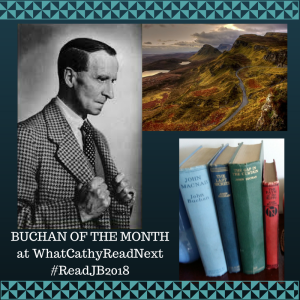
Buchan of the Month: Mr. Standfast by John Buchan

Buchan of the Month

JohnBuchanThrillersAbout the Book

“First we must go through the Valley of the Shadow…And there is the sacrifice to be made…the best of us.”

It is 1917 and Richard Hannay is brought out of the battlefield to perform the desperate task of tracking down and destroying a network of German spies.  Hannay’s opponent is Moxon Ivery, the bland master of disguise, who seeks to outwit Hannay and he and his agents are pursued through England, Scotland, France and Switzerland.

For its pace and suspense, its changes of scene, and thrilling descriptions of the last great battles against the Germans, Mr Standfast offers everything that has made its author so enduringly popular.

Format: Paperback (354 pp.)        Publisher: Oxford University Press
Published: 1993 [1919]                  Genre: Thriller, Adventure

Purchase Links*
Amazon.co.uk  ǀ  Amazon.com  ǀ Hive.co.uk (supporting UK bookshops)
*links provided for convenience, not as part of any affiliate programme

 Find Mr. Standfast on Goodreads


My Review

Mr. Standfast is the third book in my Buchan of the Month reading project.  For a spoiler-free introduction to Mr. Standfast, including details of its first publication and context, click here.  To find out more about the project and my reading list for 2018, click here.

Before I say any more, I’ll confess that Mr. Standfast is a book I’ve read many times before and it happens to be one of my favorite Buchan books (alongside Sick Heart River, which I shall be reading later this year).  For me, it has everything: a mystery, some thrilling set pieces, great characters, numerous locations, a touch of romance and some chilling scenes on the battlefields of World War One France.  I always get a bit tearful at the end.  As well as being a very entertaining book, Mr. Standfast explores some serious themes – courage, fortitude, sacrifice.

Since the title refers to one of the characters in John Bunyan’s The Pilgrim’s Progress, it’s probably no surprise that Mr. Standfast has a number of allusions and references to Bunyan’s work.  The Pilgrim’s Progress was an important text for Buchan and it informs many of the themes in Mr. Standfast mentioned above.  Full disclosure: my dissertation for my MA in English from The Open University was on the subject of the influence of The Pilgrim’s Progress on John Buchan’s books.  Don’t worry, I’m not going to test your patience by quoting from it extensively.  However, just a few thoughts on the connections between the two texts…

In his autobiography Memory-Hold-The-Door, Buchan attributes his regard for The Pilgrim’s Progress to ‘its picture of life as a pilgrimage over hill and dale, where surprising adventures lurked by the wayside, a hard road with now and then long views to cheer the traveller and a great brightness at the end of it’.   The reference to the journey being ‘over hills and dales’ acknowledges that life brings moments of difficulty and challenge as well as ease, involving either physical or mental effort. The  journey features ‘surprising adventures’ – the use of the word ‘adventures’ rather than ‘experiences’ suggesting that these will be exciting episodes – but these ‘lurk’ by the wayside.  There is a sense of the unexpected, of danger in the choice of the word ‘lurk’.  All of these elements I feel are apparent in Mr. Standfast.

As well as having thematic influences, The Pilgrim’s Progress, as a physical object, plays a role in Mr. Standfast.  It acts variously as a prize, a code-book and a source of moral comfort.

For example, The Pilgrim’s Progress is one of Peter Pienaar’s few cherished possessions; with the Bible, it acts as a source of comfort during his captivity in a German prisoner-of-war camp.  Pienaar, one of the most endearing characters in Mr. Standfast, is described as ‘puzzling over it’, using it as one of his ‘chief aids in reflection’ and for ‘self-examination’.  Peter searches The Pilgrim’s Progress for examples that he can apply to his own predicament.  Charmingly, Peter takes everything in The Pilgrim’s Progress literally and talks about the character Mr. Standfast ‘as if he were a friend’.  Arguably, Peter’s identification with the characters in The Pilgrim’s Progress in part inspires his actions at the end of the book.

For Richard Hannay, The Pilgrim’s Progress has a more practical and utilitarian function; he describes it as one of his ‘working tools’.  For example, it alerts Hannay to the fact that someone has searched his belongings as he observes ‘a receipted bill which I had stuck in The Pilgrim’s Progress to mark my place had been moved’.  Later, it provides a method of authenticating the character Hannay has adopted (he likes his disguises!).  Producing his copy of The Pilgrim’s Progress to the old postmistress of a Highland village, it creates a shared cultural connection between them as she comments, ‘I got it for a prize in the Sabbath School when I was a lassie’.

One of the most notable roles for The Pilgrim’s Progress in Mr. Standfast is as a means of communication between Hannay and his comrades.  This discourse operates at two levels: as a common language to express feelings, anxieties and hopes and, at a practical level, as a code for secret communications between the characters.  In particular, The Pilgrim’s Progress becomes a key part of the burgeoning relationship between Mary Lamington and Hannay.   At one point, Hannay sends a message of reassurance for Mary: ‘If you see Miss Lamington you can tell her I’m past the Hill Difficulty.  I’m coming back as soon as God will let me’.

There is a lot more I could say on the links between the two texts but I’ll just close by saying that Mr. Standfast is a great story even if you have no knowledge of The Pilgrim’s Porogress.  If, however, you are familiar with Bunyan’s work, you’ll have fun spotting other references and allusions.  I think Mr. Standfast is the best of Buchan’s Richard Hannay adventures and one of the finest books he wrote.

Follow my blog with Bloglovin

In three words: Thrilling, action-packed, moving


John BuchanAbout the Author

John Buchan (1875 – 1940) was an author, poet, lawyer, publisher, journalist, war correspondent, Member of Parliament, University Chancellor, keen angler and family man.  He was ennobled and, as Lord Tweedsmuir, became Governor-General of Canada.  In this role, he signed Canada’s entry into the Second World War.   Nowadays he is probably best known – maybe only known – as the author of The Thirty-Nine Steps.  However, in his lifetime he published over 100 books: fiction, poetry, short stories, biographies, memoirs and history.

You can find out more about John Buchan, his life and literary output by visiting The John Buchan Society website.