
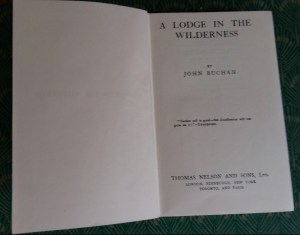
 About the Book
An imaginary conference is arranged by a multi-millionaire Francis Carey at Musuru, a lodge located on the East Kenyan Plateau some 9,000 feet above sea level, to discuss Empire.
The conference is made up of nine men and nine women, taken from the upper and professional classes.
Format: Hardcover (334 pages) Publisher: Nelson
Publication date: 1950 [1906] Genre: Fiction
My Review
My Buchan of the Month for March was A Lodge in the Wilderness. You can read my blog post introducing the book here. It was published in November 1906, initially anonymously. Although nominally fiction, the book is essentially a debate about Imperialism conducted by various supposedly fictional characters (although Buchan’s first biographer, Janet Adam Smith, observed that ‘spotting the originals of the characters was one of the pleasures of the book for its first readers‘).
In reality, it’s a political treatise masquerading as fiction and not the John Buchan book I would recommend for readers new to his work; one of his adventure stories featuring Richard Hannay or his works of historical fiction would be a much better starting point. In fact, I’m not sure I would recommend it at all, except for serious Buchanophiles. I would include myself in that category but even I struggled to maintain my interest and will confess to skimming some of the sections of poetry and the more turgid rehearsals of political doctrine. I found myself identifying with one of the more engaging characters, Lady Flora, who is described as sitting ‘with exemplary patience through the long discussion’ and discovering ‘that only a walk on the terrace would be sufficient reward’. (Lady Flora is reputedly based on Buchan’s future wife, Susan Grosvenor.) Earlier, she had remarked, “I do so wish…that they wouldn’t all talk in paragraphs.” Indeed.
The whole book has a paternalistic tone and some of the characters express extremely distasteful views, including advocating eugenics for the destitute who ‘are past hope [and] should cease to exist’ and state-organised emigration. At no point do any of the characters argue against the concept of Empire; they seem merely concerned with how to make it run more efficiently. I also found myself inwardly shuddering at references to ‘strange, sullen, childish dark-skinned people’ and that the ‘native’ must stand as an equal before the law with the white man but ‘not a social or political equal’. Thank heavens we have moved on from that sort of attitude.
However, there are early signs of John Buchan’s ability to describe landscape which would be such a feature of his later books. For example, this description of an African sunrise. ‘And then over the crest of the far downs came a red arc of fire, and the heavens changed to amethyst and saffron, and, last of all, to a delicate pale blue, where wisps of rosy cloud hung like the veils of the morning.’ Unfortunately, the occasion for this lyrical description is a hunting trip during which several species of big game are killed.
The odd dash of sardonic humour brought some light relief, such as when the Duchess reports news from home. “Eve Nottingham has written a book, purporting to be the letters of a Japanese wife to her English mother-in-law. What will that silly woman be after next? She has never been outside Europe… She might as well write the letters of a Coptic greengrocer to his Abyssinian grandmother.”
April’s Buchan of the Month is A Book of Escapes and Hurried Journeys. Look out for my introduction to the book and, later in the month, my review.
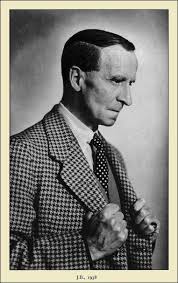 About the Author
John Buchan (1875 – 1940) was an author, poet, lawyer, publisher, journalist, war correspondent, Member of Parliament, University Chancellor, keen angler and family man. He was ennobled and, as Lord Tweedsmuir, became Governor-General of Canada. In this role, he signed Canada’s entry into the Second World War.
Nowadays he is probably best known – maybe only known – as the author of The Thirty-Nine Steps. However, in his lifetime he published over 100 books: fiction, poetry, short stories, biographies, memoirs and history.
You can find out more about John Buchan, his life and literary output by visiting The John Buchan Society website.

 About the Book
 What Cathy Read Next...