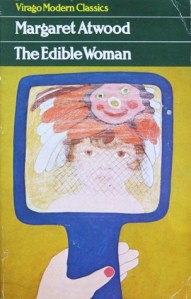
 About the Book
Marian is a determinedly ordinary girl, fresh out of university, working at her first job but really only waiting to get married. All goes well at first, she likes her work in market research, and her broody flat-mate Ainsley – even an uncharacteristic sexual fling with the divinely mad Duncan cannot lure her away from her sober fiancé, Peter.
But Marion reckons without an inner self that wants something more, which talks to her through the food she eats and calmly sabotages her careful plans. Marriage a la mode, Marian discovers, is something she literally can’t stomach.
Format: Paperback (281 pp.) Publisher: Virago
Published: 1986 [1969] Genre: Literary Fiction
Purchase Links*
Amazon.co.uk ǀ Amazon.com ǀ Hive.co.uk (supporting UK bookshops)
*links provided for convenience, not as part of any affiliate programme
Find The Edible Woman on Goodreads
My Review
In the introduction to my Virago Modern Classics edition, Margaret Atwood (writing in 1979) reports that she had been reflecting for some time about what she refers to as ‘symbolic cannibalism’, exemplified by wedding cakes decorated with sugar brides and grooms. She notes that The Edible Woman was ‘conceived by a twenty-three-year-old and written by a twenty-four-year old’ and reflects that ‘its more self-indulgent grotesqueries are perhaps attributable to the youth of the author’. She sees the book as ‘protofeminist’ rather than ‘feminist’, i.e. preceding, anticipating or laying the groundwork for feminism.
The book is structured in three parts – the first and last parts are written in the first person, the second part in the third person. I think the mention of ‘self-indulgent grotesqueries’ made me expect the concept of the ‘edible woman’ to form a greater part of the book than it actually does. (The scene that corresponds most closely to the title takes place only at the very end of the book.) However, it’s true that Marian’s dilemma about her future prompts some very rebellious behaviour by her stomach, often at the most inopportune moments. It gets to the point where Marian comes to view her body as having a personality or will of its own that she is powerless to resist. ‘She had tried to reason with it, had accused it having frivolous whims, had coaxed it and tempted it, but it was adamant; and if she used force it rebelled.’
I liked the use of food-related metaphors and similes throughout the book. For example, Marian describes the structure of the organisation she works for, Seymour Surveys, as ‘layered like an ice-cream sandwich, with three floors: the upper crust, the lower crust, and out department, the gooey layer in the middle’. At one point she describes her mind feeling as empty as if ‘someone had scooped out the inside of my skull, like a cantaloupe and left me only the rind to think with’.
I enjoyed how the novel pokes fun at the market research and advertising industries. For example, one interviewee when asked, as part of a survey about a new brand of beer, what words he would associate with the phrase ‘Tang of the wilderness’ replies: “It’s one of those Technicolor movies about dogs or horses. ‘Tang of the Wilderness’ is obviously a dog, part wolf, part husky, who saves his master three times, once from fire, once from flood and once from wicked humans, more likely to be white hunters than Indians these days, and finally gets blasted by a cruel trapper with a .22 and wept over.” The interviewee in question is the otherwise (to my mind) peculiar and rather unappetising Duncan with whom Marian subsequently becomes involved, although at least the exchange shows he has a sense of humour. His one saving grace, I’m afraid, as far as I was concerned – oh, apart from his love of ironing.
The notion that marriage and children can imprison or consume an individual is a constant theme of the book. A good example is Marian’s schoolfriend, Clara, pregrant with her third child, who blithely tolerates the havoc wreaked on her home by the previous two, such as that which results from Arthur’s little ‘accidents’. Then there’s Marian’s boyfriend, Peter, who gets in a panic whenever any of his friends get married, making his subsequent actions all the more surprising. Seemingly breaking the mould is Marian’s flatmate, Ainsley, who is intent on having a child but outside the confines of marriage or without any form of ongoing relationship with the biological father. As she searches for a ‘good specimen’ to father her child, Marian describes Ainsley as bearing ‘a chilling resemblance to a general plotting a major campaign’.
As Marian is propelled, seemingly inexorably, towards marriage, events come to a head after what might be considered the party from Hell. In her introduction to the book, the author notes (a little ruefully, I’d like to think) that her heroine’s choices ‘remain much the same at the end of the book as they are at the beginning: a career going nowhere, or marriage as an exit from it’. Atwood’s conclusion seems to be that for women ‘nothing has changed’, to coin a phrase with current resonance here in the UK. It’s a message that was probably more provocative when the book was written. I hope we’ve moved on from facing an either/or choice today.
 The Edible Woman is the book from my The Classics Club List selected for The Classics Club Spin #19. The theme of the spin was ‘chunksters’ so, at only 286 pages, it’s fair to say I got away lightly.
Follow my blog with Bloglovin
In three words: Bizarre, thought-provoking, satirical
Try something similar…The Vegetarian by Han Kang
 About the Author
Margaret Atwood was born in 1939 in Ottawa and grew up in northern Ontario, Quebec, and Toronto. She received her undergraduate degree from Victoria College at the University of Toronto and her master’s degree from Radcliffe College.
Margaret Atwood is the author of more than forty books of fiction, poetry, and critical essays. Her latest book of short stories is Stone Mattress: Nine Tales (2014). Her MaddAddam trilogy – the Giller and Booker prize-nominated Oryx and Crake (2003), The Year of the Flood (2009) and MaddAddam (2011) – is currently being adapted for HBO. The Door is her most recent volume of poetry (2007). Her most recent non-fiction books are Payback: Debt and the Shadow Side of Wealth (2008) and In Other Worlds: SF and the Human Imagination (2011). Her novels include The Edible Woman (1970), The Handmaid’s Tale (1983), The Robber Bride (1994), Alias Grace (1996), and The Blind Assassin, which won the prestigious Booker Prize in 2000.
Margaret Atwood lives in Toronto with writer Graeme Gibson. (Photo credit: Goodreads author page)
Connect with Margaret
Website ǀ Facebook ǀ Twitter ǀ Goodreads



 What Cathy Read Next...