
 About the Book
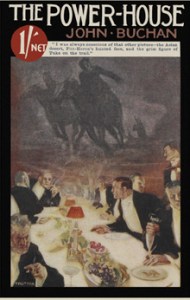
When his friend Charles Pitt-Heron vanishes mysteriously, Sir Edward Leithen is at first only mildly concerned. But a series of strange events that follow Pitt-Heron’s disappearance convinces Leithen that he is dealing with a sinister secret society. Their codename is ‘The Power-House’. The authorities are unable to act without evidence. As he gets deeper involved with the underworld, Leithen finds himself facing the enemy alone and in terrible danger.
N.B. The details below are for the collected edition of the Leithen stories. The Power-House is also widely available as a standalone book.
Format: ebook, paperback (348 pp.) Publisher: Canongate Books
Published: 1st July 2010 Genre: Thriller, Mystery
Purchase Links*
Amazon.co.uk ǀ Amazon.com
*links provided for convenience, not as part of any affiliate programme
Find ‘The Power-House’ in The Leithen Stories on Goodreads
My Review
The Power-House is the first book in my Buchan of the Month reading project. In this case, it is a reread as it’s a book I’ve read several times before. For a spoiler-free introduction to The Power-House, click here.
Our narrator is Sir Edward Leithen, in his first appearance in a Buchan adventure. A barrister and Member of Parliament, he describes himself as ‘a placid, sedentary soul’. In fact, his friend Tommy Deloraine observes acutely, ‘Life goes roaring by and you only hear the echo in your stuffy rooms.’ This all changes when, by a series of seemingly unconnected events, Leithen is drawn into investigating the unexplained disappearance of Charles Pitt-Heron. Like Leithen, the reader’s interest has by now been aroused: ‘…for every man at the bottom of his heart believes that he is a born detective.’
In his dedication to The Thirty-Nine Steps, Buchan said that his aim was to write ‘romance where the incidents defy the probabilities, and march just inside the borders of the possible.’ Well, it has to be said that the author pushes to the limits the boundaries of the possible in The Power-House. As Leithen himself admits, ‘I had collected by accident a few odd, disjointed pieces of information, and here by the most amazing accident of all was the connecting link.’
That link resides in the person of a man, Mr Andrew Lumley. Lumley is an example of one of the characteristic features of a Buchan “shocker” (his term for his adventure stories); the concept of an immense intellect unconstrained by common notions of morality. Similar, if you like, to Professor Moriarty in Sir Arthur Conan Doyle’s Sherlock Holmes stories. Furthermore, the idea of an underground global organisation, subtly wielding the levers of power for malevolent ends but whose members possesses a cloak of respectability.
As events progress, Leithen comes to realise the perceived safety of the London he knows so well is a mere facade. Not only is he being watched but his watchers likely have more sinister objectives. In some of the most brilliant scenes in the book, Buchan describes how Leithen comes close to falling into the hands of the secret organisation known as the Power House even as he walks the crowded streets of the city. He observes, ‘Now I saw how thin is the protection of civilisation.’ The fragility of civilisation is another frequent theme of Buchan’s adventure stories. As Lumley warns Leithen: “You think that a wall as solid at the earth separates civilisation from barbarism. I tell you the division is a thread, a sheet of glass.” Kate Macdonald, an acknowledged expert on Buchan, explores this idea in more detail in her article ‘Hunted Men in John Buchan’s London’.
The Power-House is an entertaining story that features many of the elements that would reappear a few years later in Buchan’s most well-known and successful book, The Thirty-Nine Steps. A relatively short book, The Power-House is an easy read thanks to Buchan’s effortless prose. It should probably be considered a rehearsal, a first attempt, to master the style of the type of adventure story that would later make his name.
My next Buchan book is completely different in tone – it’s John Macnab. I’ll be posting an introduction to it shortly with my review due at the end of February. Why not read along with me…
In three words: Entertaining, well-paced, adventure
Try something similar…Rogue Male by Geoffrey Household
About the Author
John Buchan (1875 – 1940) was an author, poet, lawyer, publisher, journalist, war correspondent, Member of Parliament, University Chancellor, keen angler and family man. He was ennobled and, as Lord Tweedsmuir, became Governor-General of Canada. In this role, he signed Canada’s entry into the Second World War. Nowadays he is probably best known – maybe only known – as the author of The Thirty-Nine Steps. However, in his lifetime he published over 100 books: fiction, poetry, short stories, biographies, memoirs and history.
You can find out more about John Buchan, his life and literary output by visiting The John Buchan Society website.


 In the dedication to The Power-House, John Buchan writes, “I have printed this story, written in the smooth days before the war, in the hope that it may enable an honest man here and there to forget for an hour the too urgent realities”. He also wryly observes that the dedicatee, Major-General Sir Francis Lloyd, shares his own “liking for precipitous yarns”.
 What Cathy Read Next...