Top Ten Tuesday: John Buchan Villains

Top Ten Tuesday new

Top Ten Tuesday is a weekly meme created by The Broke and the Bookish and now hosted by Jana at That Artsy Reader Girl.

The rules are simple:

  • Each Tuesday, Jana assigns a new topic. Create your own Top Ten list that fits that topic – putting your unique spin on it if you want.
  • Everyone is welcome to join but please link back to That Artsy Reader Girl in your own Top Ten Tuesday post.
  • Add your name to the Linky widget on that day’s post so that everyone can check out other bloggers’ lists.
  • Or if you don’t have a blog, just post your answers as a comment.

This week’s topic is Top Ten Villains (favourite, best, worst, lovable, creepiest, most evil, etc.) Once again, I’m putting my own spin on this week’s topic by concentrating on villains who feature in the novels of John Buchan.  The list may involve spoilers.

Click on the title to read my review or view the book description on Goodreads.


The Femme Fatale – Hilda von Einem from Greenmantle

‘The man that will understand her has got to take a biggish size in hats.’

The Agitator – Marka from The Half-Hearted

‘…one of the cleverest man living, a cheerful being whom the Foreign Office is more interested in than anyone else in the world.’

The Elements – The Arctic and the Swiss Alps from A Prince of the Captivity

The Is He Really A Villian? – Dr. Christoph from ‘The Loathly Opposite’ in The Runagates Club

The Ruthless Gang – The Black Stone from The Thirty-Nine Steps  

The International Mastermind – Andrew Lumley in The Power-House

“Did you ever reflect…how precarious is the tenure of the civilisation we boast about?”

The Thug – Ulric von Stumm from Greenmantle

‘He was a perfect mountain of a man, six and a half feet if he was an inch, with shoulders on him like a shorthorn bull.’

The Religious Fanatic – Ephraim Caird from Witch Wood

‘devil worship and madness’

The Flawed Patriot – Moxon Ivery from Mr. Standfast

‘He’s a cruel as a snake and as deep as hell.  But, by God, he’s got a brain below his hat.’

The Manipulator – Dominick Medina from The Three Hostages

‘I’ve only a nodding acquaintance, but one can’t help feeling the man everywhere and being acutely interested…. If he were a rogue he could play the devil with our easy-going society.’


Buchan of the Month: Introducing…Witch Wood

Buchan of the Month

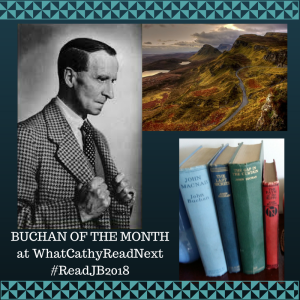
Witch Wood is the tenth book in my John Buchan reading project – Buchan of the Month. To find out more about the project and my reading list for 2018, click here.  If you would like to read along with me you will be very welcome – leave a comment on this post or on my original challenge post.   Witch Wood is also a book on my Classics Club list.

According to his first biographer, Janet Adam Smith, Buchan seldom read reviews of his novels.  She reports him telling his wife, “If writers mind bad reviews, they shouldn’t write books.”   I’ll be sharing my review later this month.  What follows is an introduction to the book (no spoilers!).  However, Witch Wood was reputedly John Buchan’s own favourite of his many novels.  It is dedicated to his brother, Walter Buchan.

Witch Wood was published in the UK in July 1927 by Hodder & Stoughton and in the US in August 1927 by The Riverside Press imprint of Houghton Mifflin.  Like many of Buchan’s earlier novels, Witch Wood first appeared in serial form in the British Weekly magazine between 20th January and 27th July 1927, although under the title ‘The High Places’.

According to his first biographer, Janet Adam Smith, Buchan used much of the reading he did whilst researching his biography of Montrose (published the following year) for Witch Wood.  David Daniell, author of The Interpreter’s House: A Critical Assessment of the Work of John Buchan, describes Witch Wood as ‘the greatest by-product’ of Buchan’s research for Montrose.  Montrose does in fact make a brief appearance in Witch Wood.

Adam Smith sees in the book’s exploration of the survival of pagan rites in a supposedly Christian society echoes of earlier works by Buchan such as the story ‘The Outgoing of the Tide’, the short story collection The Watcher by the Threshold and his novel The Dancing Floor (1926).    She records one appreciative reader of Witch Wood was author C.S. Lewis who remarked: ‘For Witch Wood specially I am always grateful; all that devilment sprouting up out of a beginning like Galt’s Annals of the Parish.  That’s the way to do it.’

David Daniell speculates about what a modern reader’s view of Buchan might be if only exposed to his historical fiction and not his thrillers.  Daniell’s own view is robustly stated: ‘All the modern impositions on to Buchan of perverted attitudes of mind would shrivel for lack of sustenance, and we would be left looking clearly at a writer of great gifts.’   He describes Witch Wood as ‘tightly enclosed’, because of its setting in the Black Wood and the parish of Woodilee, observing that there are ‘no great distances, wild escapades, miracles of chance’.

Although Buchan’s historical novels tended to sell less well than his thrillers, Witch Wood at 28,000 copies sold outstandingly well in its first year.  Having said that, Janet Adam Smith reports that by 1960 combined sales of Witch Wood were only 98,000 (compared with 355,000 for The Thirty-Nine Steps).

Sources:

David Daniell, The Interpreter’s House: A Critical Assessment of the Work of John Buchan (Nelson, 1975)

Janet Adam Smith, John Buchan: A Biography (OUP, 1985 [1965])