#BookReview When the Music Stops by Joe Heap @fictionpubteam

When The Music Stops Banner

Welcome to today’s stop on the blog tour for When the Music Stops by Joe Heap. My thanks to Anne at Random Things Tours for inviting me to take part in the tour and to Harper Collins for my digital review copy via NetGalley. Do check out the post by my tour buddy for today, Jo at Over The Rainbow Book Blog. And, for a limited time, you can grab yourself a signed copy of When the Music Stops from Hewson Books.

Finally, a note from Joe:
I owe this book to my grandparents, John and Jean Sands, for sharing the stories that inspired it. In many ways their story is more remarkable than the one I have written.

At a summer season in Ramsgate, 1959, two ice skaters held a party. My grandfather, a Glaswegian saxophonist who would rather have gone to the pub, was convinced by a comedian on the same bill to come along. My grandmother, another one of the ice skaters, sat down next to him and spilt her drink in his lap. Though she has since denied it, her first words of note to him were ‘Oh no, not another Scot.’

Nobody could have guessed how much would spin off that moment, myself and this book included. Here are a few pictures of them.”

images


9780008293208About the Book

This is the story of Ella. And Robert. And of all the things they should have said, but never did.

What have you been up to?’
I shrug, ‘Just existing, I guess.’
‘Looks like more than just existing.’
Robert gestures at the baby, the lifeboat, the ocean.
‘All right, not existing. Surviving.’
He laughs, not unkindly. ‘Sounds grim.’
‘It wasn’t so bad, really. But I wish you’d been there.’

Through seven key moments and seven key people their journey intertwines. From the streets of Glasgow during WW2 to the sex, drugs and rock n’ roll of London in the 60s and beyond, this is a story of love and near misses. Of those who come in to our lives and leave it too soon. And of those who stay with you forever…

Format: Hardcover (384 pages)           Publisher: Harper Collins
Publication date: 29th October 2020 Genre: Contemporary Fiction, Romance

Find When the Music Stops on Goodreads

Purchase links*
Amazon UK | Hive (supporting UK bookshops)
*link provided for convenience not as part of an affiliate programme


My Review

The book’s structure, revisiting seven key moments and people in Ella’s life, was, according to the author, inspired by the ‘Seven Ages of Man’ speech from Shakespeare’s As You Like It. However, as Joe Heap also writes, “This is a book about music, inspired by music” so cleverly incorporated into the story are the seven modes that have been part of musical notation since ancient times.

In When the Music Stops, each of these modes is represented by a song in a music book Ella acquires when she first takes up the guitar. Although other elements of her memory have faded by the time we first meet her as an old woman – alone, in rather strange circumstances – the tunes are still at her fingertips, evoking memories of significant stages in her life – and the people who shared them with her. As she muses, “There are seven songs. I have to play all of them, though I don’t know what will come at the end. I just have to play them.”

The ability of music to evoke memories is just one of the fascinating concepts explored in the book, along with the nature of memory itself and how we experience the passing of time. I’ll leave others to explain Einstein’s theories on the latter but I liked the metaphor Robert, Ella’s friend since childhood, employs. He compares time to a long-playing record. While you’re listening to the second verse of a song, he explains, the first verse is still there but you’re just not listening to it anymore.

As the reader learns, Ella’s life has been punctuated by moments of loss, often signalled by that thing we’ve probably all come to dread – the unexpected early morning or late night telephone call. Robert’s earlier metaphor is applicable here too. As he confides to Ella about a person they both knew, “I don’t think she’s really gone… I just think we can’t see her anymore.”

Another key theme of the book is that of the missed opportunities in life, especially between people like Ella and Robert. ‘The Road Not Taken’ of Robert Frost’s poem, as it were. Their encounters over the years are populated by falsely reassuring thoughts such as “There will be other chances” and fateful hesitations, “The door of possibility stays open, waiting for her to walk through, but she stays put”.

I admired the way the author recreated the atmosphere of each stage on the journey through Ella’s life, referencing the clothing, the television programmes or even the food of the time: the school playground gift of tablet (a sweet similar to fudge for you non-Scots out there) or a corned beef and pickle sandwich prepared for a picnic.

The standout section for me, entitled ‘The Rebel’, was Ella’s experiences as a session musician in 1960s London, rubbing shoulders with many famous, or soon to be famous, bands of the period. (In his acknowledgements, Joe mentions Carol Kaye, “a trailblazing female musician” who played guitar and bass on many hit records and was the inspiration for Ella.) I also found the section entitled ‘The Matron’ particularly moving.

At one point in the book, a character mentions ‘fantastical thinking’ and I think that’s a great description of the premise of this clever but very touching novel. At the online book launch, Joe Heap mentioned fantasy as making up some of his own early reading – books by authors such as Terry Pratchett and Neil Gaiman – and it’s easy to see that influence in elements of the book. However, more than anything, When the Music Stops is an emotional story of love, loss and the power of the human spirit. I think it would make a great book club choice.

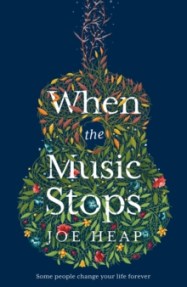
With its gorgeous cover, this is one of those occasions when I feel I’ve slightly missed out by opting for a digital version of a book.  So I may just have to treat myself and help out an independent bookshop through Lockdown 2.0 in the process…

In three words: Imaginative, insightful, heartfelt

Try something similar: Fred’s Funeral by Sandy Day

Follow this blog via Bloglovin


Joe Heap Author PicAbout the Author

Joe Heap was born in 1986 and grew up in Bradford, the son of two teachers. His debut novel, The Rules of Seeing, won Best Debut at the Romantic Novel of the Year Awards in 2019 and was shortlisted for the Books Are My Bag Reader Awards. Joe lives in London with his girlfriend, their two sons and a cat who wishes they would get out of the house more often.

Connect with Joe
Twitter
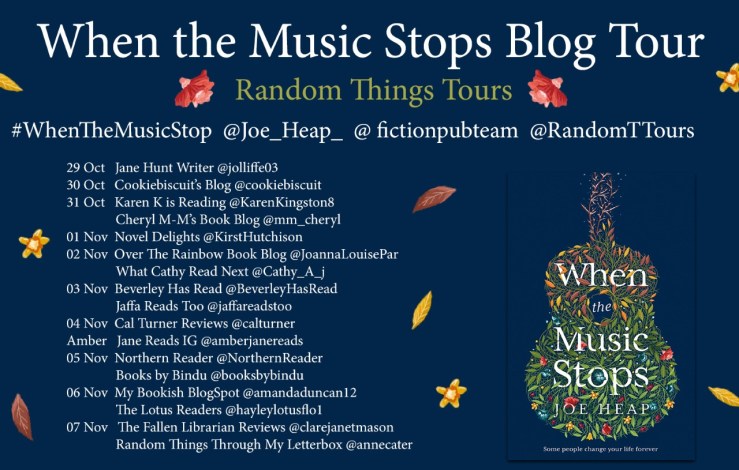
When The Music Stops BT Poster

#BookReview Immortal by Jessica Duchen @unbounders

Immortal BT Poster

Welcome to today’s stop on the blog tour for Immortal by Jessica Duchen. My thanks to Anne at Random Things Tours for inviting me to take part in the tour and to Unbound for my digital review copy.


ImmortalAbout the Book

Who was Beethoven’s ‘Immortal Beloved’?

After Ludwig van Beethoven’s death, a love letter in his writing was discovered, addressed only to his ‘Immortal Beloved’. Decades later, Countess Therese Brunsvik claims to have been the composer’s lost love. Yet is she concealing a tragic secret? Who is the one person who deserves to know the truth?

Becoming Beethoven’s pupils in 1799, Therese and her sister Josephine followed his struggles against the onset of deafness, Viennese society’s flamboyance, privilege and hypocrisy and the upheavals of the Napoleonic wars. While Therese sought liberation, Josephine found the odds stacked against even the most unquenchable of passions…

Format: Paperback (352 pages)           Publisher: Unbound
Publication date: 29th October 2020 Genre: Historical Fiction

Find Immortal on Goodreads

Purchase links*
Amazon UK | Hive (supporting UK bookshops)
*link provided for convenience not as part of an affiliate programme


My Review

Immortal is described by the author as “a novel inspired by real events”. Woven into the story is Jessica Duchen’s favoured theory (supported by many other scholars) as to the identity of the woman addressed as ‘Immortal Beloved’ in Beethoven’s letter. In fact, it becomes clear pretty quickly who that woman is and, later, why her identity might need to be protected.

The book is narrated by Countess Therese Brunsvik (known as ‘Tesi’ to her family) in a series of letters to an unidentified niece. I have to say I’m not really a fan of this narrative device. Even taking into account that people of the time in which the novel is set were more prolific and dedicated correspondents, I find it unrealistic that events and conversations can be recalled in such detail.

Given the size of Therese’s extended family – thanks to her sisters’ large number of offspring –  there are a range of possible candidates for the ‘My dear niece’ to whom her letters are addressed.   The niece’s identity is not confirmed until the end of the book, although readers may have their own suspicions earlier than that.

Leaving my earlier reservation aside, Therese’s account provides a detailed, often lively, insight into the lives of a certain section of Hungarian society at the beginning of the 19th century, a period which takes in the Napoleonic Wars and significant geopolitical changes to the countries of Europe.  In particular, the book charts the transformation of Vienna from a place of parties, palaces and musical soirees to a city under occupation in a nation bankrupted by war.

The children of the Brunsvik family are blessed with linguistic and musical ability. Therese and her sisters are talented pianists with remarkable sight-reading ability and their brother, Franz, plays the cello. The family are fluent in French and German; like other members of the aristocracy they eschew the native tongue, Hungarian, which is spoken only by their servants.

However, with the privileges of nobility come constraints, especially for the women of the family. As Therese’s mother explains, “A woman’s status, as you know, is determined by that of her husband”. Hence the unedifying spectacle of Therese’s beautiful sister Josephine (known as ‘Pepi’ within the family) being, in Therese’s words, marketed “to the first be-titled bidder”, with the unhappy consequences that follow.  And, as it turns out, an aristocratic title does not necessarily ensure financial stability or moral probity.

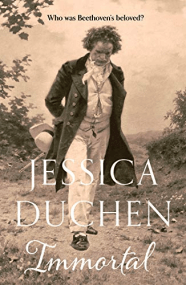
One of the key strengths of Immortal is the fascinating insight it gives into the character of Beethoven. This description of his appearance brings to life the figure depicted on the cover of the book:

…dark as a Spaniard…not tall, but broad, imposing, confident, hair swept back above his collar. His eyes were eager and curious, under low-set brows that threatened to meet in the middle. His neck was wide and short, his jawline squared, with a cleft chin that made him more determined in aspect; high cheekbones brought refinement to this unusual visage.”

The book vividly conveys Beethoven’s musical prowess and amazing ability to improvise – “I find it within myself, and it must out”. The author calls upon her own musical knowledge to comment in scholarly fashion on the structure of and themes behind some of Beethoven’s compositions, such as the piano sonatas which the two Brunsvik sisters learn to play under his tuition.

Described by Therese at one point as a ‘walking firework’, it is sad to see the first signs of Beethoven’s deafness and the impact it has on him. As Therese laments, “He, a sociable and generous soul, now preferred to avoid company rather than allow his disability to be seen”. The ups and downs of his musical career don’t help. Forced to rely on financial support from patrons, Beethoven’s ground-breaking compositions are not met with universal acclaim.

For me the pace of the book was more andante than vivace.  However, the Coda revealed an unexpected new angle and the historical notes provided a fascinating insight into the afterlives of many of the characters featured in the book.  This includes Therese herself whose interest in and championing of progressive education, especially for girls, was her lasting legacy.

Less a mystery than a painstaking historical biography, Immortal will appeal to lovers of Beethoven’s works who wish to find out more about the man behind the music and to those with an interest in the social history of Europe during a period of upheaval.

In three words: Detailed, assured, well-researched

Try something similar: Ecstasy by Mary Sharratt

Follow this blog via Bloglovin


Jessica Duchen Author PicAbout the Author

Jessica Duchen writes for and about music. She was a journalist and critic for the Independent from 2004 to 2016, and her work has appeared in the Guardian, the Sunday Times and BBC Music Magazine, among others. Her output includes fiction, biographies (Faure and Korngold), stage works and librettos. Among her recent novels is Ghost Variations (Unbound, 2016), based on the true story of the Schumann Violin Concerto’s rediscovery in the 1930s. It was chosen by John Suchet as his Best Read of 2016 for the Daily Mail‘s Christmas Books selection and was Book of the Month in BBC Music Magazine. Jessica often narrates concert versions of her novels, which have been heard at the Wigmore Hall, The Sage Gateshead, Kings Place and numerous music societies and festivals.

Her librettos include Silver Birch for composer Roxanna Panufnik, commissioned by Garsington Opera and shortlisted for a 2018 International Opera Award.

Jessica was born within the sound of Bow Bells, read music at Cambridge and lives in London with her violinist husband and two cats.

Connect with Jessica
Website | Twitter | Facebook