#BookReview The Coral Bride (Detective Morales #2) by Roxanne Bouchard, trans. David Warriner @OrendaBooks

Welcome to today’s stop on the blog tour for The Coral Bride by Roxanne Bouchard, the follow-up to We Were the Salt of the Sea. My thanks to Anne at Random Things Tours for inviting me to take part in the tour and to Orenda Books for my digital review copy.


The Coral BrideAbout the Book

When an abandoned lobster trawler is found adrift off the coast of Quebec’s Gaspé Peninsula, DS Joaquin Moralès begins a straightforward search for the boat’s missing captain, Angel Roberts – a rare female in a male-dominated world. But Moralès finds himself blocked at every turn – by his police colleagues, by fisheries bureaucrats, and by his grown-up son, who has turned up at his door with a host of his own personal problems.

When Angel’s body is finally discovered, it’s clear something very sinister is afoot, and Moralès and son are pulled into murky, dangerous waters, where old resentments run deep.

Format: ebook (400 pages)                 Publisher: Orenda Books
Publication date: 20th August 2020 Genre: Crime, Mystery

Find The Coral Bride (Detective Morales#2) on Goodreads

Purchase links*
Amazon UK | Hive (supporting UK bookshops)
*link provided for convenience not as part of an affiliate programme


My Review

The Coral Bride is set among the same close-knit fishing communities of Quebec’s Gaspé Peninsula as her first book featuring Detective Sergeant Joaquin Moralès, We Were the Salt of the Sea, a book I very much enjoyed. The events in The Coral Bride take place over the space of a few weeks at the end of the fishing season when the shrimp and lobster trawlers are brought ashore for the winter.

If you’ll pardon the pun, Moralès remains rather a fish out of water. He still feels like something of an outsider, not just because of his Mexican heritage or the fact that the life he imagined with his wife, Sarah, has not turned out the way he planned. It’s also that he finds it hard to adjust to the different pace and way of doing things in Gaspé, even from a policing perspective where so much depends on local knowledge.

Having been reassigned against his wishes, and for reasons he doesn’t fully understand, to what was initially a missing person case doesn’t help. Nor does being put in charge of an investigation team consisting of Erik Lefebvre, an officer who much prefers desk research to field work, and Simone Lord, a rather combative Fisheries officer. However, Moralès is conscious he will need to find a way to work with them because they possess the local and technical knowledge he lacks.

When the missing person case becomes a suspicious death, Moralès faces the knotty problem of discovering whether it was a case of murder or suicide. His investigation reveals fractures in the small community that go back decades and, like nearly everything in the Gaspé Peninsula, involve fishing and the sea.

The introduction of Moralès’ eldest son, Sebastien, a young man with his own personal problems, into the story provides a fresh perspective. Sebastien’s respect for and confidence in his father has been undermined both by the estrangement of his parents and rumours that Joaquin has been unfaithful. If true, the latter is a bit too close to home. As he confides, “All I’ve seen lately is a whole bunch of lies” and, given his own behaviour, he’s begun to doubt that loyalty is something he’s inherited from his father.

The book demonstrates once again the author’s skill at conveying the beauty and power of the sea, preserved in the translation from French by David Warriner. “Beyond the windows, the sea scattered incalculable shards of moonlight, their illusory fragments of silver shimmering on the surface as the horizon stretched into the night.” But The Coral Bride is also a tightly plotted crime mystery whose solution reveals itself in a satisfying manner.

The Coral Bride is another beautifully written, engrossing mystery from the pen of Roxanne Bouchard.

In three words: Atmospheric, intriguing, suspenseful

Try something similar: Containment by Vanda Symon

Follow this blog via Bloglovin


RoxanneAbout the Author

Over ten years ago, Roxanne Bouchard decided it was time she found her sea legs. So she learned to sail, first on the St Lawrence River, before taking to the open waters off the Gaspé Peninsula. The local fishermen soon invited her aboard to reel in their lobster nets, and Roxanne saw for herself that the sunrise over Bonaventure never lies. Her fifth novel (but the first translated into English) We Were the Salt of the Sea was published in 2018 to resounding critical acclaim, sure to be followed by its sequel, The Coral Bride. She lives in Quebec.

Connect with Roxanne
Website | Twitter 

About the Translator

David Warriner grew up in deepest Yorkshire, has lived in France and Quebec, and now calls British Columbia home. He translated Johanna Gustawsson’s Blood Song for Orenda Books, and his translation of Roxanne Bouchard’s We Were the Salt of the Sea was runner-up for the 2019 Scott Moncrieff Prize for French-English translation.

Connect with David
Website | Twitter
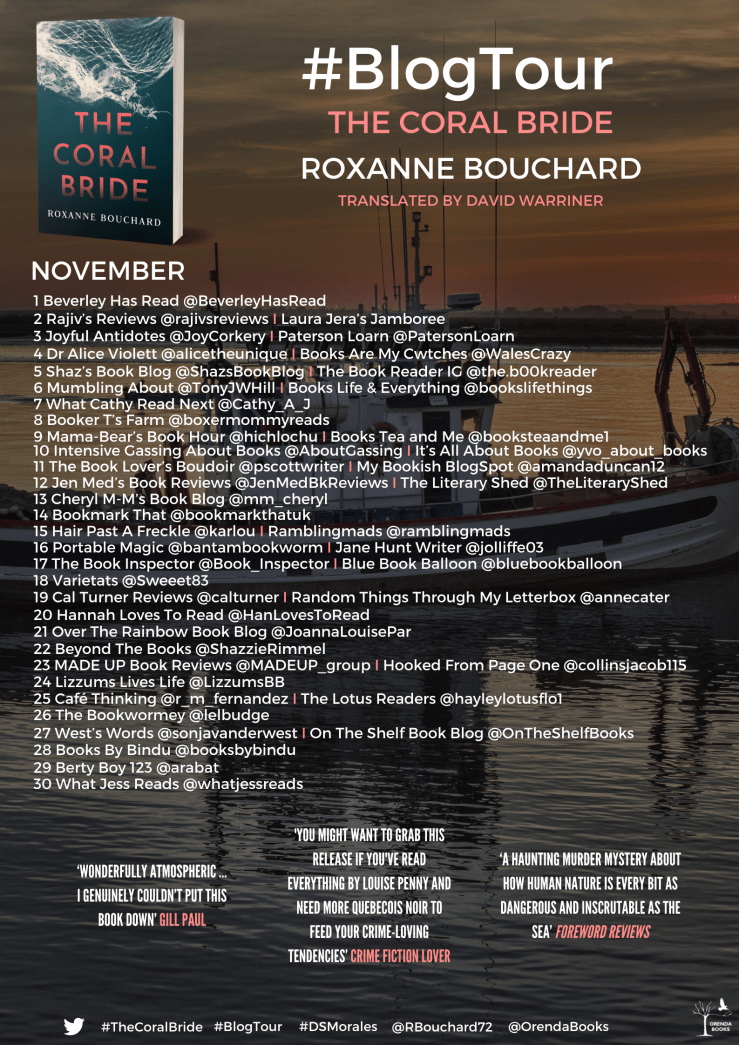
Coral Bride BT Poster JPEG

#BookReview When I Come Home Again by Caroline Scott @simonschusterUK

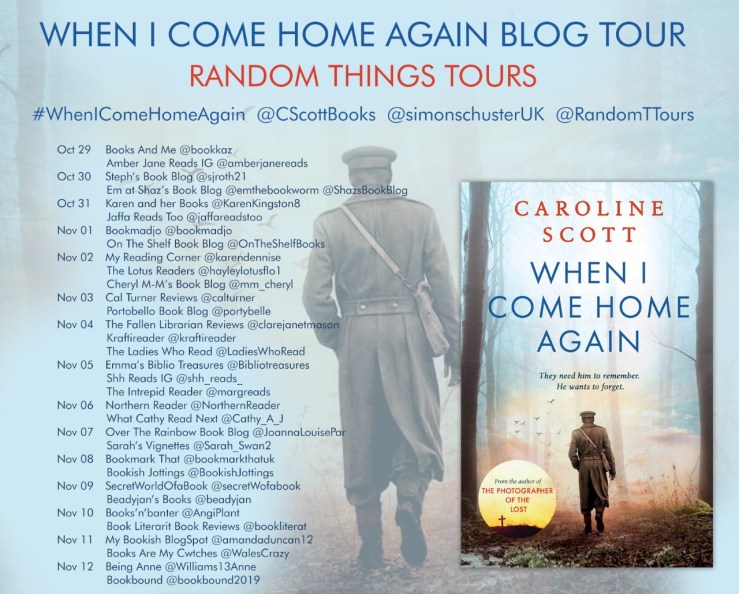
When I Come Home Again BT Poster

Welcome to today’s stop on the blog tour for When I Come Home Again by Caroline Scott. My thanks to Anne at Random Things Tours for inviting me to take part and to Simon & Schuster for my digital review copy via NetGalley. Do also check out the post by my tour buddy for today, Joules at Northern Reader.


When I Come Home Again - Graphic 3About the Book

How can you know who you are, when you choose to forget who you’ve been?

November 1918. On the cusp of the end of the First World War, a uniformed soldier is arrested in Durham Cathedral. It quickly becomes clear that he has no memory of who he is or how he came to be there. The soldier is given the name Adam and transferred to a rehabilitation home where his doctor, James, tries everything he can to help Adam remember who he once was. There’s just one problem. Adam doesn’t want to remember.

Unwilling to relive the trauma of war, Adam has locked his mind away, seemingly for good. But when a newspaper publishes Adam’s photograph, three women come forward, each just as certain that Adam is their relative and that he should go home with them.

But does Adam really belong with any of these women? Or is there another family waiting for him to come home?

Based on true events, When I Come Home Again is a deeply moving and powerful story of a nation’s outpouring of grief, and the search for hope in the aftermath of the First World War.

Format: Hardcover (496 pages)           Publisher: Simon & Schuster
Publication date: 29th October 2020 Genre: Historical Fiction, Romance

Find When I Come Home Again on Goodreads

Purchase links*
Amazon UK | Hive (supporting UK bookshops)
*link provided for convenience not as part of an affiliate programme


My Review

I loved Caroline Scott’s book, The Photographer of the Lost, so I was prepared for an emotional story and beautiful writing in this, her second book; I wasn’t disappointed. Once again the focus is the period after the First World War and the long-lasting effect of the conflict on the lives of so many.

Appropriately, as we approach Remembrance Sunday, the opening scenes of the book depict the journey of the coffin containing the body of the Unknown Warrior prior to its interment in Westminster Abbey. For some, the possibility the body may be that of a lost loved one brings solace, pride even. But for others, including the three women featured in the book, it does nothing but add to their fierce conviction that their missing brother, son or husband is not the body in the coffin, is not dead and will return some day. Often this in the face of advice from others to accept their loved one is gone and move on with their lives.

I loved how photographs play a part in the story, providing a link to the author’s first book. There’s the photograph published in the newspaper of the man given the name Adam Galilee that raises such fervent hope in those who have lost loved ones. And there are the photographs cherished by those families – of brothers, sons, husband who went to war and never came back – produced as evidence that Adam belongs with them. Or the photographs of parents, places or children placed in Adam’s hands in the hope of provoking a response, a flicker of recognition or a glimpse of his life before.

The scenes in which the three women who believe that Adam is their husband, son or brother come face to face with him for the first time are full of emotion and anguish. Their certainty, even though they cannot all be right, is heart-breaking to witness. But the author also conveys the emotional impact these encounters have on Adam himself, knowing the disappointment it will bring if they evoke no memories for him. Equally, the reader witnesses the effect on James Haworth, the doctor in charge of Fellside House, whose dogged determination to uncover Adam’s true identity threatens his own peace of mind.

The theme of memory runs through the book. Whether that’s the memories – good and bad – evoked by a particular place, the “muscle memory” of throwing a pot on a wheel or playing a piece by Chopin on the piano, the memory of a face but without the ability to put a name to it, or the act of remembrance in general. As long as someone is remembered, are they ever really lost? The book also poses the question whether memory can always be relied upon or, in wanting something so much to be true, it can become distorted. “Grief and hope are powerful emotions. What we see is sometimes what we want to see.”

When I Come Home Again is a beautifully crafted, emotional story that is also a timely reminder of the damaged minds and bodies that are the legacy of war.

In three words: Tender, insightful, emotional

Try something similar: The Return of the Soldier by Rebecca West

Follow this blog via Bloglovin


thumbnail_Caroline Scott author photo - credit Johnny RingAbout the Author

Caroline completed a PhD in History at the University of Durham. She has a particular interest in the experience of women during the First World War, in the challenges faced by the returning soldier, and in the development of tourism and pilgrimage in the former conflict zones. Caroline is originally from Lancashire, but now lives in south-west France.

Connect with Caroline
Twitter