#BookReview Children’s Fate (The Meonbridge Chronicles 4) by Carolyn Hughes @rararesources

Childrens Fate

Welcome to today’s stop on the blog tour for Children’s Fate by Carolyn Hughes, the fourth book in her Meonbridge Chronicles series set in 14th century England. My thanks to Rachel at Rachel’s Random Resources for inviting me to take part in the tour and to Carolyn for my digital review copy. Do check out the posts by my tour buddies for today Anne at Being Anne and Elaine at Splashes Into Books.
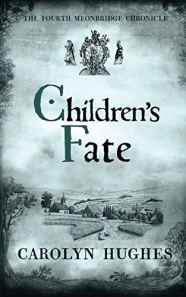

Children's FateAbout the Book

How can a mother just stand by when her daughter is being cozened into sin?

It’s 1360, eleven years since the Black Death devastated all of England, and six years since Emma Ward fled Meonbridge with her children, to find a more prosperous life in Winchester. Long satisfied that she’d made the right decision, Emma is now terrified that she was wrong. For she’s convinced her daughter Bea is in grave danger, being exploited by her scheming and immoral mistress. Bea herself is confused: fearful and ashamed of her sudden descent into sin, but also thrilled by her wealthy and attentive client.

When Emma resolves to rescue Bea from ruin and tricks her into returning to Meonbridge, Bea doesn’t at first suspect her mother’s motives. She is happy to renew her former friendships but, yearning for her rich lover, Bea soon absconds back to the city. Yet, only months later, plague is stalking Winchester again and, in terror, Bea flees once more to Meonbridge. But, this time, she finds herself unwelcome, and fear, hostility and hatred threaten…

Terror, betrayal and deceit, but also love and courage, in a time of continuing change and challenge –

Format: ebook (452 pages)                   Publisher: Riverdown Books
Publication date: 26th October 2020 Genre: Historical Fiction

Find Children’s Fate (The Meonbridge Chronicles #4) on Goodreads

Purchase links
Amazon UK
Links provided for convenience only, not as part of an affiliate programme
ch-banner-1024x479-4bks


My Review

Children’s Fate is the fourth in Carolyn Hughes’ series about the village of Meonbridge. You can find out more about the Meon Valley, the location of the fictional village, in this post on The History Girls blog.  Carolyn’s website also has a very useful glossary of medieval terms.  Readers new to the series  – or those who need their memories jogged – need not worry because the author incorporates useful recaps on events in the first three books.  Indeed, new readers may be surprised to learn that life in Meonbridge has not been without incident over the years.

As before, Children’s Fate explores the social and economic impacts of the Black Death on life.  “Folk weren’t tied to manors any more, or to one master.” The focus of the story is very much on the women of the village, in particular Emma Ward and her daughter Bea.  Life in Winchester brings opportunities for those prepared to grasp them but also temptations, as Emma and Bea will discover.  Their return to Meonbridge coincides with the Midsummer celebrations which involve torchlit processions around the village ‘bone-fires’, music and dancing, feasting and ‘fire-leaping’ by the young men.

Building on historical fact, the year 1361 sees the return of the plague, presaged in the belief of many by a solar eclipse.  For some, the resurgence of the pestilence is an Act of God, a sign of the Almighty’s displeasure at the prevalence of sin in their communities.  The only defence is confession or the power of prayer.  Luckily, we live in an age when science can provide us with facts about the method of transmission.  Our 14th century forbears lacked such information although the instructions to ‘keep your families at home, avoid public places where you can’ and wear a face covering were strikingly familiar.  Carolyn talks about the experience of writing about a pandemic and its aftermath during a pandemic here.

Faced with the indiscriminate nature of the pestilence and the loss of loved ones, it’s no surprise the people of Meonbridge search for answers as to why some live and others die and that some, fuelled by grief, despair and fear, look for scapegoats. As is often the case, suspicion falls on outsiders and those who have recently returned to the village. leading to some dramatic scenes.  The book’s conclusion sees happy endings for some and, for others, their just desserts.

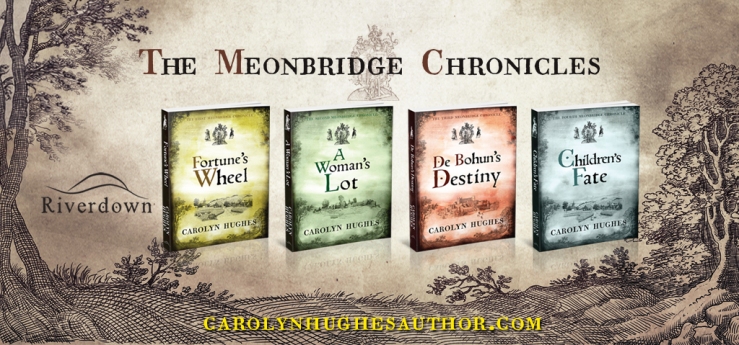
Looking back at my reviews of the three previous books in the series – Fortune’s Wheel, A Woman’s Lot and De Bohun’s Destiny – I see a frequent comment is how the detailed depiction of daily life gives the books a real sense of authenticity.  This latest book is no exception. In Children’s Fate you don’t so much read about the folk of Meonbridge as dwell amongst them for a few precious hours.

In three words: Engaging, immersive, well-researched

Try something similar: The Turn of Midnight by Minette Walters

Follow this blog via Bloglovin
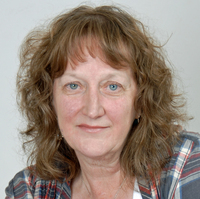

Carolyn HughesAbout the Author

Carolyn Hughes was born in London but has lived most of her life in Hampshire. After completing a degree in Classics and English, she started her working life as a computer programmer, in those days a very new profession. But it was when she discovered technical authoring that she knew she had found her vocation. She spent the next few decades writing and editing all sorts of material, some fascinating, some dull, for a wide variety of clients, including an international hotel group, medical instrument manufacturers and the government.

She has written creatively for most of her adult life but it was not until her children grew up and flew the nest several years ago that writing historical fiction took centre stage in her life. She has a Master’s degree in Creative Writing from Portsmouth University and a PhD from the University of Southampton.
Children’s Fate is the fourth novel in the Meonbridge Chronicles series. A fifth novel is under way.

Connect with Carolyn
Website | Twitter | Facebook
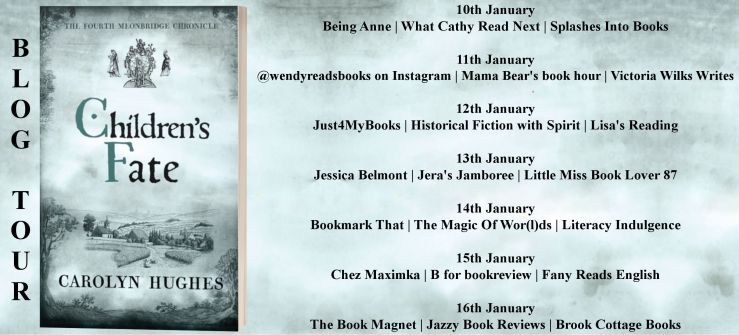
Childrens Fate Full Tour Banner

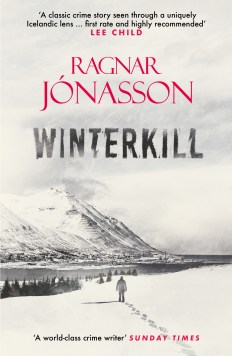
#BookReview Winterkill (Dark Iceland #6) by Ragnar Jónasson, trans. by David Warriner @OrendaBooks

Welcome to today’s stop on the blog tour for Winterkill by Ragnar Jónasson, the sixth – and sadly, final – book in his bestselling ‘Dark Iceland’ series, featuring Inspector Ari Thór Arason. My thanks to Anne at Random Things Tours for inviting me to take part in the tour and to Orenda Books for my digital proof copy. Winterkill was published as an ebook and in hardcover on 10th December 2020 and will be available in paperback on 21st January 2021.


WinterkillAbout the Book

Easter weekend is approaching, and snow is gently falling in Siglufjörður, the northernmost town in Iceland, as crowds of tourists arrive to visit the majestic ski slopes.

Ari Thór Arason is now a police inspector, but he’s separated from his girlfriend, who lives in Sweden with their three-year-old son. A family reunion is planned for the holiday, but a violent blizzard is threatening and there is an unsettling chill in the air.

Three days before Easter, a nineteen-year-old local girl falls to her death from the balcony of a house on the main street. A perplexing entry in her diary suggests that this may not be an accident, and when an old man in a local nursing home writes ‘She was murdered’ again and again on the wall of his room, there is every suggestion that something more sinister lies at the heart of her death…

As the extreme weather closes in, cutting the power and access to Siglufjörður, Ari Thór must piece together the puzzle to reveal a horrible truth …one that will leave no one unscathed.

Format: Hardback (240 pages)                Publisher: Orenda Books
Publication date: 10th December 2020 Genre: Crime, Mystery, Thriller

Find Winterkill (Dark Iceland #6) on Goodreads

Purchase links
Bookshop.org
Disclosure: If you buy a book via the above link, I may earn a commission from Bookshop.org, whose fees support independent bookshops

Hive | Amazon UK
Links provided for convenience only, not as part of an affiliate programme


My Review

Winterkill is only the second book I’ve read in Ragnar Jónasson’s Dark Iceland series (the other was the previous book in the series, Whiteout) but I’m sure even those who haven’t read any of the previous books will be able to enjoy this skillfully crafted crime thriller. And I can pretty much guarantee you’ll then want to go back and read the series from the beginning.

The book sees Inspector Ari Thór called to investigate the unexplained death of a young girl. Unfortunately, it coincides with the arrival for the Easter holiday of his ex-girlfriend Kristin and his young son, Stefnir. His attempts to balance the demands of the investigation with spending quality time with his son illustrate just one of the reasons for the breakdown of his and Kristin’s relationship.

Away from concerns about his private life, Ari Thór is feeling the pressure of his new rank and the absence of a sounding board in the shape of his former boss, Tomas. Ari Thór is also struggling to replicate that close working relationship with his new junior officer, Ögmundur. One of the many things that make Ari Thór such an engaging character is his strong sense of justice, meaning he feels an acute responsibility to the dead girl’s heartbroken mother to discover how and why she died.

As the investigation progresses, Ari Thór interviews a number of witnesses who knew the dead girl but none seem to fit the bill as suspects although, as he reflects, ‘appearances could be deceptive and nothing was ever completely black or white’.  Most significantly, the motive for her death – whether murder or suicide –  continues to elude him, this in a community where everyone knows everyone else or is related.

As well as constructing intriguing mysteries, the author is adept at creating an atmosphere of unease. Even amidst the beauty of the landscape and the tourists enjoying themselves on the ski slopes or indulging in hot chocolate and cinnamon rolls (mmm!) in one of the town’s cafes, there exists the threat a snowstorm could cut off the town from the outside world at any moment.

The snowstorm, when it arrives, coincides with Ari Thór getting closer to discovering the truth about the girl’s death.  Although the snow may have turned the streets of Siglufjörður white, there are black deeds to be uncovered beneath its snow-covered roofs. It all makes for a tense and dramatic climax to Ari Thór’s investigation.

Naturally, fans of the series will be sad to bid farewell to Ari Thór. However, they do say it’s good to go out on a high and Winterkill certainly delivers in that respect.

In three words: Gripping, dark, atmospheric

Try something similar: The Coral Bride by Roxanne Bouchard

Follow this blog via Bloglovin


Ragnar JonassonAbout the Author

Icelandic crime writer Ragnar Jónasson was born in Reykjavík, and currently works as a lawyer, while teaching copyright law at the Reykjavík University Law School. In the past, he’s worked in TV and radio, including as a news reporter for the Icelandic National Broadcasting Service. Before embarking on a writing career, Ragnar translated fourteen Agatha Christie novels into Icelandic, and has had several short stories published in German, English and Icelandic literary magazines.

Ragnar set up the first overseas chapter of the CWA (Crime Writers’ Association) in Reykjavík, and is co-founder of the International crime-writing festival Iceland Noir. Ragnar’s debut thriller, Snowblind became an almost instant bestseller when it was published in June 2015 with Nightblind (winner of the Dead Good Reads Most Captivating Crime in Translation Award) and then Blackout and Rupture following soon after. To date, Ragnar Jónasson has written five novels in the Dark Iceland series, which has been optioned for TV by On the Corner. He lives in Reykjavík with his wife and two daughters.

Connect with Ragnar
Website | Twitter

About the Translator

David Warriner translates from French and nurtures a healthy passion for Franco, Nordic and British crime fiction. Growing up in deepest Yorkshire, he developed incurable Francophilia at an early age. Emerging from Oxford with a modern languages degree, he narrowly escaped the graduate rat race by hopping on a plane to Canada – and never looked back. More than a decade into a high-powered commercial translation career, he listened to his heart and turned his hand again to the delicate art of literary translation. David has lived in France and Quebec, and now calls beautiful British Columbia home.

Winterkill BT 4