
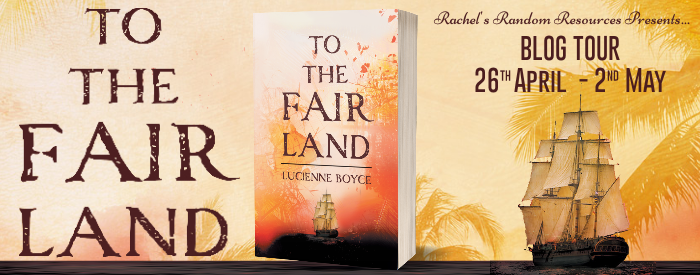
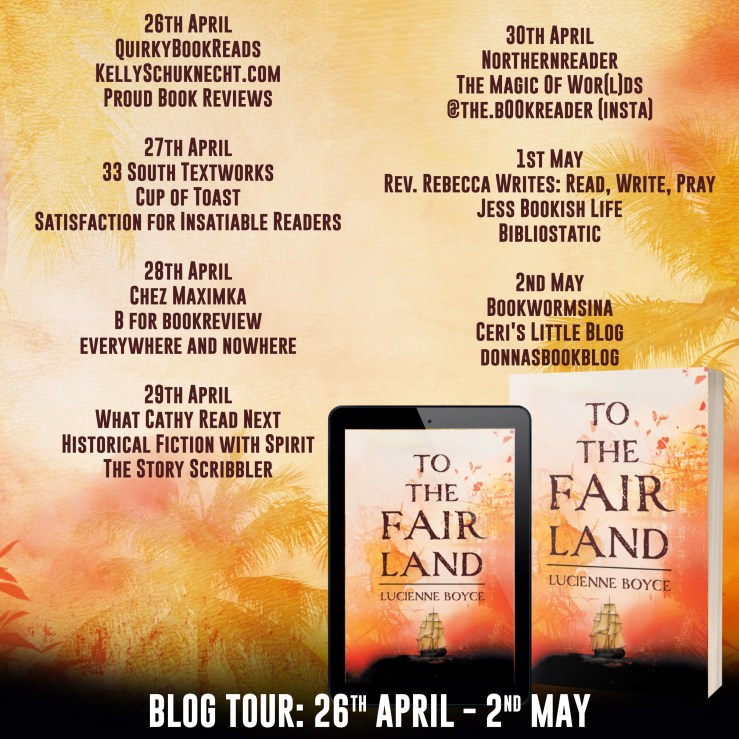
Welcome to today’s stop on the blog tour for To The Fair Land by Lucienne Boyce. My thanks to Rachel at Rachel’s Random Resources for inviting me to take part in the tour and for my digital review copy.
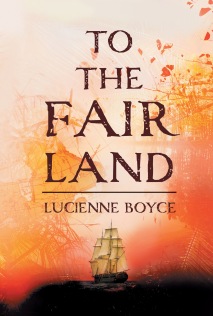 About the Book
In 1789 struggling writer Ben Dearlove rescues a woman from a furious Covent Garden mob. The woman is ill and in her delirium cries out the name ‘Miranda’. Weeks later an anonymous novel about the voyage of the Miranda to the fabled Great Southern Continent causes a sensation. Ben decides to find the author everyone is talking about. He is sure the woman can help him – but she has disappeared.
It is soon clear that Ben is involved in something more dangerous than the search for a reclusive writer. Who is the woman and what is she running from? Who is following Ben? And what is the Admiralty trying to hide? Before he can discover the shocking truth Ben has to get out of prison, catch a thief, and bring a murderer to justice.
Format: ebook (332 pages) Publisher: SilverWood Books
Publication date: 27th August 2012 Genre: Historical Fiction, Crime, Mystery
Find To the Fair Land on Goodreads
Purchase links
Bookshop.org
Disclosure: If you buy a book via the above link, I may earn a commission from Bookshop.org, whose fees support independent bookshops
Publisher | Amazon UK
Links provided for convenience only, not as part of an affiliate programme
My Review
Set in the eighteenth century during what the author describes as “the Age of Sail”, To The Fair Land involves a quest to discover the true identity of the anonymous author of a book depicting a voyage to the South Seas which has become the literary sensation of London. I enjoyed the scenes in the shop of the book’s publisher as customers jostle one another to reach the front of the queue and claim their copy.
Ben Dearlove’s ambition to be an author looks likely to be thwarted by the expectation he will take over the family’s apothecary business in Bristol. Rather reluctantly, his father has agreed to pay Ben an allowance for two years in order that he can pursue his dream in London. However, time is nearly up and he’s no nearer finishing his book, let alone finding a publisher or any kind of literary success. In fact, Ben is pretty much resigned to a future ‘measuring out powders and potions for the querulous old, the whimpering sick, the vomiting young’.
He embarks upon the search for the mystery author in the hope of receiving a commission from the publisher if the rights to a sequel can be secured. This involves piecing together small clues and delving into maritime records. However, as Ben’s search progresses, he becomes all too aware there are ruthless individuals out to prevent him succeeding, for reasons he does not initially understand.
The author creates vivid pictures of 18th century London and Bristol, with their pleasure gardens, crowded taverns, bustling streets and coffee houses in which merchants and traders gather to do business. ‘Under the high ceiling of Lloyd’s Coffee Room, waiters scurried back and forth with jugs of coffee and chocolate, armfuls of paper and writing materials. Counting-house clerks ran in and out with messages for their employers. Each of the booths around the wall had its complement of men talking, writing, reading the newspapers.‘ There is also a colourful cast of secondary characters, including that which no novel set in the 18th century should be without – the social climbing mother always on the lookout for an eligible bachelor for her daughters.
I have to say I was less surprised than Ben at the identity of the author when it was revealed but then I’m not hampered by the prejudices of the time.
The narrative is interspersed with occasional excerpts from the book that has caused such a sensation. There are also lengthy sections in which we get to hear from the ‘mystery’ author (although by now no longer a mystery to the reader) as well as indirectly via individuals with whom they have shared the story of their experiences during the voyage of the Miranda, their time spent on the land they discover, and the circumstances of their departure. Personally, I preferred the sections narrated directly by the ‘mystery’ author since I found the depth of detail made it more credible than a story relayed from memory by another person.
Through the eyes of the mystery author, the ‘fair land’ has something of the quality of the Garden of Eden, being inhabited by an indigenous tribe who eschew violence and live in a state of harmony. ‘They were a people who lived to serve one another and to whom service, always willing, always cheerful, was the greatest happiness they knew.’
As well as a tale of adventure, discovery and forbidden love, the book questions the notion of Europe as the ‘civilized world’ and exposes the all too real impact on indigenous people of the arrival of explorers. As our mystery author observes, “What do you think happens to a land when it has been discovered? What do you think it becomes once it has been exposed to our greed and cruelty? Its wealth plundered, its people turned into slaves…?”
To The Fair Land is an intriguing mystery, rich in period detail. Although there was a useful glossary, I regretted the absence of any sort of historical note (at least in my advance review copy) to expand more on the real life attempts to discover the ‘Great Southern Continent’.
In three words: Intriguing, detailed, mystery
Try something similar: Fled by Meg Keneally
Follow this blog via Bloglovin
 About the Author
Lucienne Boyce writes historical fiction, non-fiction and biography. After gaining an MA in English Literature, specialising in eighteenth-century fiction, she published her first historical novel, To The Fair Land (2012), an eighteenth-century thriller set in Bristol and the South Seas.
Her second novel, Bloodie Bones: A Dan Foster Mystery (SilverWood Books, 2015) is the first of the Dan Foster Mysteries and follows the fortunes of a Bow Street Runner who is also an amateur pugilist. Bloodie Bones was joint winner of the Historical Novel Society Indie Award 2016, and was also a semi-finalist for the M M Bennetts Award for Historical Fiction 2016. The second Dan Foster Mystery, The Butcher’s Block, was published in 2017 and was awarded an IndieBrag Medallion in 2018. The third in the series, Death Makes No Distinction, was published in 2019 and is also an IndieBrag Medallion honoree, a recipient of Chill With a Books Premium Readers’ Award, and a joint Discovering Diamonds Book of the Month. In 2017 an e-book Dan Foster novella, The Fatal Coin, was trade published by SBooks.
In 2013, Lucienne published The Bristol Suffragettes, a history of the suffragette movement in Bristol and the west country and in 2017 a collection of short essays, The Road to Representation: Essays on the Women’s Suffrage Campaign.
Connect with Lucienne
Blog | Twitter | Facebook | Goodreads

 About the Book
 About the Author
 What Cathy Read Next...