#BookReview #BlogTour The Hidden Child by Louise Fein @HoZ_Books


THE HIDDEN CHILD_Blog tour banners

Welcome to today’s stop on the blog tour for The Hidden Child by Louise Fein. My thanks to Lauren Tavella and Jade Gwilliam at Head of Zeus for inviting me to take part in the tour and for my limited edition proof.


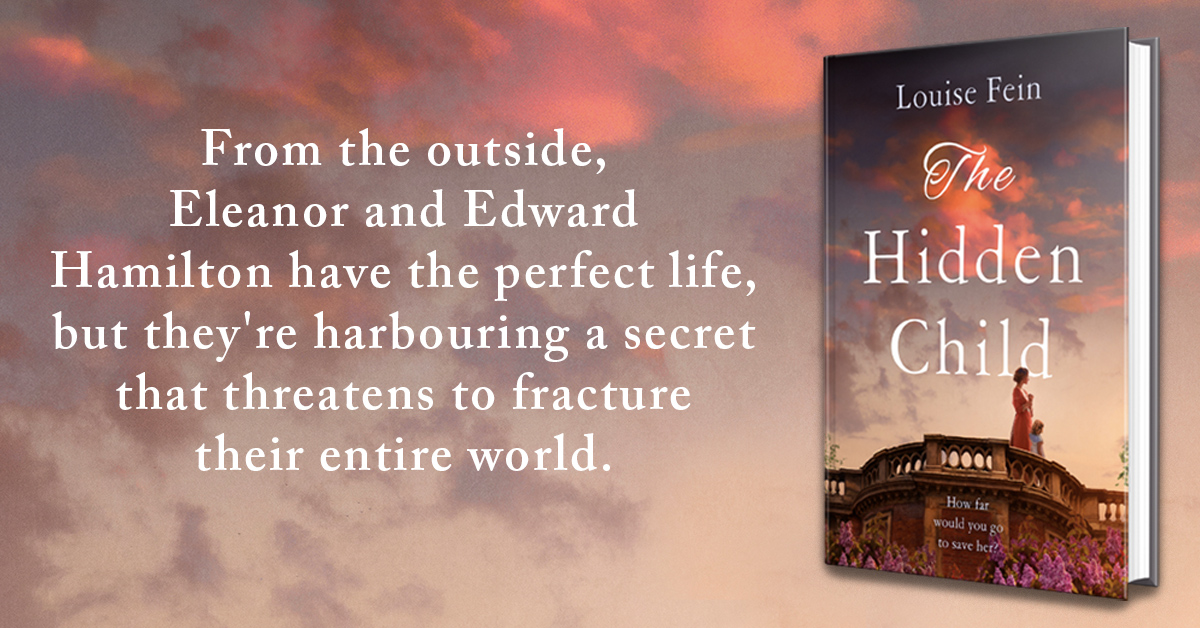
The Hidden ChildAbout the Book

From the outside, Eleanor and Edward Hamilton are the epitome of the perfect marriage but they’re harbouring a shameful secret that threatens to fracture their entire world.

London, 1929. Eleanor Hamilton is a dutiful mother, a caring sister and adoring wife to a celebrated war hero. Her husband, Edward, is a leading light in the Eugenics movement. The Hamiltons are on the social rise, and it looks as though their future is bright.

When Mabel, their young daughter, begins to develop debilitating seizures, their world fractures as they have to face the uncomfortable truth – Mabel is an epileptic: one of the undesirables Edward campaigns against.

Forced to hide the truth so as not to jeopardize Edward’s life work, the couple must confront the truth of their past -and the secrets that have been buried. How far are they willing to go to protect their charmed life – even if it means abandoning their child to a horrific fate?

Will Eleanor and Edward be able to fight for their family? Or will the truth destroy them?

Format: Hardback (496 pages)              Publisher: Head of Zeus
Publication date: 2nd September 2021 Genre: Historical Fiction

Find The Hidden Child on Goodreads

Purchase links
Bookshop.org
Disclosure: If you buy a book via the above link, I may earn a commission from Bookshop.org, whose fees support independent bookshops

Hive | Amazon UK
Links provided for convenience only, not as part of an affiliate programme


My Review

Having loved Louise Fein’s previous book, People Like Us, I was keen to read whatever she came up with next. However, I’ll freely admit that as someone with epilepsy – thankfully controlled with medication (as it happens the same one mentioned in the Author’s Note) – its subject matter made it a challenging read for me. However, I was reassured to learn the book was inspired by the author’s personal experience of bringing up a child with epilepsy and her desire to raise awareness of the stigma and misunderstanding that still exists about the condition, not least the fact that epilepsy can take many different forms.

For the reasons I’ve stated, it’s difficult for me to imagine what it must have been like to live with epilepsy at a time when it was viewed as something shameful, something to be hidden and that would have had you categorized as an ‘undesirable’.

At first I thought the author had set herself an impossible task in making me feel any empathy towards Edward. Seemingly heedless of his own hypocrisy, he espouses a belief in eugenics, a philosophy I find utterly repugnant. Although I appreciate such views were held in certain circles at the time, I couldn’t help but be appalled by Edward’s comments and those of his fellow eugenicists about ‘undesirables’, ‘hordes of defectives’ and ‘inferior races’. There were moments in the book that were too close to home, such as Edward’s inclusion of epileptics, alongside criminals and alcoholics, in a list of those judged to be the result of ‘overbreeding by the lower stratus of the population’. (The Author’s Note provides fascinating information about the history of the Eugenics Movement.)

Learning more about the tragic events in Eleanor’s life made me understand why she was susceptible to the theory of eugenics, although her fear that, if her sister Rose was to bear a child by her boyfriend Marcel, it might lower the quality of Rose’s ‘excellent genes’ made me shudder. On the other hand, I could well imagine Eleanor’s distress at witnessing her daughter Mabel’s seizures, her feeling of helplessness and the growing realisation that her sweet-natured little girl has been changed, in all likelihood, irrevocably. As it turns out, Eleanor is forced to revise her opinion of Marcel when he gives her a gift just as valuable as his devotion to Rose. Where initially I’d thought Eleanor weak, I began to admire her willingness to fight the forces arrayed against her in defence of Mabel’s future, and in the end I was cheering for her.

I was hoping Edward’s personal experience would make him revise his views on eugenics but his motivation continued to be fear of disclosure and how his reputation would be affected should Mabel’s condition become known. In addition, it transpires he has his own shameful secret he’d rather was not revealed. Will Edward’s realisation of his mistakes come eventually, or will it be too late?

One of the most striking elements of the book were the sections in which we hear the ‘voice’ of Mabel’s condition, revelling in its ability to wreak havoc on the human brain. ‘I am anti-order. I am chaos. I disrupt and disturb.’ I thought this was inspired. Depicting the human response to epilepsy as analogous to a contest of wits made me think of all those who have waged war on the condition over the decades: from those who carried out research and developed the drugs we now have to control it in many cases, to the specialists who support those with it and the charities who work to raise awareness.

As you have no doubt gathered from this review, The Hidden Child had a very personal resonance for me and it was a difficult read at times. In particular, I found much of what Mabel undergoes harrowing to witness. But those closing chapters… I’ll admit tears were shed.  The Hidden Child is beautifully written and made me appreciate how far we have come as a society and how fortunate I am to be living in a more enlightened age. By the way, you can find out more about epilepsy on the Epilepsy Action website. They are just one of the many charities working in this area.

In three words: Thought-provoking, moving, immersive

Follow this blog via Bloglovin


Louise FeinAbout the Author

Louise Fein was born and brought up in London. She harboured a secret love of writing from a young age, preferring to live in her imagination than the real world. After a law degree, Louise worked in Hong Kong and Australia, travelling for a while through Asia and North America before settling back to a working life in London.

She finally gave in to the urge to write, taking an MA in creative writing, and embarking on her first novel, Daughter of the Reich (named People Like Us in the UK and Commonwealth edition). The novel was inspired by the experience of her father’s family, who escaped from the Nazis and arrived in England as refugees in the 1930’s. Daughter of the Reich/People Like Us is being translated into 11 foreign languages, has been shortlisted for the 2021 RNA Historical Novel of the Year Award, and has been long listed for the Not The Booker Prize.

Louise lives in the beautiful English countryside with her husband, three children, two cats, small dog and the local wildlife who like to make an occasional appearance in the house. Louise is currently working on her third novel.

Connect with Louise
Website | Twitter  | Instagram | Facebook | Goodreads
The Hidden Child Author Facebook 2

#BookReview One August Night by Victoria Hislop @RandomTTours

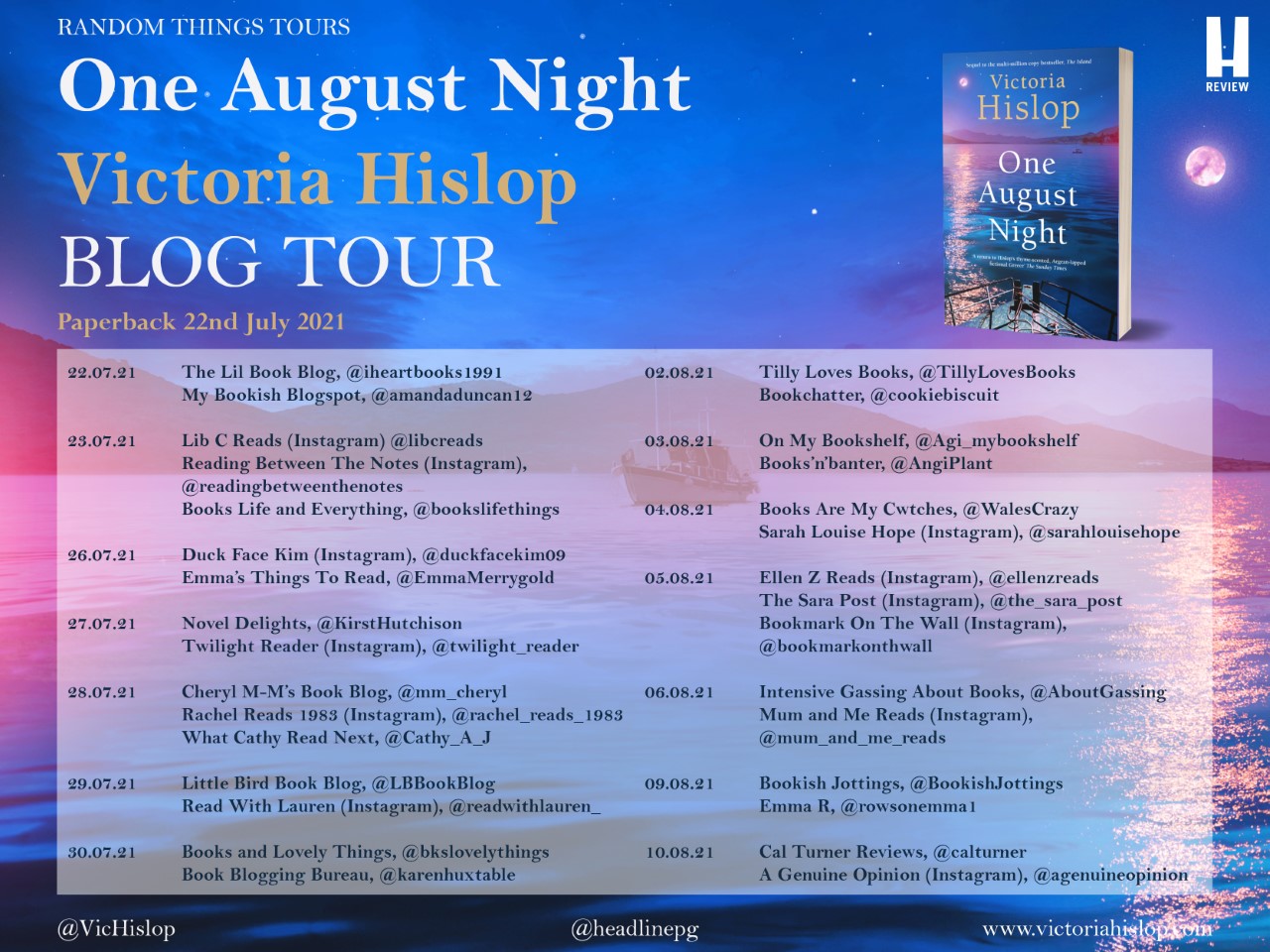
One August Night - BT Poster

Welcome to today’s stop on the blog tour for One August Night by Victoria Hislop which was published in paperback on 22nd July 2021. My thanks to Anne at Random Things Tours for inviting me to take part in the tour. Do look out for the posts by the other book bloggers hosting stops on the tour.


One August NightAbout the Book

25th August 1957. The island of Spinalonga closes its leper colony. And a moment of violence has devastating consequences.

When time stops dead for Maria Petrakis and her sister, Anna, two families splinter apart and, for the people of Plaka, the closure of Spinalonga is forever coloured with tragedy.

In the aftermath, the question of how to resume life looms large. Stigma and scandal need to be confronted and somehow, for those impacted, a future built from the ruins of the past.

Format: Paperback (320 pages)    Publisher: Headline
Publication date: 22nd July 2021 Genre: Historical Fiction

Find One August Night on Goodreads

Purchase links
Bookshop.org
Disclosure: If you buy a book via the above link, I may earn a commission from Bookshop.org, whose fees support independent bookshops

Hive | Amazon UK
Links provided for convenience only, not as part of an affiliate programme


My Review

Being one of many thousands who loved The Island, I treated myself to a copy of One August Night when it was first published in October 2020. I’m sorry to say it’s been languishing in my To-Be-Read pile ever since so Anne’s invitation to join the blog tour marking the book’s publication in paperback was the perfect opportunity to take it down from the bookshelf and get stuck in.

One August Night returns readers to the island of Crete and the small village of Plaka, near Elounda. It also reunites them with some of the characters from The Island, in particular Anna Vandoulakis and her husband Andreas, Anna’s sister Maria and her husband Dr Nikos Kyritsis, and Manolis, Andreas’s cousin. Those who haven’t read The Island need not worry because key events from the last section of the earlier book are repeated, although this time experienced first hand by the reader; this means One August Night can definitely be read as a standalone.

The Island had a particular resonance for me having visited Spinalonga, the site of a former leper colony, many years ago during a holiday on Crete; it was a similar visit that inspired the author to write The Island. Long since abandoned, for me it possessed an eerie quality and it was unsettling to imagine the people living there, believing themselves exiled from friends and family forever. Interestingly, the author had a quite different reaction to her visit to Spinalonga, as she reveals in her Afterword.

One August Night focuses on events just prior to and after the return of those exiled on the island, a return made possible by the discovery of a cure for leprosy. You might think it a cause for celebration and indeed for some it is, bringing the prospect of being reunited with relatives and friends, and a return to something like a normal life, albeit that many bear the physical and mental scars of their illness. However, the return of others means bringing to the surface a tangled web of relationships, both past and present.

As always, Victoria Hislop creates a vivid picture of life in Crete and Greek culture more generally. I particularly enjoyed the way she described the traditional celebration of events such as baptisms and saint’s days at which there are always plentiful supplies of food and drink, including the locally produced raki. One scene that sticks in my memory is when Manolis visits a taverna where traditional music is being performed.

“Manolis suddenly caught the opening notes of a zeibékiko song and felt something inside him stir. The lyrics of this particular song seemed to mirror his life, jabbing at his heart. As if possessed by the power of the music, he rose from his seat… The movements were personal but the tradition of the zeibékiko was known to everyone. It was a dance that should only be performed by a man, and only by a man with grief to express. As the musicians played and the insistent beat thumped and repeated and thumped again, Manolis revolved slowly in a trance-like state, his eyes glazed, unfocused. Someone threw a plate at his feet and one of the girls tossed a flower that she had been wearing in her hair. He was aware of neither.”

It is at a celebration on an August night in Plaka intended to mark the return of those from Spinalonga, that a shocking event occurs. Although it’s an event that will be no surprise to those who have read The Island, One August Night concentrates on the ramifications for those involved, for their families and friends, as well as for the wider community. In recounting its consequences, the author explores the strong ties of family that underpin Greek society including the concept of philótimo, or honour.

Focusing particularly on the lives of Maria and Manolis in the years that follow, the author takes the reader beyond Plaka, and indeed beyond the island of Crete, as both Maria and Manolis struggle with the legacy of that eventful August night. Feeling she must find a way to repay the good fortune that saw her cured of leprosy and married to Nikos, Maria’s solution involves a breathtaking act of forgiveness. But despite being fully cured, the stigma of her leprosy remains although, as she observes, stigma can be a weapon in the right circumstances. Manolis’s solution is to try to banish the past and the memories that haunt him by seeking a new life away from Crete. 

In One August Night the author creates a story that encompasses passion, jealousy and anger but shows how, in time, those feelings can be replaced by others and that, even after a tragedy, it is possible to find a degree of happiness and the release that comes from finally facing up to the truth.

Now I really must get around to reading Victoria’s previous novel, Those Who Are Loved, which I was lucky enough to hear her talk about at Henley Literary Festival in 2019. (You can read my review of the event here.) I’ve also recently added one of her earlier books, Cartes Postales from Greece, to my To-Be-Read pile and I’m looking forward to exploring more of her back catalogue.

In three words: Evocative, emotional, vibrant

Try something similar: Songbirds by Christy Lefteri

Follow this blog via Bloglovin


contributor-victoria-hislop-68About the Author

Inspired by a visit to Spinalonga, the abandoned Greek leprosy colony, Victoria Hislop wrote The Island in 2005. It became an international bestseller, has sold more than six million copies and was turned into a 26-part Greek TV series. She was named Newcomer of the Year at the British Book Awards and is now an ambassador for Lepra.

Her affection for the Mediterranean then took her to Spain, and in the number one bestseller The Return she wrote about the painful secrets of its civil war. In The Thread, Victoria returned to Greece to tell the turbulent tale of Thessaloniki and its people across the twentieth century. Shortlisted for a British Book Award, it confirmed her reputation as an inspirational storyteller.

Her fourth novel, The Sunrise, about the Turkish invasion of Cyprus and the enduring ghost town of Famagusta, was a Sunday Times number one bestseller. Cartes Postales from Greece, fiction illustrated with photographs, followed and was one of the biggest selling books of 2016. The poignant and powerful Those Who Are Loved was a Sunday Times number one hardback bestseller in 2019 and explores a tempestuous period of modern Greek history through the eyes of a complex and compelling heroine. Victoria’s most recent novel, One August Night, returns to Crete in the long-anticipated sequel to The Island. The novel spent twelve weeks in the Top 10 hardback fiction charts. Her books have been translated into more than thirty-five languages.

Victoria divides her time between England and Greece and in 2020, Victoria was granted honorary citizenship by the President of Greece. She was recently appointed patron of Knossos 2025, which is raising funds for a new research centre at one of Greece’s most significant archaeological sites. She is also on the British Committee for the Reunification of the Parthenon Marbles.

Connect with Victoria
Website | Twitter | Goodreads

One August Graphic 2