#BlogTour #Extract Lucifer’s Game by Cristina Loggia @RandomTTours @lume_books

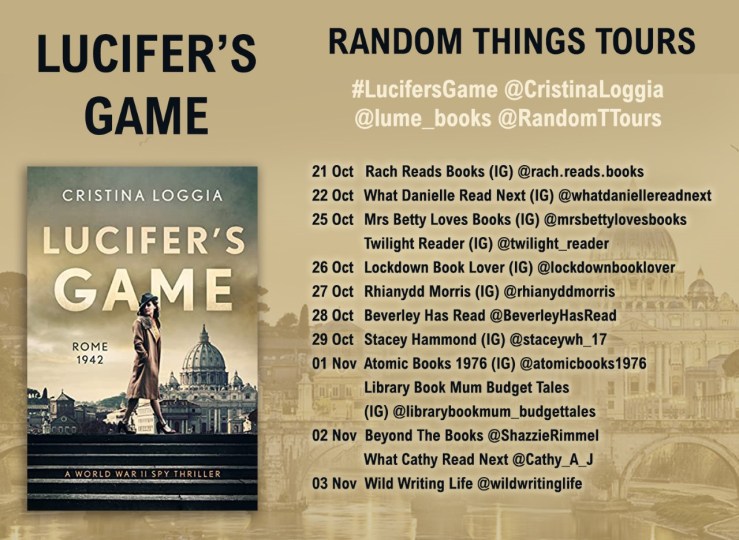
Lucifer's Game BT PosterWelcome to today’s stop on the blog tour for Lucifer’s Game by Cristina Loggia. My thanks to Anne at Random Things Tours for inviting me to take part in the tour. You can read an extract from the book below.
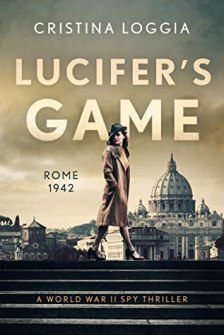

Lucifer's GameAbout the Book

Rome, 1942. Cordelia Olivieri is a young, determined hotel owner desperate to escape Mussolini’s racial persecution. But as Fascist leaders gather in Rome, Cordelia is suddenly surrounded by the world’s most ruthless and powerful commanders.

In an effort to keep her Jewish heritage a secret and secure safe passage out of Italy, Cordelia forms a dangerous alliance with the British army who want to push the Axis out of North Africa once and for all.

Going undercover, Cordelia begins obtaining and leaking military intelligence to a British agent, hoping the intel will secure her freedom. But the more Cordelia uncovers, the greater the risks – especially for one handsome German Afrika Korps officer.

How far must Cordelia go to protect her identity and secure passage out of Rome?

Format: ebook (340 pages)                Publisher: Lume Books
Publication date: 14th October 2021 Genre: Historical Fiction

Find Lucifer’s Game on Goodreads

Purchase links
Hive | Amazon UK
Links provided for convenience only, not as part of an affiliate programme


Extract from Lucifer’s Game by Cristina Loggia

Prologue

Gazala, North Africa, June 1942

Erwin Rommel removed the goggles that had been sheltering his eyes from the desert sand, stepped out of his Horch armoured cabriolet and walked to the edge of the cliff perched over the East Mediterranean Sea. He was a sober man, of medium height. His sharp, inquisitive eyes scanned the horizon as if his next military target were due north, rather than west. His gaze remained fixed across the water.

In a day that was coming to an end, the General inhaled a deep breath of the fresh and humid air blowing from the sea, a sudden relief from the heat of a scorching and unforgiving North African sun. His lungs felt an immediate balsamic cooling. The evening dew was starting to appear on the few blades of surviving grass. He could hear the soft backwash of the waves crashing on the narrow beach at the bottom, foamy and shining in the glow of the last rays of light.

Von Mellenthin, his intelligence officer, had travelled with him up there, just outside Gazala, after a twenty-minute car trip on the road along the rugged east coast of town. He handed the General a cup of mint tea that Rudolf Schneider, Rommel’s driver, had rushed to pour from a field thermos as soon as they stopped. The Desert Fox, as he came to be known for his daring manoeuvres that routinely outwitted an enemy in far greater number, had adopted this habit from the Berber tribes that had been roaming over those lands for centuries. He found the drink quite refreshing, despite the heat of the liquid.

Von Mellenthin lit a cigarette, observed the spiral of smoke that came out from his lips, then looked at Rommel. He wondered if a Roman General, or a Persian, or even a Carthaginian Commander before him, had stood in that same vantage point to admire the vastness of the sea, while plotting his next move. Time and time again, Libya had been a land of conquest by the powerful empires of the ancient past, and now it was the turn of the mighty Third Reich.

Rommel turned around and began to observe the hauntingly beautiful dunes of the desert. A hawk was screaming, high in the silent, clear sky, which was rapidly turning to a deeper blue now. What a stark contrast with its earlier blinding whiteness, the clouds of dust and the infernal noise of the heavy artillery in the battle that had raged until a few hours before.

The Panzers of the German Afrika Korps and the Italian Ariete Division tanks had defeated the Eighth Army of the British Forces, which was left flying in disorder. In a relentless attack, his men, fighting like devils, had conquered the all-important Gazala line, west of Tobruk, taking a substantial number of enemy prisoners. A landslide, an overwhelming victory, achieved despite the desperate situation of his supply lines: Rommel had been receiving a third of what was necessary.

That’s what was on his mind right now. And he was furious.


Cristina Loggia Author PicAbout the Author

Cristina started her career as a newspaper reporter for L’Eco di Biella and La Provincia di Biella in Piedmont, Italy. After a spell running the press office of an MP, she moved to London, where she worked for several years as a public affairs and media relations professional, advising major multinational corporations on communications campaigns. Cristina read English Literature and Foreign Languages at the Catholic University of Milan, Italy. Writing and reading have always been her greatest passion. Lucifer’s Game is her first fiction novel. She currently lives with her husband in Berkshire, United Kingdom.

Connect with Cristina
Website | Twitter | Facebook | Instagram

Lucifers Game Graphic 2

#BookReview When the Music Stops by Joe Heap @fictionpubteam

A note from Joe:

I owe this book to my grandparents, John and Jean Sands, for sharing the stories that inspired it. In many ways their story is more remarkable than the one I have written.

At a summer season in Ramsgate, 1959, two ice skaters held a party. My grandfather, a Glaswegian saxophonist who would rather have gone to the pub, was convinced by a comedian on the same bill to come along. My grandmother, another one of the ice skaters, sat down next to him and spilt her drink in his lap. Though she has since denied it, her first words of note to him were ‘Oh no, not another Scot.’

Nobody could have guessed how much would spin off that moment, myself and this book included. Here are a few pictures of them.”

images


9780008293208About the Book

This is the story of Ella. And Robert. And of all the things they should have said, but never did.

What have you been up to?’
I shrug, ‘Just existing, I guess.’
‘Looks like more than just existing.’
Robert gestures at the baby, the lifeboat, the ocean.
‘All right, not existing. Surviving.’
He laughs, not unkindly. ‘Sounds grim.’
‘It wasn’t so bad, really. But I wish you’d been there.’

Through seven key moments and seven key people their journey intertwines. From the streets of Glasgow during WW2 to the sex, drugs and rock n’ roll of London in the 60s and beyond, this is a story of love and near misses. Of those who come in to our lives and leave it too soon. And of those who stay with you forever…

Format: Hardcover (384 pages)           Publisher: Harper Collins
Publication date: 29th October 2020 Genre: Contemporary Fiction, Romance

Find When the Music Stops on Goodreads

Purchase links*
Amazon UK | Hive (supporting UK bookshops)
*link provided for convenience not as part of an affiliate programme


My Review

The book’s structure, revisiting seven key moments and people in Ella’s life, was, according to the author, inspired by the ‘Seven Ages of Man’ speech from Shakespeare’s As You Like It. However, as Joe Heap also writes, “This is a book about music, inspired by music” so cleverly incorporated into the story are the seven modes that have been part of musical notation since ancient times.

In When the Music Stops, each of these modes is represented by a song in a music book Ella acquires when she first takes up the guitar. Although other elements of her memory have faded by the time we first meet her as an old woman – alone, in rather strange circumstances – the tunes are still at her fingertips, evoking memories of significant stages in her life – and the people who shared them with her. As she muses, “There are seven songs. I have to play all of them, though I don’t know what will come at the end. I just have to play them.”

The ability of music to evoke memories is just one of the fascinating concepts explored in the book, along with the nature of memory itself and how we experience the passing of time. I’ll leave others to explain Einstein’s theories on the latter but I liked the metaphor Robert, Ella’s friend since childhood, employs. He compares time to a long-playing record. While you’re listening to the second verse of a song, he explains, the first verse is still there but you’re just not listening to it anymore.

As the reader learns, Ella’s life has been punctuated by moments of loss, often signalled by that thing we’ve probably all come to dread – the unexpected early morning or late night telephone call. Robert’s earlier metaphor is applicable here too. As he confides to Ella about a person they both knew, “I don’t think she’s really gone… I just think we can’t see her anymore.”

Another key theme of the book is that of the missed opportunities in life, especially between people like Ella and Robert. ‘The Road Not Taken’ of Robert Frost’s poem, as it were. Their encounters over the years are populated by falsely reassuring thoughts such as “There will be other chances” and fateful hesitations, “The door of possibility stays open, waiting for her to walk through, but she stays put”.

I admired the way the author recreated the atmosphere of each stage on the journey through Ella’s life, referencing the clothing, the television programmes or even the food of the time: the school playground gift of tablet (a sweet similar to fudge for you non-Scots out there) or a corned beef and pickle sandwich prepared for a picnic.

The standout section for me, entitled ‘The Rebel’, was Ella’s experiences as a session musician in 1960s London, rubbing shoulders with many famous, or soon to be famous, bands of the period. (In his acknowledgements, Joe mentions Carol Kaye, “a trailblazing female musician” who played guitar and bass on many hit records and was the inspiration for Ella.) I also found the section entitled ‘The Matron’ particularly moving.

At one point in the book, a character mentions ‘fantastical thinking’ and I think that’s a great description of the premise of this clever but very touching novel. At the online book launch, Joe Heap mentioned fantasy as making up some of his own early reading – books by authors such as Terry Pratchett and Neil Gaiman – and it’s easy to see that influence in elements of the book. However, more than anything, When the Music Stops is an emotional story of love, loss and the power of the human spirit. I think it would make a great book club choice.

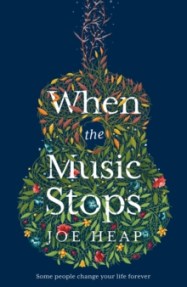
With its gorgeous cover, this is one of those occasions when I feel I’ve slightly missed out by opting for a digital version of a book.  So I may just have to treat myself and help out an independent bookshop through Lockdown 2.0 in the process…

In three words: Imaginative, insightful, heartfelt

Try something similar: Fred’s Funeral by Sandy Day

Follow this blog via Bloglovin


Joe Heap Author PicAbout the Author

Joe Heap was born in 1986 and grew up in Bradford, the son of two teachers. His debut novel, The Rules of Seeing, won Best Debut at the Romantic Novel of the Year Awards in 2019 and was shortlisted for the Books Are My Bag Reader Awards. Joe lives in London with his girlfriend, their two sons and a cat who wishes they would get out of the house more often.

Connect with Joe
Twitter