Blog Tour & Guest Post: The Body in the Ice by A.J. MacKenzie

I’m delighted to be hosting today’s stop on the blog tour for The Body in Ice by A. J. MacKenzie, a historical mystery set on Romney Marsh, Kent.   You’re in for a real treat because I have a guest post by the authors entitled ‘Secrets of Romney Marsh’.   If any of you have visited Romney Marsh, you’ll know what a spooky place it can be!

Follow my blog with Bloglovin


TheBodyInTheIce2About the Book

Christmas Day, Kent, 1796. On the frozen fields of Romney Marsh stands New Hall; silent, lifeless, deserted. In its grounds lies an unexpected Christmas offering: a corpse, frozen into the ice of a horse pond. It falls to the Reverend Hardcastle, justice of the peace at St Mary in the Marsh, to investigate. But with the victim’s identity unknown, no murder weapon and no known motive, it seems like an impossible task. Working along with his trusted friend, Amelia Chaytor, and new arrival Captain Edward Austen, Hardcastle soon discovers there is more to the mystery than there first appeared.  With the arrival of an American family torn apart by war and desperate to reclaim their ancestral home, a French spy returning to the scene of his crimes, ancient loyalties and new vengeance combine to make Hardcastle and Mrs Chaytor’s attempts to discover the secret of New Hall all the more dangerous. The Body in the Ice, with its unique cast of characters, captivating amateur sleuths and a bitter family feud at its heart, is a twisting tale that vividly brings to life eighteenth-century Kent and draws readers into its pages.

Book Facts

  • Format: Hardcover
  • Publisher: Bonnier Zaffre
  • No. of pages: 368
  • Publication date: 20th April 2017
  • Genre: Historical Fiction, Mystery

To purchase The Body in the Ice from Amazon.co.uk, click here (link provided for convenience, not as part of any affiliate programme)


Guest Post: ‘Secrets of Romney Marsh’

The landscape of Romney Marsh hasn’t changed that much over the years. There are more trees now, and fewer people. The ground is dryer, thanks to better drainage after the Royal Military Canal was built two centuries ago, and many fields are now ploughed. Of course you have to shut your eyes to the power station at Dungeness and the wind farm on the Guldford Levels. But apart from that, you can still stand and let the wind rush around you and listen to the murmur of the sea, just as Reverend Hardcastle and Mrs Chaytor did long ago. Many of the roads are now paved, but are still very narrow and bounded by drainage ditches and need to be negotiated with care. Bicycles are now more of a hazard than the wagons that slowed Mrs Chaytor down in The Body on the Doorstep.

One of the finest features of Romney Marsh are its churches. Built in the Middle Ages, when the Marsh grew rich and populous on the back of the wool trade, they range from intimate little buildings, barely larger than chapels, like St Clement’s at Old Romney or lonely St Thomas a Becket at Fairfield, to magnificent buildings rising like lighthouses above the flat lands. All Saints at Lydd at St Nicholas at New Romney are true landmarks, their tall towers visible for miles across the Marsh. So too is the smaller church at St Mary in the Marsh. One can imagine mariners at sea taking bearings on it and using it as a landmark.

More secretive and hard to find are the ruins of other churches, crumbling back into the ground. These churches were abandoned after the communities around them were laid waste by the Black Death and malaria, or ‘marsh fever’. Hope was one such village; the church of All Saints there is now no more than a few fragments of stone. (In The Body in the Ice, set two hundred years ago, we have given the ruined church rather more substantial walls.) Blackmanstone is a single fragment of wall, overgrown among the trees. If you stop on the roadside and look hard enough, you will eventually spot the few remaining stones of the church at Midley, next to a working farm.

Remants of Roman occupation of the area can also be glimpsed. All Saints Lydd has one wall surviving from an earlier Roman building. The settlement at Portus Lemanis looks over the marsh low on the hill at Lympne. Glimpses of re-used Roman carving and sculpture can be found in the corners of the Marsh’s churches.

Some secrets of the Marsh are now a matter for public pride. Go into a pub anywhere on the Marsh and the chances are it will boast a smuggling connection. In many cases – the Woolpack near Fairfield, the Ship in New Romney, the Star in St Mary in the Marsh – this is verifiably true. But two hundred years ago no one would have talked openly about smuggling in public; not with Customs snitches lurking and listening. Smuggling was an offence punishable by death. The smugglers and their families kept their mouths closed, and watched every stranger with suspicion.

One of the best kept secrets of the Marsh is also the most ghoulish. Hidden away below the chancel of St Leonard’s church in Hythe is an ossuary. One of only two in the country, the ossuary is a bone store, believed to have been created in the Middle Ages when bodies had to be removed from graves to make way for new burials. There are about 2,000 skulls in the ossuary, neatly arranged on wooden shelves, and around 8,000 other assorted bones.

Today the Marsh is green and peaceful, quiet and off the beaten track. Its landscape has been forged by men (and sheep) over many centuries. Its churches and its ruins hold many secrets; and some have yet to be discovered.

TheBodyintheIceMap


AJMackenzieAbout the Authors

A.J. MacKenzie is the pseudonym of Marilyn Livingstone and Morgen Witzel, a collaborative Anglo-Canadian husband-and-wife duo. Between them they have written more than twenty non-fiction and academic titles, with specialisms including management, medieval economic history and medieval warfare.  The original idea for The Body…series came when the authors were living in Kent, when they often went down to Romney Marsh to enjoy the unique landscape and the beautiful old churches. The authors now live in Devon.

Connect with the authors

Twitter  https://twitter.com/AJMacKnovels
Website http://www.ajmackenzienovels.com/
Facebook https://www.facebook.com/AJMacKenzienovels/
Pinterest https://uk.pinterest.com/bonnierzaffre/the-body-on-the-doorstep/?etslf=7279&eq=body%20on%20the%20

Follow the tour
TheBodyInTheIceTour

Blog Tour/Giveaway: Across Great Divides by Monique Roy

AcrossGreatDividesTourBanner

I am delighted to be today’s host on the blog tour of Across Great Divides by Monique Roy and to bring you my review of this powerful story of one family’s struggle for a place to call home.

Two lucky people will receive a digital copy of Across Great Divides, courtesy of the author.  To be in with a chance of winning, click on this link to enter the giveaway… http://www.rafflecopter.com/rafl/display/bf633057115/?

DividesAbout the Book

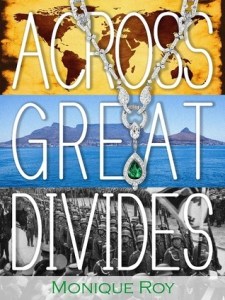
Across Great Divides is a timeless World War II story of the upheavals of war, the power of family and the resiliency of human spirit. When Hitler comes to power in 1933, one Jewish family refuses to be destroyed and defies the Nazis only to come up against another struggle—confronting Apartheid in South Africa.

As Jews, life becomes increasingly difficult for identical twin sisters Eva and Inge under the oppressive and anti-Semitic laws of Nazi Germany. After witnessing the horrors of Kristallnacht, they flee their beloved homeland, finally finding a new home for themselves in the beautiful country of South Africa; however, just as things begin to feel safe, their new home becomes caught up in its own battles of bigotry and hate under the National Party’s demand for apartheid. Will Eva and Inge ever be allowed to live in peace? Across Great Divides is a tale of one family’s struggle to survive in a world tainted with hate, and the power of love that held them all together.

Purchase links*
US Amazon
UK Amazon
Kobo
Ibookstore
Barnes and Noble

*links provided for convenience, not as part of any affiliate programme


My Review (3.5 out of 5)

As the book opens, the author depicts how life gets increasingly difficult for the family with the rise of Hitler. There are detailed descriptions of events in Berlin such as the book-burning and violence of Kristallnacht. I did feel that one or two sections read more like straight history rather than being illustrated through the experiences of Eva or her family.  The author has clearly undertaken extensive research because as well as a wealth of information about events in Germany there are fascinating details about the diamond cutting and trading business.

Eva and her brother, Max, get the most page time with other members of the family, including Eva’s twin, Inge, more in the background. The unique connection between the twins is explored early on and returned to briefly later but it would have been interesting to have more focus on this.

The family’s struggle to escape from Nazi Germany illustrates the bravery and resourcefulness of those in real life who aided Jews to escape death in the concentration camps but also the opportunity for corruption for those prepared to take advantage of the situation. The family have a number of lucky escapes and are fortunate to have a seemingly unlimited stock of diamonds to ease their passage. One wonders how those without such resources would have fared.

Although powerfully told, I found some of the story lines a little too convenient and there are a couple of coincidences that seem a little far-fetched – along the lines of “of all the gin joints in all the towns in all the world, she walks into mine” (Casablanca) or, in this case, tent.  However, I really liked the impression the author created of the family’s sense of uprootedness, of feeling no longer welcome somewhere they had considered home and being viewed as a hated “other”.

‘Our home was everything and then we felt like we existed nowhere.  The place where I thought I would live all my life was no longer the place where I could exist at all.’

In the latter section of the book, the author juxtaposes the persecution suffered by Jewish families at the hands of the Nazis with the discrimination meted out to black South Africans through the apartheid system. Of the family, only Max and Eva really seem to see the parallels and some of the responses of other family members are surprising given their own experiences.  The author’s love of South Africa is clear from the wonderful descriptions of the landscape and scenery of Cape Town.

I did enjoy the book and admire the author for attempting to explore some weighty themes.

I received an advance reader copy courtesy of Neverland Book Tours and the author in return for an honest review.

Follow my blog with Bloglovin


MoniqueRoyAbout the Author

Monique was born in Cape Town, South Africa, and her grandparents were European Jews who fled their home as Hitler rose to power. It’s their story that inspired her to write Across Great Divides. She is also the author of a middle-grade book, Once Upon a Time in Venice, and Monique is working on her third novel, which also takes place during the World War II.

Connect with Monique
Website http://www.monique-roy.com/
Twitter https://twitter.com/MonWriter1
Facebook https://www.facebook.com/AcrossGreatDivides/
Goodreads https://www.goodreads.com/Monique_Roy

Follow the Tour
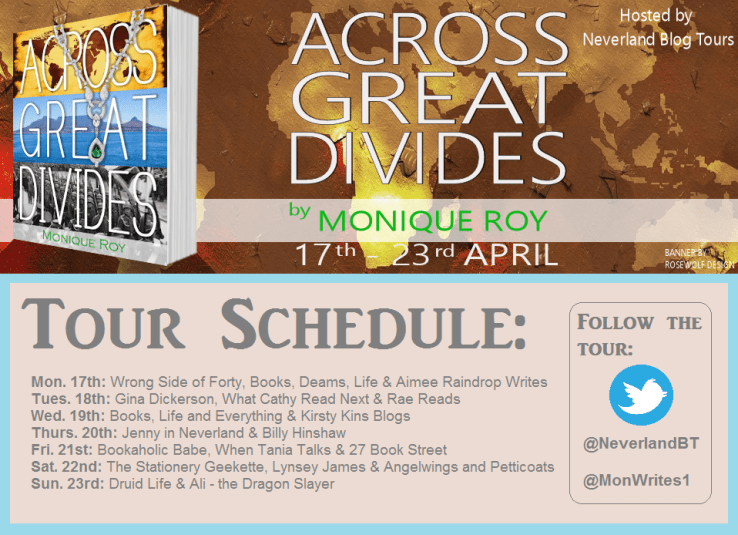
AcrossGreatDividesTourSchedule