
I’m thrilled to co-host today’s stop on the blog tour for the Crime Writers’ Association latest anthology of short stories, subtitled ‘Mystery Tour’. If you love crime and good writing, then be sure to snap this one up when it’s published on 15th November 2017. It would also make a superb Christmas present for any lover of crime fiction.
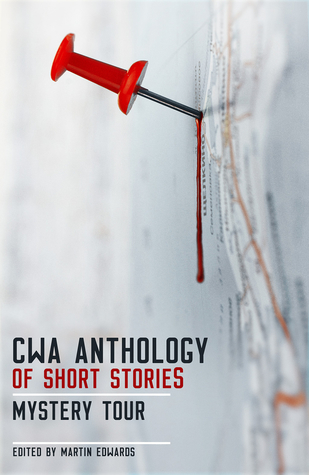 About the Book
Crime spreads across the globe in this new collection of short stories from the Crime Writers’ Association, as a conspiracy of prominent crime authors take you on a world mystery tour. Highlights of the trip include a treacherous cruise to French Polynesia, a horrifying trek in South Africa, a murderous train-ride across Ukraine and a vengeful killing in Mumbai. But back home in the UK, life isn’t so easy either. Dead bodies turn up on the backstreets of Glasgow, crime writers turn words into deeds at literary events, and Lady Luck seems to guide the fate of a Twickenham hood. Showcasing the range, breadth and vitality of the contemporary crime-fiction genre, these twenty-eight chilling and unputdownable stories will take you on a trip you’ll never forget.
Format: eBook, paperback (276 pp.) Publisher: Orenda Books
Published: 15th November 2017 Genre: Crime, Short Stories
Purchase Links*
Amazon.co.uk ǀ Amazon.com
*links provided for convenience, not as part of any affiliate programme
Find CWA Anthology of Short Stories: Mystery Tour on Goodreads
My Review
The stories in this collection are an object lesson in conciseness. Each of the contributors possesses the ability to create an atmosphere of tension, intrigue and suspense from the off, propelling the reader straight into the story and then delivering a satisfyingly punchy conclusion. There are tales motivated by revenge, envy, greed, lust, to punish sins or a desire for freedom. But, as is so often the case, best laid plans are thwarted and events take an unexpected turn.
Because of the high standard of all the stories in the collection, it’s really difficult to single out specific ones and it’s also tough to summarise any of them without giving away the plots. However, I particularly liked the dark, self-deprecating humour of Ann Cleeve’s ‘The Queen of Mystery’ and Judith Cutler’s ‘Mystery Tour’, which both feature authors as their protagonists, and the inventiveness of Christine Poulson’s ‘Accounting for Murder’.
The CWA Anthology is like a plate of exquisitely crafted truffles begging to be tasted: some dark, some with exotic flavours, some lighter but disguising unexpected centres. Now, I don’t mean to alarm you, but have you noticed that, of the two of us, you’re the only one who’s eaten them?
I received an advance reader copy courtesy of publishers, Orenda Books, in return for an honest and unbiased review.
In three words: Sharp, dark, accomplished
Try something similar…CWA Anthology of Short Stories: Truly Criminal ed. by Martin Edwards
About the Authors
Martin Edwards has published eighteen novels, including the Lake District Mysteries. The Golden Age of Murder won the Edgar, Agatha, H.R.F. Keating, and Macavity awards. He has edited thirty-five crime anthologies and has won the CWA Short Story Dagger, the CWA Margery Allingham Prize and the Poirot award. He is president of the Detection Club and current chair of the CWA.
Martine Bailey writes about food and mystery and was credited by Fay Weldon as inventing a new genre, the ‘culinary gothic’. Her debut in the genre was An Appetite for Violets, and while living in New Zealand she wrote The Penny Heart (retitled A Taste for Nightshade in the US). Martine is an award-winning amateur cook and now lives in Cheshire.
Gordon Brown lives in Scotland but splits his time between the UK and Spain. He’s married with two children and has been writing since his teens. So far he has had five books published – his latest, Darkest Thoughts, being the first in the Craig McIntyre series. Gordon also helped found Bloody Scotland – Scotland’s International Crime Writing Festival.
Paul Charles was born and raised in the Northern Irish countryside. He is the author of the Detective Inspector Christy Kennedy series, set in Camden Town, and the Inspector Starrett series, which is set in Donegal in Ireland. The short mystery in this collection features retired PSNI Detective McCusker fro Down on Cyprus Avenue. Paul is currently working on a second McCusker novel.
Ann Cleeves began her crime-writing career with a series featuring George and Molly Palmer-Jones, and followed it with books about a cop from the North-East, Inspector Ramsay. More recently she was won international acclaim for two further series, featuring Vera Stanhope and Jimmy Perez, respectively, which have been successfully adapted for television as Vera and Shetland. Raven Black won the CWA Gold Dagger, and in 2017 Ann was awarded the CWA Diamond Dagger.
Julia Crouch has been a theatre director, playwright, drama teacher, publicist, graphic/website designer and illustrator. It was while she was doing an MA in sequential illustration that she realised what she really loved was writing. Her debut novel, Cuckoo, was followed by Every Vow You Break, Tarnished, The Long Fall and Her Husband’s Lover.
Judith Cutler has produced no fewer than five series of crime novels and more than thirty books in all. Her first regular detective was Sophie Rivers, and since then she has featured Fran Harman, Josie Welford, Tobias Campion and Lina Townend. She has also published stand-alone novels, and is a former secretary of the CWA.
Carol Anne Davis is the author of seven novels and eight true-crime books, the latest of which is Masking Evil: When Good Men and Women Turn Criminal. She is currently one of the judges for the CWA’s Gold Dagger for Non-Fiction, and when she’s not reading or writing she loves to dance. Unfortunately she’s dyspraxic so can’t tell her left foot from her right and has been in the beginner’s flamenco class for the past five years.
Kate Ellis worked in teaching, marketing and accountancy before finding success as a writer. The latest title in her series featuring Wesley Peterson is The Mermaid’s Scream, while she has published a series about another cop, Joe Plantagenet, and two historical crime novels, including A High Mortality of Doves.
Paul Gitsham started his career as a biologist, before deciding to retrain and impart his love of science and sloppy lab skills to the next generation of enquiring minds as a school teacher. Paul lives in a flat with more books than shelf space, where he writes the DCI Warren Jones series of police procedurals and spends more time than he should on social media.
JM (Jeanette) Hewitt is a crime-fiction writer living on the Suffolk coast. She is the author of Exclusion Zone, The Hunger Within and The Eight Year Lie. Her short story ‘Fingers’ was published in Twisted50, a horror anthology, and she was the winner of the BritCrime Pitch Competition in 2015, a success that led to the publication of Exclusion Zone.
Susi Holliday grew up in Scotland and now lives in London. She was shortlisted for the CWA Margery Allingham Prize with her short story ‘Home From Home’. She has published three crime novels set in the fictional Scottish town of Banktoun, and her latest novel is a Christmas themed serial killer thriller, The Deaths of December.
Maxim Jakubowski is a crime, erotic, science-fiction and rock-music writer and critic. He is also a leading anthologist. Born in England to Russian-British and Polish parents, he was raised in France and ran the Murder One bookshop for many years. He is the current chair of judges for the CWA Debut John Creasy Dagger, and also serves as joint vice chair of the CWA. He is a frequent commentator on radio and television.
Ed James writes crime-fiction novels, predominantly the Scott Cullen series of police procedurals set in Edinburgh and the surrounding Lothians. He is currently developing two new series set in London and Dundee, respectively. He also writes the Supernature series, featuring vampires and other folkloric creatures.
Ragnar Jonasson was born in Reykjavik, where he still lives, and is a lawyer. He teaches copyright law at Reykjavik University and has previously worked on radio and television, including as a TV news reporter for the Icelandic National Broadcasting Service. His novels include the Dark Iceland series.
Vaseem Khan is the author of the Baby Ganesh Detective Agency novels, a series of crime novels set in India. The books feature retired Mumbai police inspector Ashwin Chopra and his sidekick, a baby elephant named Ganesha. Vaseem says that elephants are third on his list of passions, first and second being great literature and cricket, not always in that order. He plays cricket all summer, attempting to bat as an opener, while fielding as little as possible.
Peter Lovesay’s short stories have won a number of international awards, including the Veuve Clicquot Prize, the Ellery Queen Reader’s Award and the CWA Short Story Dagger. When the Mystery Writers of America ran a competition to mark their fiftieth year, The Pushover was the winner. Peter is a recipient of the CWA Diamond Dagger (among many other honours) and also a former chair of the CWA.
Anna Mazzola writes historical crime fiction. She studied English at Pembroke College, Oxford, before becoming a criminal justice solicitor. Her debut novel was The Unseeing, and her second, about a collector of folklore on the Isle of Skye will be published in Spring 2018. She lives in Camberwell, London, with two small children, two cats and one husband.
William Burton McCormick’s fiction appears regularly in American mystery magazines. A Nevada native, William earned his MA in novel writing from Manchester University, was elected a Hawthornden Fellow in Scotland and has lived in Russia, Ukraine and Latvia. His novel Lenin’s Harem was the first fictional work added to the Latvian War Museum’s library in Riga.
Before Christine Poulson turned to crime, she was a responsible academic with a PhD in the history of art. Cambridge provided the setting for her first three novels, Dead Letters, Stage Fright and Footfall, which were followed by a stand-alone suspense novel, Invisible. The first in a new series, Deep Water, appeared in 2016. Her short stories have been short-listed for a Derringer and for the CWA Margery Allingham Prize
Sarah Rayne is the author of a number of acclaimed psychological thrillers, and ghost-themed books. Much of the inspiration for her settings comes from the histories and atmospheres of old buildings, a fact that is strongly apparent in many of her books. She recently launched a new series, featuring the music historian and researcher Phineas Fox.
Kate Rhodes went to the University of Essex and completed a doctorate on the playwright Tennessee Williams. She has taught at universities in Britain and the United States, and now writes full time. Her first books were two collections of poetry, and her novels Crossbones Yard and A Killing of Angels are both set in London, her birthplace. She lives in Cambridge.
William Ryan is an Irish writer, living in London. He was called to the English Bar after university in Dublin, and then worked as a lawyer in the City. He now teaches crime writing at City University. His first novel, The Holy Thief, was shortlisted for four awards, including a CWA New Blood Dagger. His latest book is The Constant Soldier.
Shawn Reilly Simmons lives in Frederick, Maryland, and has worked as a bookstore manager, fiction editor, convention organiser and wine rep. Currently she serves on the Board of Malice Domestic, is a member of the Dames of Detection, and an editor and co-publisher at Level Best Books. Her Red Carpet Catering Mysteries feature Penelope Sutherland, an on-set movie caterer. She has also published several short crime stories, and co-edited crime anthologies.
Chris Simms graduated from Newcastle University then travelled round the world before moving to Manchester in 1994. Since then he has worked as a freelance copywriter for advertising agencies throughout the city. The idea for his first novel, Outside The White Lines, came to him one night when broken down on the hard shoulder of a motorway. More recently he has written a series featuring DC Iona King.
Cath Staincliffe is an award-winning novelist, radio playwright and creator of ITV’s hit series Blue Murder. She was joint winner, with Margaret Murphy, of the CWA Short Story Dagger in 2012. She also writes the Scott & Bailey books, based on the popular ITV series. She lives with her family in Manchester.
Michael Stanley is the writing team of Michael Sears and Stanley Trollip. Both born in South Africa and have worked in academia and business. Their first mystery, A Carrion Death, introduced Detective Kubu Bengu of the Botswana Criminal Investigation Department, and was a finalist for five awards, including the CWA Debut Dagger. Their third book, Death of the Mantis, won the Barry Award and was a finalist for an Edgar Award.
CL Taylor was born in Worcester, studied psychology in Newcastle and has had a variety of jobs, including fruit picker, waitress, postwoman, receptionist, shipping co-ordinator, graphic designer and web developer. Her debut novel was Heaven Can Wait and in 2011 she won the RNA Elizabeth Goudge Trophy. More recently she has enjoyed success with psychological thrillers such as The Missing and The Escape.
Connect with The Crime Writers’ Association

 About the Book
 About the Author

