Blog Tour/Q&A: The Tide Between Us by Olive Collins

The Tide Between Us Blog Tour Banner

I’m delighted to be taking part in the blog tour for The Tide Between Us by Olive Collins and to welcome Olive to What Cathy Read Next.   Below you can find a fascinating interview in which Olive talks about the inspiration for The Tide Between Us, the historical background to the events in the book and her view that we must examine the past in order to fully understand the present.

Be sure to check out the other bloggers taking part in the tour.

I’d like to thank Olive for providing me with a review copy of The Tide Between Us. I can’t wait for it to reach the top of my review pile. If you’re less patient than me, follow the purchase links below.

Follow my blog with Bloglovin


The Tide Between UsAbout the Book

1821: After the landlord of Lugdale Estate in Kerry is assassinated, young Art O’Neill’s innocent father is hanged and Art is deported to the cane fields of Jamaica as an indentured servant. He gradually acclimatises to the exotic country and unfamiliar customs of the African slaves and achieves a kind of contentment. Then the new heirs to the plantation arrive. His new owner is Colonel Stratford-Rice from Lugdale Estate, the man who hanged his father. Art must overcome his hatred to survive the harsh life of a slave and live to see the eventual emancipation of his coloured children. Eventually he is promised seven gold coins when he finishes his service.

One hundred years later in Ireland, a skeleton is discovered beneath a fallen tree on the grounds of Lugdale Estate. By its side is a gold coin minted in 1870. Yseult, the owner of the estate, watches as events unfold, fearful of the long-buried truths that may emerge about her family’s past and its links to the slave trade. As the body gives up its secrets, Yseult realises she too can no longer hide.

Format: eBook, Paperback (400 pp.) Publisher: Poolbeg Press
Published: 7th September 2017           Genre: Historical Fiction

Purchase Links*
Amazon.co.uk ǀ Barnes & Noble
*links provided for convenience, not as part of any affiliate programme


Find The Tide Between Us on Goodreads


Interview with Olive Collins, author of The Tide Between Us

Without giving too much away, can you tell me a bit about The Tide Between Us?

My novel is based between Jamaica and Ireland (1821 – 1991). It follows the story of Art O’Neill, an Irish boy deported to Jamaica at 10 years of age. He takes us through the decades of his life and the coarseness of Jamaica, a country that eventually allows him to progress from servant to overseer, to landowner. We see him become a father and watch as slave emancipation unfolds liberating his coloured children. His greatest battle is fought quietly as he struggles with his abhorrence at his Anglo-Jamaica oppressors, a mutual loathing that passes from father to son. Eventually Art is promised seven gold coins when he finishes his service, although he doubts the plantation owner will part with the coins. Part 1 ends in 1891 with Art going to the Big House to claim his gratuity.

Part 2 is based in Ireland (1921 – 1991). It opens with the discovery of a skeleton beneath a tree on the grounds of Lugdale Estate with a gold coin minted in 1870. Yseult, the owner of Ludgale Estate, watches events unfold fearful of the rumours that abound about her father’s beginnings in Jamaica, a county with 25% of the population claiming Irish descent.

What was the inspiration for the book?

In the 1990’s I met a man at a St. Patrick’s Day party in Israel. He was from Jamaica yet identified his heritage as Irish. He told me that vast numbers of Jamaicans were of Irish descent. At the time I didn’t believe him and only when Google became available did I research his story. I found so many accounts of exiled Irish to Jamaica, I was enthralled. One particular story about 2,000 exiled children tugged at me. My inspiration is those who survived and passed their stories onto the following generations; those who survived adversity to find their own sense of freedom.

How did you approach the research for the book? Do you enjoy the process of research?

I knew very little about the Caribbean so I had to start from scratch. Unlike a lot of colonies, there was little that survived on Jamaica. I used academic papers, memoirs, history books and some diaries from the southern American states to establish the role of an overseer and the attitudes of the time towards slavery. There was one valuable diary from Thomas Thistlewood, an English overseer and planter in Jamaica.

Only when my main character, Art O’Neill, began his journey did I begin to enjoy the research. Reading about the unnecessary cruelty and what the slaves and indentured servants endured was difficult yet it helped me establish how the slaves and servants were viewed. I became very involved in the characters. Writing about slave emancipation was wonderful; the great strides the ex-slaves made to ensure their days of whippings were finally over.

The Tide Between Us tells the story of a young Irish man deported to Jamaica as an indentured servant. Do you feel this is an aspect of Irish history that has been overlooked?

Yes, I think it’s overlooked. Most people who’ve read my novel never knew about the exiled Irish or how the masses of Irish left as indentured servants during the 18th century and until the mid-19th century. When I looked at the map of Jamaica and saw the amount of Irish place-names I was even more surprised that so many are not aware of our exiled history.

What was the most surprising fact you uncovered during your research?

The amount of Irish who emigrated to Jamaica. Initially I thought the number was much smaller. We don’t have accurate numbers; suffice to say, 25% of Jamaican’s claim Irish ancestry. I was equally surprised to see that some Irish owned slaves and could be as cruel as any other slave-owner.

Your previous novel, The Memory of Music, is partly set in Ireland during the Easter Rising of 1916. What is it you enjoy about writing historical fiction?

I write historical fiction because I’m curious about the unknown. The present is familiar to me whereas the atmosphere of times long gone is mysterious. Sometimes I simply want to explore how people survived. The novels and location interest me; if nothing else, it sates my curiosity. When I read certain histories, so much is explained about a nation’s outlook. To understand the present, we need to examine the past.

Both The Memory of Music and The Tide Between Us have dual time narratives. What is it that attracts you to this structure for your novels?

It’s the continuation that interests me. I like to explore how the following generation is impacted by the previous generation. Naturally as time passes we become more civilised and tolerant, yet each of us inhabit our own smaller histories, the little nuggets we pass onto the following generations. I’m interested in how families and we as individuals evolve and how much of the deep, dark past we pull into the present and pass on again and again.

Do you have a special place to write or any writing rituals?

I don’t have a special place, although I like to write at night. Most of the time I sit by a window with a lamp and the flickering lights from houses and cars in the distance. Writing at night removes layers and brings me closer to those I want to reach. There is a sense that it’s only me and them (my beloved characters) and the time they inhabit.

Which other writers do you admire?

I like Elizabeth Strout for her solid characters, Isabelle Allende for her sweeping sagas, and Chimamanda Ngozi Adichie for her prose bubbling on each page.

What are you working on next?

I’m researching the American Wild West and the pioneers who ventured into the prairies. A few years ago I visited Oregon. At one point I went for a drive into the desert and saw the remains of the Oregon Trail. Although it had been 130 years since the last pioneers used the same trail, the route they travelled was still evident in the desert. I remember looking across the arid landscape and further to the distant mountains. I’ve often thought of the trail I saw and thought about the men and women who packed up everything and chased a dream.

Thank you, Olive, for the fascinating answers. I’m sure we all hope those nights spent connecting with the characters of your next book will prove fruitful.


Olive CollinsAbout the Author

Olive Collins grew up in Thurles, Tipperary, and now lives in Kildare. For the last fifteen years, she has worked in advertising in print media and radio. She has always loved the diversity of books and people. She has travelled extensively and still enjoys exploring other cultures and countries. Her inspiration is the ordinary everyday people who feed her little snippets of their lives. It’s the unsaid and gaps in conversation that she finds most valuable.

Connect with Olive

Facebook ǀ Twitter ǀ Goodreads


Book Review: A Pearl for my Mistress by Annabel Fielding

I’m delighted to be taking part in the blog tour for A Pearl for my Mistress by Annabel Fielding and to share my review of this compelling historical novel set in the turbulent years of the 1930s.
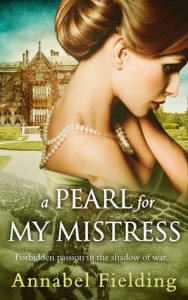
APearlForMyMistressAbout the Book

England, 1934. Hester Blake, an ambitious girl from an industrial Northern town, finds a job as a lady’s maid in a small aristocratic household. Despite their impressive title and glorious past, the Fitzmartins are crumbling under the pressures of the new century. And in the cold isolation of these new surroundings, Hester ends up hopelessly besotted with her young mistress, Lady Lucy. Accompanying Lucy on her London Season, Hester is plunged into a heady and decadent world. But hushed whispers of another war swirl beneath the capital… and soon, Hester finds herself the keeper of some of society’s most dangerous secrets…

Format: eBook (384 pp.)                 Publisher: HQ Digital
Published: 9th August 2017            Genre: Historical Fiction

Purchase Links*
Amazon.co.uk ǀ Amazon.com
*links provided for convenience, not as part of any affiliate programme

Find A Pearl for my Mistress on Goodreads


My Review

A Pearl for my Mistress is the story of the intense relationship between two women from very different social backgrounds – Lady Lucy Fitzmartin and Hester Blake, her lady’s maid. However, the book also immerses the reader in the turbulent political situation of the 1930s, with the rise of pro-Fascist organisations like that led by Sir Oswald Mosley and other pro-German movements.

Lady Lucy’s life is one of relative privilege but constrained by the social norms of the day and the limitations on her freedom imposed by her parents. She desperately wants to break free of these confines, exert her independence and make a name for herself. Misguided sympathy for the aims of Mosley’s movement and her talent for writing, provide her with the possibility of achieving her ambitions. Lucy has also become adept at listening from the shadows, picking up nuggets of conversation and information. As the story unfolds, the reader sees that her desperation for freedom makes her ripe for manipulation by others who have few qualms about how to achieve their aims. Having started down a path, Lucy finds herself having to face hard and unwelcome moral choices. Indeed, one of the many interesting themes the book explores is what people will do and who and what they will betray in order to protect themselves.

Although Hester does not share her mistress’s political views, her loyalty and love for Lady Lucy find her conflicted, especially when events threaten to come close to home. Having been central to the book initially as her relationship with Lady Lucy develops, Hester does recede into the background in the latter part of the book.

A theme of the book I found really interesting was its exploration of the power of words to inspire, persuade and, yes, even manipulate.

Words had colours, even textures, and she could faintly sense it, rolling them around in her thoughts. Some words were soft and languid, like silk. Some clinked, like iron. Some were fresh and crisp, like green apples. It was a trick of which words to use to invoke, for example, elegance and dream, or fire and iron.’

In fact, stories and writing play an important part in the development of the relationship between Lucy and Hester. Having had to keep her writing secret, Lucy finally has someone she can share it with. Lucy’s stories are her gift to Hester and Hester’s appreciation of them is her gift to Lucy.

‘The tale caught her in its grip, like a pot of honey could catch a careless fly. The longer she read, the more she was beguiled by the sweetness of the passages, the lushness of the sentences, the tribulations of the plot. It was as if the mere lines in front of her eyes, black ink on white paper, were transfiguring into something else.’

Later, Lucy’s writing ability becomes a possible route to independence for her but also a valuable asset for those seeking to advance the aims of the National Socialist government in Germany. So, she learns, is her position in society and her ear for gossip and information. The cold, hard truth of the art (science?) of manipulating people in positions of influence is revealed.

“‘What can we give him that he craves? A sense of belonging? A sense of rebellion? A sense of doing justice? A dream of glory? A dream of peace? Protection of his commercial interests on the Continent? It’s important to unearth these needs, these reasons. Then you can do anything.”

The author creates a really believable picture of the period which is clearly based on considerable research. There are walk-on parts for many of the key personalities of the period: politicians, the nobility, society hostesses and diplomats. I found the political machinations behind the scenes and some of the views expressed by those in the pro-Fascist movements positively chilling and, at times, worryingly reminiscent of contemporary debates around discrimination, migration and ‘fake news’.

I really enjoyed A Pearl for my Mistress and thought it a compelling and accomplished debut by a clearly talented author.  I received a review copy courtesy of the author and publishers, HQ Digital, in return for an honest and unbiased review.

Follow my blog with Bloglovin

In three words: Compelling, intimate, well-researched

Try something similar…Fingersmith by Sarah Waters


AnnabelFieldingAbout the Author

Annabel Fielding describes herself as ‘a novelist, a history geek and an international woman of mystery’. She has long since pledged her allegiance to travel, tea and books. A Pearl for my Mistress is her debut novel.

Connect with Annabel

Website ǀ Facebook ǀ Twitter ǀ Goodreads