
I’m delighted to be hosting today’s stop on the blog tour for The Concubine’s Child by Carol Jones. Described as perfect for fans of Amy Tan, Dinah Jefferies, Julia Gregson or Kate Morton, The Concubine’s Child is an evocative, multi-generational tale of a family haunted by the death of a young concubine in 1930s Malaysia.
And if that description doesn’t already have you with your finger hovering over the ‘Buy’ button, I have a fantastic guest post from Carol about how her first trip to Malaysia provided the inspiration for the setting of her novel. Oh, and her experiences with naughty macaques.
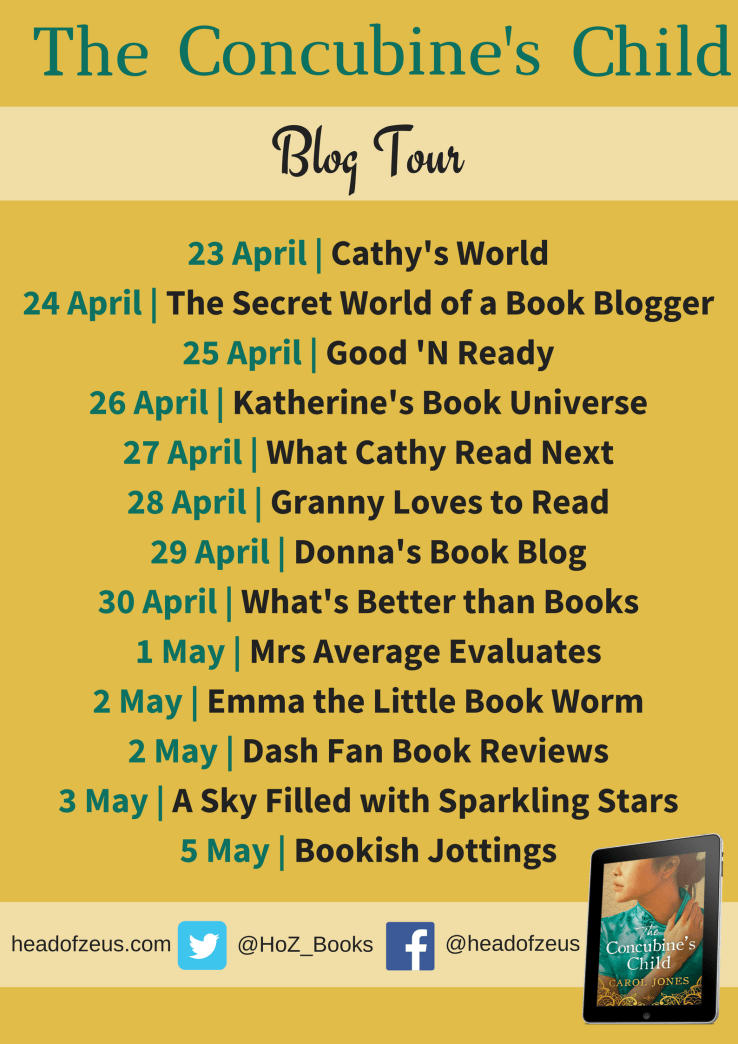
Do check out the tour schedule at the bottom of this post to see the other great book bloggers taking part in the tour. Visit them for reviews, interviews and book extracts.
 About the Book
In 1930s Malaya a sixteen-year-old girl, dreaming of marriage to her sweetheart, is sold as a concubine to a rich old man desperate for an heir. Trapped, and bullied by his spiteful wife, Yu Lan plans to escape with her baby son, despite knowing that they will pursue her to the ends of the earth.
Four generations later, her great-grandson, Nick, will return to Malaysia, looking for the truth behind the facade of a house cursed by the unhappy past. Nothing can prepare him for what he will find.
This exquisitely rich novel brings to life a vanished world – a world of abandoned ghost houses, inquisitive monkeys, smoky temples and a panoply of gods and demons. A world where a poor girl can be sold to fulfil a rich man’s dream. But though he can buy her body, he can never capture her soul, nor quench her spirit.
Format: ebook, hardcover (384 pp.) Publisher: Head of Zeus
Published: 1st April 2018 (ebook), 1st June (hardcover) Genre: Historical Fiction
Pre-order/Purchase Links*
Amazon.co.uk ǀ Amazon.com ǀ Kobo | Google Play | iBooks | Hive.co.uk (supporting UK bookshops)
*links provided for convenience, not as part of any affiliate programme
Find The Concubine’s Child on Goodreads
Guest Post: ‘Gods, Ghosts and Monkeys in Old Kuala Lumpur’ by Carol Jones
I first visited Malaysia, the setting for The Concubine’s Child, on my honeymoon in 1991. It was my first trip to Asia, and the first time I stepped inside a Chinese temple, or witnessed people making offerings to the gods. Hailing from Queensland originally, the tropical weather was nothing new to me but I was accustomed to backyard wildlife such as possums, lorikeets or the occasional duck in the swimming pool, not monkeys sitting on walls watching me hang out the washing.
Everything about that first visit to Kuala Lumpur was strange and exotic but having returned every year since to stay with my husband’s family, the exotic has become familiar. So much so that I have wanted to write a novel set there for some time, saving up impressions and experiences, collecting memoirs and historical references. But it was a chance remark that my mother-in-law didn’t attend school in the 1930s, instead learning to read and write (Chinese) at her local clan house, which gave me my beginning. The first chapter of The Concubine’s Child introduces Yu Lan, a sixteen year old girl whose father doesn’t think it worthwhile sending her to school but finally allows her to attend lessons at the Chan Clan house.
The Chan See Shue Yuen is a real place, the stunning hall and lineage temple of the Chan clan society in Kuala Lumpur. It has typical Chinese temple architecture and shines with brilliant turquoise tiles. It and many other temples and shop houses in the old Chinatown area were built in the mid- to late-nineteenth century. It is an area I love to return to for all its colour and history, and it is where the first few chapters of my novel are set.
It was a visit to another temple, this time in China, which inspired the antagonist in the novel. Madam Chan is the childless wife of the wealthy tin miner who buys Yu Lan from her apothecary father. She has a tricky relationship with the gods. She argues and blames them for her troubles, and she is based upon an elderly woman I witnessed tossing moon blocks at a temple in Quanzhou. Moon blocks are a divining tool and this woman wasn’t at all happy with the answers she was receiving. Hence she was complaining and arguing with the gods, who she expected to be far more obliging after all the offerings she had made.
On my earlier trips to Kuala Lumpur I noticed a nearby house had been empty and abandoned for years. It was a perfectly good house but was going to rack and ruin in the tropical climate. When I asked my sisters-in-law why it was empty, they replied nonchalantly that it was a ghost house. As if that were self-evident. I soon discovered that ghost houses are quite common in Malaysia, where people of many faiths believe in ghosts. In fact, when I began researching the phenomenon on the Internet I discovered dozens of websites devoted to the topic, and hundreds of photos of abandoned buildings and reputed ghost houses.
To this day it’s not unusual to read newspaper articles about schoolgirls becoming hysterical after seeing ghosts, or pawangs (traditional Malay healers and shamans) being called in to help bring rain, or find something that has been lost. The pawangs were called in to help locate missing flight MH370. They were far less expensive than the costly undersea exploration carried out by Australia. Of course, neither found very much. Nevertheless, in the 1930s, when much of my novel is set, pawangs reputedly helped miners locate tin, fishermen catch more fish, and they blessed just about anything.
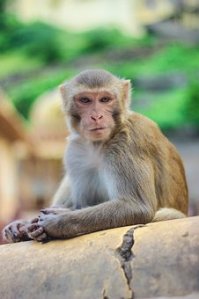 Monkeys feature several times in The Concubine’s Child, inspired in part by my encounters with macaques. The macaques near my in-law’s house live in a narrow strip of remnant jungle and roam backyards and local parks searching for food. They live in family groups, usually with at least one large male and several babies. Years ago, I was bailed up by a very large monkey while hanging out washing. He was hissing and snarling at me and his teeth didn’t look at all pleasant. My elderly father-in-law saved me by running out shouting and throwing slippers at it. On another occasion, I came downstairs to find a young macaque sitting on the family altar, snacking on the offerings to the gods. It had snuck in between the window bars.
Twenty-five years of impressions and experiences have gone into the writing of The Concubine’s Child, coupled with thousands of pages of research into the history and culture of the Chinese people in Malaysia, and not a little reminiscing from family.
© Carol Jones
 About the Author
Born in Brisbane, Australia, Carol Jones taught English and Drama at secondary schools before working as an editor of children’s magazines.
She is the author of several young adult novels as well as children’s non-fiction.
Connect with Carol

 About the Book
 About the Author


