#BlogTour #BookReview #Ad Animal Life by Auður Ava Ólafsdóttir, trans. by Brian FitzGibbon @PushkinPress

TWITTER BLOG TOURS (3)Welcome to the opening day of the blog tour for Animal Life by Auður Ava Ólafsdóttir, translated by Brian FitzGibbon. My thanks to Kate at Pushkin Press for inviting me to take part in the tour and for my digital review copy via NetGalley.


Animal LifeAbout the Book

With just over a week until Christmas, Dómhildur delivers her one thousandth, nine hundred and ninety second baby. Beginnings and endings are her family trade; she is a midwife descended from a long line of midwives on her mother’s side and a long line of undertakers on her father’s.

There’s a terrible storm heading towards Reykjavík, and Dómhildur is feeling unsettled. In her apartment, she stumbles across decades’ worth of letters and manuscripts hidden amongst the clutter that belonged to her grandaunt – a legendary midwife with a reputation for unconventional methods. At the darkest point of the year, when the sun barely lifts above the horizon, Dómhildur discovers strange and beautiful new meanings in her grandaunt’s writings.

For even in the depths of an Icelandic winter, new life will find a way.

Format: Paperback (192 pages)            Publisher: Pushkin Press
Publication date: 1st December 2022  Genre: Contemporary Fiction, Literature in Translation

Find Animal Life on Goodreads

Purchase links 
Bookshop.org 
Disclosure: If you buy a book via the above link, I may earn a commission from Bookshop.org, whose fees support independent bookshops

Hive | Amazon UK 
Links provided for convenience only, not as part of an affiliate programme


My Review

Animal Life is probably not a book for those who like a conventional plot-driven narrative. Much like the letters and manuscripts that Dómhildur inherits from her great aunt (referred to as her grandaunt) the book is a kind of literary scrapbook made up of random thoughts on a vast variety of subjects. It becomes clear that Dómhildur’s great aunt had an interest – some might consider to the point of obsessional – in many different subjects and in gathering information about topics ranging from the lifespan of an oak tree to the nature of black holes.  In letters exchanged with a pen pal over the course of forty years she also speculated on the fragility of human life and the nature of conicidence, including the coincidences necessary to bring about the birth of any child. 

Amongst the many, many themes explored in the book is inheritance. Not only has Dómhildur followed in the footsteps of her great aunt and other members of her family in becoming a midwife but she has also inherited her great aunt’s apartment complete with an array of mismatched and rather outdated furniture which, for a long time, she feels disinclined to change.

Another theme the book explores is light and darkness – in both an actual and metaphorical sense. For instance, the book is set during the darkest part of the year when in Iceland there are only a few hours of daylight. ‘I wake up on the shortest day of the year into the longest night of time. It will be a long time before the light dissolves the night and the world takes on a form.’ We also discover that darkness is something Dómhildur knows all about both in her personal and in her professional life.  On the other hand, the Icelandic word for midwife is ljósmóðir which literally translates as ‘mother of light’.

There’s also a strong theme of environmentalism running through the book. In this respect, Dómhildur’s great aunt was something of a pioneer writing of the deleterious impact of humans – ‘the most dangerous animal of them all’ – on the planet.

If this all sounds a little serious, there are moments of humour too. For example, the calls Dómhildur receives from her sister which invariably open with the questions ‘where are you and what are you doing’ and are always followed by a close interrogation of her answers. Light relief (see what I did there?) is also provided by the tourist who takes up temporary residence on the top floor of Dómhildur’s apartment building and has chosen a particularly inappropriate time to go sightseeing in Iceland, by the electrician who is afraid of the dark, and by Dómhildur’s unsuccessful stint as a tour guide.

At one point Dómhildur muses, ‘The more I try to piece the jigsaw of my grandaunt’s life together the more questions it raises’. The fluid, fragmentary structure of Animal Life means it won’t appeal to everyone but those who are attracted by a book which explores a range of topics will, I think, find it a thought-provoking read. 

In three words: Quirky, reflective, enigmatic


Audur Ava OlafsdottirAbout the Author

Auður Ava Ólafsdóttir is a prize-winning novelist, playwright and poet.

Auður Ava’s novels have been translated into over 25 languages, and they include Butterflies in NovemberHotel Silence and Miss Iceland, also published by Pushkin Press. Hotel Silence won the Nordic Council Literature Prize, the Icelandic Literary Prize, and was chosen Best Icelandic Novel in 2016 by the booksellers in Iceland. Miss Iceland won the Prix Médicis Étranger and the Icelandic Booksellers Prize. 

About the Translator

Brian FitzGibbon translates from Italian, French and Icelandic. Recent translations include Woman at 1000 Degrees by Hallgrímur Helgason as well as Hotel Silence and Miss Iceland by Auður Ava Ólafsdóttir.

#BlogTour #BookReview Death to the Emperor by Simon Scarrow

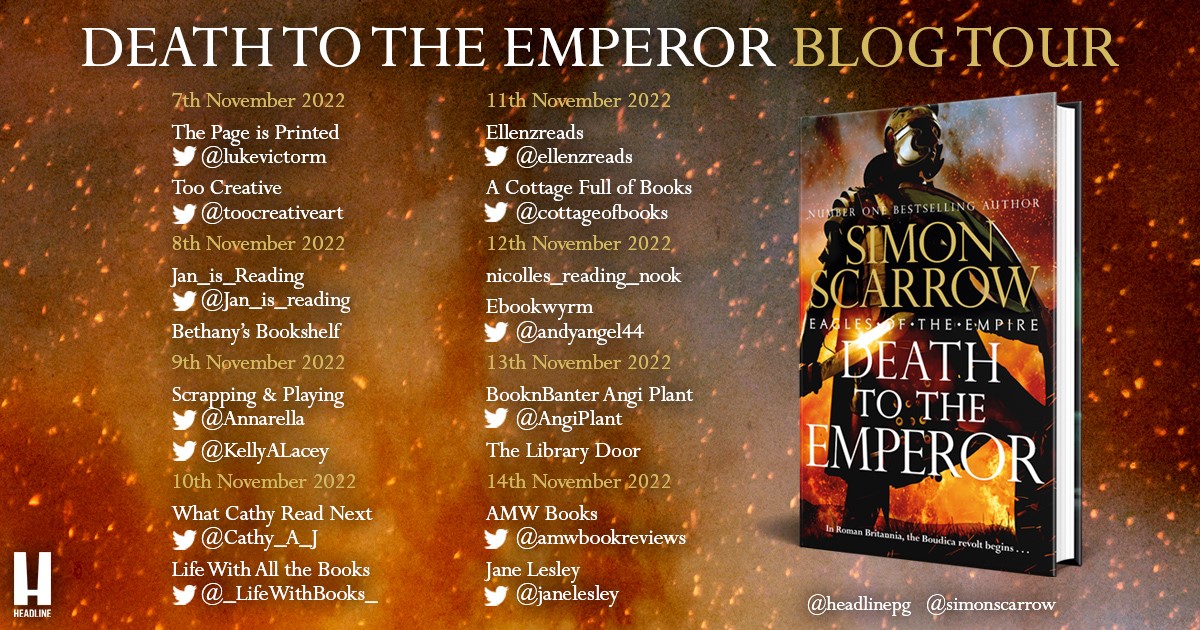
Death To The Emperor  blog tour Final draftWelcome to today’s stop on the blog tour for Death to the Emperor by Simon Scarrow which is published today by Headline. My thanks to Jess at Ransom PR for inviting me to take part in the tour and for organising my digital review copy via NetGalley. Do check out the post by my tour buddy for today, Christine at LifeWithAllTheBooks.


Death to the EmperorAbout the Book

AD 60. Britannia. The Roman Empire’s hold on the province of Britannia is fragile. The tribes implacably opposed to Rome have grown cunning in their attacks on the legions. Even amongst those who have sworn loyalty, dissent simmers. In distant Rome, Nero is blind to the danger.

As hostilities create mayhem in the west, Governor Gaius Suetonius Paulinus gathers a vast army, with Prefect Cato in command. A hero of countless battles, Cato wants his loyal comrade Centurion Macro by his side. But the Governor leaves Macro behind, in charge of the veteran reserves in Camulodunum. Suetonius dismisses concerns that the poorly fortified colony will be vulnerable to attack when only a skeleton force remains.

With the military distracted, slow-burning anger amongst the tribespeople bursts into flames. The king of the Iceni is dead and a proud kingdom is set for plundering and annexation. But the widow is Queen Boudica, a woman with a warrior’s heart. If Boudica calls for death to the emperor, a bloodbath will follow.

Macro and Cato each face deadly battles against enemies who would rather die than succumb to Roman rule. The future of Britannia hangs in the balance.

Format: Hardback (480 pages)               Publisher: Headline
Publication date: 10th November 2022 Genre: Historical Fiction

Find Death to the Emperor on Goodreads

Purchase links
Bookshop.org
Disclosure: If you buy a book via the above link, I may earn a commission from Bookshop.org, whose fees support independent bookshops

Hive | Amazon UK
Links provided for convenience only, not as part of an affiliate programme


My Review

I wrote in a recent blog post about my tendency to discover series only once they have been going for some time. Could there be a better example than Death to the Emperor which is the 21st (yes, you read that right) in the author’s ‘Eagles of the Empire’ series. And here’s me, a so-called fan of historical fiction set in Roman times, reading a Simon Scarrow book for the first time.  However, the good news is he now has a new fan and I shall be scouring bookshops for previous books in the series. In fact, I spotted one – Day of the Caesars – in my local Oxfam bookshop just the other day so only nineteen more to go.

Despite Death to the Emperor being the first book I’ve read in the series, I never felt at a loss. The author provides sufficient detail about previous events to help make sense of things but not too much that you feel you’ve learned everything there is to know. Although this is my first introduction to Centurion Macro and Prefect Cato, I loved their partnership borne of mutual respect and a soldierly comradeship forged in the heat of battle. For much of the book, though, they find themselves apart, each wishing they had the other beside them for support and advice, and because of their complementary skills.

Although now officially an army veteran living in the Roman colony of Camulodunum (Colchester), as Macro remarks to his wife, Petronella, ‘You can take the man out of the army, but never the army out of the man’. That will soon be put the test especially since Camulodunum is ‘a powder keg’, surrounded by tribes chafing under the yoke of Roman rule and people left hungry as a result of poor harvests and high taxes. Poorly defended and with a large civilian population, Camulodunum is vulnerable to attack but only a few, like Macro, can see the potential danger.

Both Cato and Macro find themselves under the command of men whose actions they doubt or whose motives they distrust. For Cato, that man is Gaius Suetonius Paulinus, Governor of Britannia. Suetonius is ambitious for military success. ‘Rulers need victories and heroes keep the mob happy.’ He does not much care how many of his soldiers die in the process so long as he achieves his objective which in this case is to attack and destroy a stronghold of the Druid cult on the island of Mona (Anglesey).

Macro has drawn an even shorter straw in the person of Procurator Decianus, the man tasked with collecting the tribute owed to Rome by the Iceni, ruled by Queen Boudica. Macro has his measure from the start, ‘You seek power and riches and you don’t care who you have to ruin to achieve that… You don’t serve Rome’s interests, only your own, even if that means putting the Empire in danger’. Decianus considers the Iceni savages and demonstrates this in the most ruthless way. Realising Macro’s worst fears, his actions set in motion a series of events that will threaten Rome’s hold on the province of Britannia and the lives of the Romans who have settled there. This includes Cato, Macro and their families.

As you might expect, the book is full of authentic detail about weaponry, military strategy, social and religious customs and much, much more. There are some terrific set pieces such as the assault on the island of Mona which involves not just a battle against a ferocious enemy but against the elements too. Battle scenes are brought thrillingly to life, putting the reader right in the heart of the action. ‘The two sides became a heaving mass of helmets, crests, blades, spears, swords and axes, amid sprays of crimson and a cacophany of weapns clashing and thudding home on shields and limbs’.

Although history tells us how the uprising led by Boudica ended, the book’s stunning but savage conclusion leaves many questions unanswered about the fate of some characters, meaning book twenty-two cannot come too soon.

In three words: Thrilling, action-packed, immersive

Try something similar: The Iron Way by Tim Leach


Simon ScarrowAbout the Author

Simon Scarrow is a Sunday Times No. 1 bestselling author with several million copies of his books sold worldwide. After a childhood spent travelling the world, he pursued his great love of history as a teacher, before becoming a full-time writer. His Roman soldier heroes Cato and Macro made their debut in 2000 in Under the Eagle and have subsequently appeared in many bestsellers in the Eagles of the Empire series, including Centurion, Invictus and  Day of the Caesars. Many of the series have been Sunday Times bestsellers.

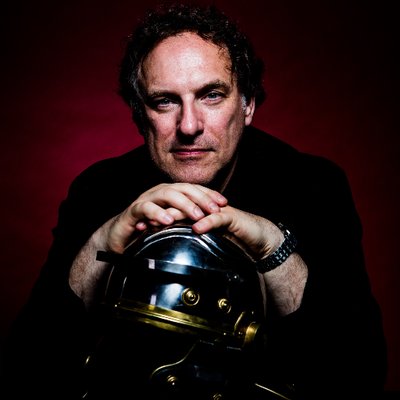
Simon Scarrow is also the author of a quartet of novels about the lives of the Duke of Wellington and Napoleon Bonaparte – Young Bloods, The Generals, Fire and Sword and The Fields of Death; a novel about the 1565 Siege of Malta, Sword & Scimitar; Hearts of Stone, set in Greece during the Second World War; and Playing with Death, a contemporary thriller written with Lee Francis. He also wrote the novels Arena and Invader with T. J. Andrews. His thriller, Blackout, set in WW2 Berlin and first published in 2021 was a Richard and Judy Book Club pick.  (Photo: Twitter profile)

Connect with Simon
Website | Twitter | Facebook