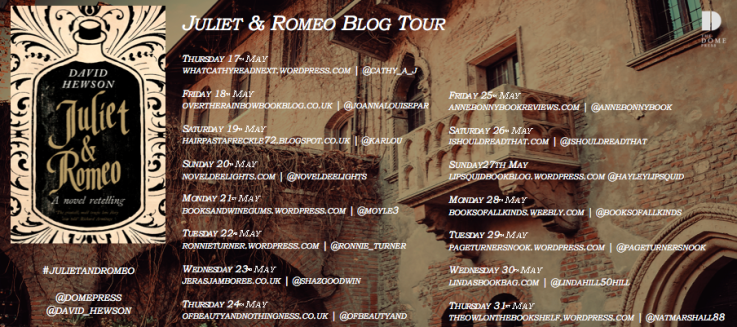
I’m thrilled to be hosting the first stop on the blog tour for Juliet & Romeo, David Hewson’s “novel retelling” of Shakespeare’s famous play about Verona’s star-crossed lovers. Happy publication day, David! I have a fascinating Q&A with David and you can also read my review of Juliet & Romeo and find out the many things I loved about the book.
Do look out for the posts by the other fantastic book bloggers taking part in the tour.
I’d like to thank Emily at The Dome Press for inviting me to attend the book launch for Juliet & Romeo on 15th May in the wonderful surroundings of Goldsboro Books in Cecil Court, London. If you love books even just a teeny bit and you’re ever in that area, you simply to have to pay it a visit.
 About the Book
Two young people meet: Romeo, desperate for love before being sent away to study, and Juliet facing a forced marriage to a nobleman she doesn’t know. Fate and circumstance bring them together in a desperate attempt to thwart their parents with a secret marriage. But in a single fateful week, their intricate scheming falls terribly apart.
Shakespeare’s most well-known and well-loved play has been turned in to a gripping romantic thriller with a modern twist. Rich with the sights and sounds of medieval Italy, peopled with a vibrant cast of characters who spring from the page, this is Shakespeare as you’ve never read it before.
Format: Hardcover (352 pp.) paperback, ebook (256 pp.) Publisher: The Dome Press. Published: 17th May 2018 Genre: Historical Fiction
Purchase Links*
Publisher | Amazon.co.uk ǀ Amazon.com ǀ Audible (audiobook) | Hive.co.uk (supporting UK bookshops)
*links provided for convenience, not as part of any affiliate programme
Find Juliet & Romeo on Goodreads
Interview with David Hewson, author of Juliet & Romeo
David, let’s get the obvious question out of the way first… The book’s title is Juliet & Romeo, not Romeo & Juliet. What is the significance of this inversion?
It’s simple really. If you look at the story very closely – and I include in this the versions before Shakespeare since he didn’t invent it – I think it becomes obvious that Juliet deserves to be the focus of the narrative. Romeo is a young, idealistic lad who’s desperate to be in love. Juliet’s an intelligent young woman facing a forced marriage to someone she doesn’t know, someone she loathes when she meets him. It’s an effective death sentence. She’s the one in true jeopardy. But Shakespeare, of course, couldn’t work with women actors because it was illegal for them to appear on stage. So I wanted to bring her to the forefront in a way that was difficult in Elizabethan times.
Shakespeare’s Romeo and Juliet is an iconic text. Did you approach retelling the story with a degree of trepidation or with excitement about the possibilities?
I’ve adapted two previous Shakespeare plays for Audible before, Macbeth and Hamlet, with my good friend AJ Hartley who’s a Shakespeare professor. So I’m familiar with the challenges though this time I’m on my own. I also adapted all three series of The Killing on TV into books which may sound very different but pose the same technical issues – point of view, the fact that books require more in the way of explanation and back story than drama.
The important thing with all adaptations is to be respectful of the original but never in awe of it. Adaptation means change – you’re not trying to photocopy what went before. So I took a free and roaming approach to the job. Before I wrote a word I went to Verona to scan out real life locations and made some of the key decisions about what I was going to change too. It was a fun project throughout – especially with Richard Armitage on board for the audio original. He’s an amazing talent – we’re both up for best audio original production in the Audies, the audio Oscars, in New York at the end of May which is going to be an exciting night.
I understand you went back to the original Italian stories on which Shakespeare’s Romeo and Juliet is based. Can you us a bit more about this and how it changed your view of the story?
The main change was in the portrayal of Juliet. First, they didn’t, unlike Shakespeare, see her as thirteen years old – which frankly is ridiculous and not just because of the sexual connotations. She’s far too adult and smart to be thirteen so in this version I restore her to sixteen which was how the earlier versions saw her. They also made me realise I had to change the telling of their first meeting too. In medieval literature there was the notion of ‘courtly love’, which was a sort of love at first sight on steroids. Shakespeare sort of follows this line and has the loved-up couple basically decide they’re made for one another in sixteen or seventeen lines. The earlier versions take it for granted that courtly love happens and that’s that. I knew this wasn’t going to work for a modern retelling so that part of the story is completely different in the book, and much more of a modern meeting where the ice is broken not by flowery declarations of love but the simple fact Romeo makes Juliet laugh – when she’s not in much of a laughing mood.
The Hogarth Shakespeare project has seen authors such as Margaret Atwood, Tracy Chevalier and Jo Nesbo take on the challenge of reinterpreting Shakespeare’s plays. What do you think is the attraction of retellings of literary classics for authors, and for readers?
In a way every production of Shakespeare is a kind of retelling since the originals are so open to interpretation. You can play Henry V as a nationalistic paean of praise to mighty England or a bold anti-war statement. Hamlet can be portrayed any number of ways. The other thing about Shakespeare is he manages to engage with themes that are timeless. The core of this story for me is identity – are we the people we feel ourselves to be inside or the masks that society, family, church the world demand we wear? How far can you really be yourself? What’s the price and is it worth paying? So really the attraction is seeing familiar, well-loved stories in a new light, from a different perspective. And with this one people shouldn’t expect the story they may think they know already. It’s not a simple ’novelisation’ at all.
What’s your own favourite literary retelling?
Robert Graves’ brilliant I, Claudius and Claudius the God. Graves was a classical scholar who’d earlier translated Suetonius’ The Twelve Caesars. After working on that history Graves claimed Claudius came to him in a dream and demanded the story be told in his own voice. So he took a lot of material from Suetonius and other historians of the time and turned the events and personalities in them into a wonderful couple of novels.
Of course fictional history often becomes accepted history too. So we now think of Claudius as a bumbling, gentle chap who went a bit bad towards the end. When in truth he was probably just as much a tyrant as the others. The same with Richard III who’s principally seen through the lens of Shakespeare these days, though few people realise Shakespeare was writing for a Tudor monarch in the line that took the crown of Richard (and may have damned him unfairly on the way).
When did you first see the elements of ‘a gripping romantic thriller’ in Shakespeare’s Romeo and Juliet?
After we did Macbeth (with Alan Cumming) and Hamlet (with Richard Armitage) we got so many people pleading for more Shakespeare. Quite a lot of people asking that we do all the plays this way (which isn’t going to happen). So I set about wondering about which play to do next. Romeo and Juliet interested me because I felt the story was often seen, unfairly, as a simple romance, two teenagers making terrible decisions. There seemed a lot more to it than that. It also has an extraordinary structure, starting off almost as raw, rude street comedy, moving into romance, suspense, thriller, then finally, in the crypt, a kind of horror tale. I liked the idea of the challenge of trying to turn that into a modern language novel and also just burrowing beneath the surface of a story that’s richer than many believe.
Juliet & Romeo retains the original play’s medieval setting and location. Did you consider setting it in a different time period?
It’s unclear exactly when the original tale is meant to be set. Shakespeare doesn’t say – he’s a dramatist and has no need. The literary versions point to Verona in the fourteenth century. I move it forwards a hundred years to 1499 so that it could reflect what we now call the Renaissance. The idea of humanism chimes very clearly with the theme of identity in the play. The stress on the individual within society, the idea that we’re not all slaves to the systems that went before. I really didn’t even think about making it one of those adaptations that translates the story to a council estate in Bermondsey or something. Nothing wrong with that but I felt this version deserved to be in historical Verona, nowhere else.
On the other hand, you’ve chosen to use modern dialogue. What was the thinking behind this?
Simple – I want the story to be read and the more road blocks you put in the way of the reader, the less that’s going to happen. The play itself is incredibly difficult to read in parts because the language is so opaque and cryptic. Also I wanted to avoid the trap of using bits of Italian – grazie and the like – to try to give it a fake Italian feel. When Richard narrated he used a variety of accents, but only one that is halfway Italian. You want to be understood without difficulty and modern English is the way to do that. I try to avoid anachronisms such as jarring modern terms of speech for example. But you can get hung up on language too much. The characters in ‘real life’ wouldn’t be speaking Italian at all – the language as we know it didn’t exist back then, and they’d probably be speaking a version of Veneto, which is close to Croatian and still heard in parts of the region today.
Your Nic Costa crime mystery series is set mainly in Rome, your books based on the TV series The Killing are set in Copenhagen and your Pieter Vos series is set in Amsterdam. How important is location to your stories?
It’s essential. Books don’t demand locations, they demand worlds. You need to see them, hear them, smell them, feel them, taste them. It’s important too for me that the story you tell can come from that place and that place alone. If this could be transplanted as it stands to any other city then I’ve failed. The place is as much a part of the story as the characters and the events they meet along the way.
What are you working on next?
Next up in July is my first new Nic Costa in nine years. It’s called The Savage Shore and is set in Calabria where Costa and crew have been sent undercover to try to wangle the defection of a crime lord from the local mafia. It’s a book I’ve been meaning to write for years since so many people have been asking for a new Costa. And I love the characters too, though I’m particularly beastly towards them in this. Later in the year I have a new audio project coming out which is a long way from Shakespeare (and secret still so I can’t talk about it). Then next year there’ll be a new standalone crime story set in a location that’s new for me. Busy times…
Thank you, David, for those fascinating answers to my questions.
My Review
In Juliet & Romeo, the feud between the Montagues and Capulets is of longstanding and born out of a friendship betrayed (‘Time had dealt its blows, yet the enmity between them had never wavered’) and a trade war over pre-eminence in the wine trade. The uneasy relations between the two families simmer in the heat of a Verona summer, threatening to boil over at any minute. It even extends to each family’s servants, ‘sharing the same borrowed hatred and never asking why’.
The author brings the reader a Juliet who is intelligent, questioning, spirited and independent-minded. She finds herself rebelling against the expectations of her parents (primarily the expectations of her father) to make a marriage that will advance the family’s interests, describing herself as ‘a tiny bird in a tiny cage my father and the rest have made for me.’ For the reason explained by the author in his Historical Notes, this Juliet is older than depicted in Shakespeare’s play, more confident and sure of herself, with a witty sense of humour.
Romeo is thoughtful and longs to be a writer although, again, his family see a different future for him, in the law this time. Although the setting is medieval – 1499, to be precise – there are no ‘thee’s’ and ‘thou’s’ in this book, instead the characters express themselves in modern dialogue, including slang and some juicy insults. For example, Romeo’s erstwhile love, the daughter of a livestock merchant, is described at one point as ‘randy Rosaline from the knacker’s yard.’
The author brings alive the Verona of the period through descriptions of the houses, palazzos, piazzas, clothing and food. I could almost sense the aromas from the dishes at a particularly lavish banquet organised by the Capulets to try to impress their pick of suitor for Juliet, Count Paris. ‘Boned roast goat’s head covered in white meat sauce and decorated with pomegranate seeds. Fried trout caught in Lake Garda by busy cormorants. Cucumbers with dill. Chicken pie with cherries. Tart with cheese and chard and saffron. And pastissada de caval, horsemeat stew slow cooked until it was near black, seasoned with laurel, nutmeg and cloves, a dish Verona had been eating for so long it seemed as much a part of the city as its old stone walls and the constant flow of the Adige.’ (OK, not so sure about the horsemeat stew.)
The novel explores a number of themes, including that of possession and ownership. At one point, Luca Capulet, insisting that Juliet’s marriage to Count Paris will go ahead, states: “This marriage is made. Not in heaven. But by me.” A chuckle then. “The household god.” When Count Paris presents Juliet with a ring as a token of his love, she is shocked to see it bears the inscription ‘I have obtained whom God ordained.’ Days later, preparing for her wedding against her will, Juliet reflects, ‘She felt as if she were nothing more than a cog in the mechanism of a relentless machine, turning to the will of others.’ Even Romeo at one point wonders, ‘How much of love was the noble sacrifice that verse portrayed? How much a selfish, obsessional need to possess another?’ With dread, he recognises in himself ‘a man possessed, who craved to possess in return’.
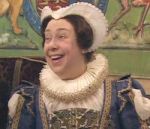 Juliet & Romeo has everything you would expect of a Shakespearean drama – masks and disguises, mistaken identities, chance meetings, fight scenes, thwarted lovers and comic interludes. Speaking of the latter, from the cast of secondary characters, I have to pick out Nurse. With her excruciatingly embarrassing stories about Juliet when she was a baby and her bawdy comments, she reminded me of Nursie in Blackadder 2 (as played by the wonderful Patsy Byrne).
The publishers describe Juliet & Romeo as ‘a gripping romantic thriller’ and it certainly fits that bill in terms of its pace and its menu of intrigue, mystery, body count and more than one race against time. In answer to one of my questions above, David comments that ‘Adaptation means change’. I’m not going to tell you what one of those key changes is, you’re going to have to read the book to find out. What I will say is that it’s entirely in keeping with the character the author has created.
Whether you have read Shakespeare’s play, seen film versions of the play or know only the outlines of the story of Romeo and Juliet, you will find much to enjoy in this “novel retelling”. It would also be a superb introduction to Shakespeare’s play. As David mentioned above, the audiobook version of Juliet & Romeo, from which this novel is derived, has been nominated for this year’s Audies, the audio Oscars. Reading this novel has certainly made me want to seek out that version.
I received an uncorrected proof copy courtesy of publishers, The Dome Press, in return for an honest and unbiased review. Please note all quotations are from the uncorrected proof copy.
Follow my blog with Bloglovin
In three words: Pacy, romantic, thrilling
Try something similar…New Boy by Tracy Chevalier (click here to read my review)
 About the Author
David Hewson is the author of more than 20 published novels including the Pieter Vos series set in Amsterdam and the Nic Costa books set in Rome.
His acclaimed book adaptations of The Killing television series were published around the world. His audio adaptations of Shakespeare’s Macbeth and Hamlet with A.J. Hartley, narrated by Alan Cumming and Richard Armitage respectively, were both shortlisted for Audie Awards.
A former journalist with the Sunday Times, Independent and The Times he lives in Kent. His first book with The Dome Press, Juliet and Romeo, will be published in May 2018.
Connect with David
Website ǀ Facebook ǀ Twitter ǀ Instagram ǀ Goodreads

 About the Book
 About the Author


 What Cathy Read Next...