Book Review – What Remains After A Fire: Stories by Kanza Javed @dylanthomprize #SUDTP26

About the Book

In eight unflinching and stunningly crafted stories, Kanza Javed unspools the lives of characters desperately trying to forge a path for themselves on the margins of society. An addict teaches his young son to shoot feral dogs on the streets of Lahore. A Christian nurse gets drawn into a plan to trap the ghost of her patient’s former lover. A Pakistani student in a small Appalachian town grapples with a startling act of violence that shatters her illusions of safety and freedom. A lonely wife becomes increasingly obsessed with a cloth worry doll left behind by a previous tenant.

Written with sharp insight and remarkable empathy, these stories reach across divides of class, gender, and religion as Javed deftly examines questions of identity and agency, belonging and loss. What Remains After a Fire is a moving portrayal of fiercely resilient characters who desire more than what their circumstances can offer them—and what these desires ultimately cost them.

Format: Hardcover (240 pages) Publisher: W. W. Norton
Publication date: 28th October 2025 Genre: Contemporary Fiction, Short Stories

Find What Remains After A Fire on Goodreads

Purchase What Remains After A Fire from Bookshop.org [Disclosure: If you buy books linked to our site, we may earn a commission from Bookshop.org, whose fees support independent bookshops]

My Review

Longlisted for the Dylan Thomas Prize 2026, the description of What Remains After A Fire as ‘a haunting, powerful collection of stories’ is absolutely spot on. It’s a fantastically strong collection, each story containing something to admire, to move you or to make you think about things in a different way.

Recurring themes of the stories include motherhood, grief and loss, the weight of cultural expectation and family obligations, and the often unbearable burden of secrets. Many of the female characters (and they are predominately female) are struggling to keep things together or to move forward with their lives. Death and dying feature frequently, often associated with facing up to guilt about past actions, even the idea that current suffering is the price to be paid for wrongdoings. Past trauma is replayed in nightmares or the ghosts of departed loved ones. Misfortune is seen as evidence of evil spirits, a much more convenient explanation than the result of human actions.

The male characters are often predatory, or cowed by social pressure or purveyors of a toxic masculinity. For example, in ‘Stray Things Do Not Carry A Soul’, a boy begins to absorb his father’s negative attitude to the women of the household, the boy’s mother and sister. ‘Do you see how the witches are conspiring against us?’ When the boy suggests his sister should be married off, his father responds approvingly ‘Now you’re thinking like a man’.

Each story is beautifully crafted and I found myself frequently jotting down phrases that stood out for me. For example, in ‘Rani’, a young woman’s dying grandmother is described as existing ‘in fragments, in vapors’. And in ‘I Will Follow You Home’, the city of Lahore is ‘a mottled mess of vanishing history and new regimes.’ In ‘Carry It All’ a woman who has suffered multiple miscarriages imagines ‘a heavenly orphanage for ghostly, unborn children’. She’s made to feel a failure by her husband’s family for being unable to bear a son, her childhood dreams of marriage and motherhood recognised now as mere fantasy. ‘In the real world – bodies matter, and in some houses, fertility was the only currency.’ And in ‘My Bones Hold A Stillness’, a young student reflects, ‘Guilt wrecks people. It chews them right up.’

In What Remains After A Fire the author explores what is left behind after loss, betrayal and displacement. Sometimes it’s nothing, sometimes mere fragments of a previous life, sometimes it’s a seed of something that just might grow and flourish if nurtured.

My thanks to Henrietta at Midas for inviting me to join the blog tour celebrating the longlist and to W.W. Norton for my review copy.

In three words: Poignant, intimate, disquieting

About the Author

Kanza Javed is a Pakistani author with an MFA in Fiction from West Virginia University, where she received the Rebecca Mason Perry Award. She is also the winner of the 2020 Reynolds Price Prize for Fiction. Her writing has been published in the American Literary Review, Punch Magazine, Salamander and Greensboro Review, among other publications.

Connect with Kanza
X | Facebook | Instagram

Book Review – The House at Devil’s Neck by Tom Mead

Welcome to today’s stop on the blog tour for The House at Devil’s Neck by Tom Mead, the latest in the crime series featuring illusionist and solver of seemingly insoluble mysteries, Joseph Spector. My thanks to Eleanor at Ransom PR for inviting me to take part in the tour and for my proof copy. Do check out the review by my tour buddy for today, Jen at Jen Med’s Book Reviews.

About the Book

A former First World War field hospital, the spooky old mansion at Devil’s Neck attracts spirit-seekers from far and wide.

Illusionist-turned-sleuth Joseph Spector knows the house of old. With stories spreading of a phantom soldier making mischief, he joins a party of visitors in search of the truth.

But the house, located on a lonely causeway, is quickly cut off by floods. The stranded visitors are soon being killed off one by one.

With old ally Inspector Flint working on a complex case that has links to Spector’s investigation, the two men must connect the dots before Devil’s Neck claims Spector himself as its next victim.

Format: Hardcover (288 pages) Publisher: Head of Zeus
Publication date: 14th August 2025 Genre: Historical Fiction, Crime

Find The House at Devil’s Neck on Goodreads

Purchase The House at Devil’s Neck from Bookshop.org [Disclosure: If you buy books linked to our site, we may earn a commission from Bookshop.org, whose fees support independent bookshops]

My Review

The House at Devil’s Neck contains all the ingredients of a ‘Golden Age’ crime novel including a host of suspicious deaths, an inheritance and multiple suspects, some of whom may not be exactly who they profess to be. Add an enormous number of twists and unexpected reveals and you have a mystery that will confound every attempt to solve it – unless you’re Joseph Spector, of course.

The author introduces an air of the supernatural by setting the book in a sinister old manor house – the Devil’s Neck of the title – accessible only by a causeway when the tide is right and reputed to be haunted. It’s certainly haunted by its past use as a hospital for soldiers wounded in the First World War, many of whom suffered lifechanging disfigurement. The perfect place for a seance then. This strand of the story reflects the interest in spiritualism at the time with many grieving relatives seeking to make contact from beyond the grave with loved ones killed in the war. Unfortunately this made them easy prey for the unscrupulous.

Spector’s old ally Inspector Flint of Scotland Yard returns, attempting to use Spector’s own methods to come up with a solution to a mysterious and, initially, seemingly unconnected death in that staple of classic crime – the locked room which no-one was seen to enter or leave. Will Spector be impressed with his theory? The reader must wait to see.

I’m not even going to attempt to summarise the twists and turns of the plot, which would be beyond me in any case. All I will say is that the author has outdone himself when it comes to intricate plotting and I pity the copy editor who had to make sure there were no loose ends.

Like previous novels in the series, there’s a chapter near the end which invites the reader to put all the facts together and come up with a solution. (Good luck with that.) There are also footnotes directing you back to the page on which a relevant piece of information appeared. Or more realistically, the pages on which the pieces of information you totally overlooked appeared. If you indentified the culprit, the motive and the means before Spector revealed everything then all I can say is you’re a much, much cleverer person than me. Even if you didn’t solve the mystery, it’s a fun ride in the hands of an author who knows how to keep a reader turning the pages.

If you’re in the mood for a book that evokes those doyennes of the ‘Golden Age’ crime novel Agatha Christie and Dorothy L. Sayers, then The House at Devil’s Neck is the book for you. Just don’t blame me if your brain is in a spin by the end.

In three words: Ingenious, atmospheric, intricate
Try something similar: Hemlock Bay by Martin Edwards

About the Author

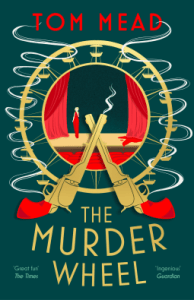
Tom Mead is a Derbyshire author and Golden Age crime aficionado. His Joseph Spector crime novels include Death and The ConjurorThe Murder Wheel and Cabaret Macabre and have been nominated for the Capital Crime Award for Debut Novel of the Year, shortlisted for the Historical Writers’ Association Debut Crown and long listed for the CWA Historical Dagger Award. His short stories have appeared in Alfred Hitchcock’s Mystery Magazine and Best Crime Stories of the Year (edited by Lee Child). His books have been named as crime novels of the year by the likes of The Guardian, Telegraph and Publishers Weekly. (The series has been translated into several languages and is currently in development for screen adaptation.)

Connect with Tom
Website | X/Twitter | Instagram | Facebook | Bluesky