
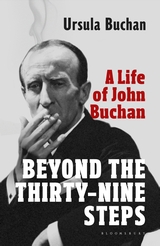
 About the Book
John Buchan’s name is known across the world for The Thirty-Nine Steps. In the past one hundred years the classic thriller has never been out of print and has inspired numerous adaptations for film, television, radio and stage, beginning with the celebrated version by Alfred Hitchcock.
Yet there was vastly more to ‘JB’. He wrote more than a hundred books – fiction and non-fiction – and a thousand articles for newspapers and magazines. He was a scholar, antiquarian, barrister, colonial administrator, journal editor, literary critic, publisher, war correspondent, director of wartime propaganda, member of parliament and imperial proconsul – given a state funeral when he died, a deeply admired and loved Governor-General of Canada.
His teenage years in Glasgow’s Gorbals, where his father was the Free Church minister, contributed to his ease with shepherds and ambassadors, fur-trappers and prime ministers. His improbable marriage to a member of the aristocratic Grosvenor family means that this account of his life contains, at its heart, an enduring love story.
Ursula Buchan, his granddaughter, has drawn on recently discovered family documents to write this comprehensive and illuminating biography. With perception, style, wit and a penetratingly clear eye, she brings vividly to life this remarkable man and his times.
Format: Hardcover (512 pp.) Publisher: Bloomsbury Publishing
Published: 18th April 2019 Genre: Biography
Purchase Links*
Amazon.co.uk ǀ Amazon.com ǀ Hive.co.uk (supporting UK bookshops)
*links provided for convenience, not as part of any affiliate programme
Find Beyond the Thirty-Nine Steps: A Life of John Buchan on Goodreads
My Review
Ursula Buchan’s biography of her grandfather does exactly what its title suggests. It looks beyond the author of the well-known novel to the man whose career encompassed politics, the law, publishing, journalism and public office as well as authorship of over a hundred books. It also provides a touching portrait of John Buchan the family man and husband.
There is limited exposition of Buchan’s works of fiction and non-fiction but what there is is even-handed, offering both praise and criticism where appropriate. For example, Ursula Buchan describes Prester John as ‘well-nigh unreadable now’, confirming my opinion of the book which I re-read and reviewed recently. On the other hand, she is an enthusiastic advocate for John Buchan’s historical novels, such as Midwinter and The Blanket of the Dark (her own personal recommendations), regretting they are not more widely read and appreciated.
The author addresses the accusations of ‘jingoism’ that have been directed at John Buchan’s books (I suspect by those who have not read many of them) producing convincing evidence to rebut them. She also presents a similarly stout defence of the claims of anti-Semitism made against him, pointing out he was friends with many prominent Jews, including the first President of Israel. On the other hand, she is not afraid to criticize where appropriate. For instance, noting John Buchan’s propensity for small acts of vanity and that on occasions his sense of family duty could cloud his judgment.
The author rejects the notion that John Buchan married Susan Grosvenor for social position, arguing it was a true love match. This becomes evident from the excerpts from their touching letters to each other. In fact, one of the many things I liked about the book is the way Ursula Buchan brings Susan ‘into the light’, as she puts it. For example, she writes sensitively about Susan’s initial problems adjusting to her very public role as wife of the Governor-General of Canada and her struggles with depression.
The chapter covering the First World War encompasses both John Buchan’s official roles in intelligence and propaganda and the tragic personal losses his family, like so many others, experienced. One of my favourite Buchan novels, Mr. Standfast, was his personal literary contribution to the propaganda effort, intended to influence public opinion at home.
What I always find amazing about John Buchan is his sheer industry and I loved this description of a typical day whilst living at Elsfield, the family’s country home near Oxford. ‘In the spring and summer, at weekends, he would ride out in the early morning but be back for family prayers before breakfast… On Saturdays, he started writing punctually at nine o’clock and worked steadily until lunchtime… He did not work in the afternoons – that was the time for walking, playing with the children or energetic gardening – but he would go back to his desk after tea for a couple of hours… On Sundays after church, if no-one was staying, he would go for a very long walk, wearing his oldest tweeds. A thirty-mile round trip via Brill was not unusual.’ This is on top of taking the train to London each morning during the week to pursue his business interests.
He also possessed the gift of a remarkable memory. For example, whilst Governor-General of Canada, the author describes how he would dictate speeches to his secretary which would be typed up and given to the press in advance of speaking engagements. He would then deliver the speech, without notes, rarely diverging from the printed script.
The author describes how John Buchan’s travels to the north of Canada whilst Governor-General provided inspiration for, in my opinion, his finest book, Sick Heart River, featuring the final appearance of Sir Edward Leithen (who Ursula Buchan revealed is her favourite of her grandfather’s characters). At the time he was writing the book, he was suffering from particularly poor health and world affairs were dominated by the threat of war. Ursula Buchan describes how Buchan’s extensive network of contacts and behind the scenes influence resulted in, for example, a visit by the King and Queen to Canada and, importantly, to the United States. As she notes, ‘The mutual regard and respect between King and President [Roosevelt] were to prove very beneficial during the war years’.
Although you know it’s coming, I still found myself deeply moved by the description of John Buchan’s sudden death and the outpouring of national grief that followed. Given the ending of Mr. Standfast always leaves me slightly teary, you can imagine how affected I was by learning that the address given at John Buchan’s funeral ended with the description of Mr Valiant-for-Truth in Bunyan’s The Pilgrim’s Progress which Richard Hannay reads over the grave of a friend in Mr. Standfast: ‘So he passed over and all the trumpets sounded for him on the other side.’
Beyond the Thirty-Nine Steps is clearly the product of diligent and exhaustive research, witnessed by the extensive notes and references that account for over 80 pages of the book. Even for someone like myself familiar with John Buchan’s life from previous biographies by Janet Adam Smith and Andrew Lownie, Beyond the Thirty-Nine Steps still gave me fresh perspective and fascinating nuggets of new (to me) information. For example, that there might have been film adaptations of other Buchan books had not his appointment as Governor-General of Canada put an end to any discussion of film deals. Or that the book Alfred Hitchcock initially wanted to adapt for film was Greenmantle rather than The Thirty-Nine Steps.
For those whose only knowledge of John Buchan is from the book The Thirty-Nine Steps or the film adaptations of it, I can wholeheartedly recommend this fascinating, very readable biography of a man who packed a massive amount into a relatively short life.
 I was lucky enough to hear Ursula talk about her book at this year’s Oxford Literary Festival and to have a few words with her afterwards as she signed my copy of her book. During the Q&A session that followed Ursula’s talk, she was asked the very good question (not by me, I regret) whether she’d found it hard to retain the objectivity required of a biographer given her personal connection to her subject. She said she liked to think that she hadn’t held back where her grandfather may have fallen short, although it will be plain she admired him and had been inspired by his hard work, high principles and courage in the face of illness. Ursula Buchan concluded her talk by saying that, although her grandfather died before she was born, through writing his biography, she’d felt she could almost touch him ‘across the void of time and space’. I have to say I got the same feeling from reading this book.
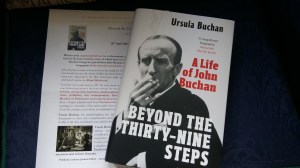 I received an advance review copy courtesy of publishers, Bloomsbury Publishing.
In three words: Detailed, well-researched, insightful
Try something similar…Memory Hold-the-Door by John Buchan (read my review here)
 About the Author
Ursula Buchan studied modern history at New Hall, Cambridge, and horticulture at the Royal Botanic Gardens, Kew. She is an award-winning journalist and author, having written eighteen books and contributed regularly to the Spectator, Observer, Independent, Sunday Telegraph, Daily Telegraph and The Garden.
She is a daughter of John Buchan’s second son, William. (Photo credit: Author Twitter profile)
Connect with Ursula

 About the Book
 About the Author

