
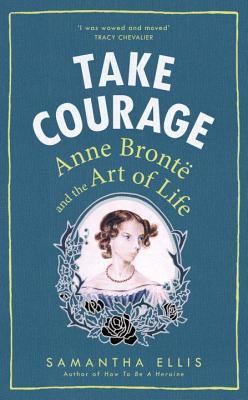
 About the Book
Anne Brontë is the forgotten Brontë sister, overshadowed by her older siblings – virtuous, successful Charlotte, free-spirited Emily and dissolute Branwell. Tragic, virginal, sweet, stoic, selfless Anne. The less talented Brontë, the other Brontë. Or that’s what Samantha Ellis, a life-long Emily and Wuthering Heights devotee, had always thought. Until, that is, she started questioning that devotion and, in looking more closely at Emily and Charlotte, found herself confronted by Anne instead. Take Courage is Samantha’s personal, poignant and surprising journey into the life and work of a woman sidelined by history. A brave, strongly feminist writer well ahead of her time – and her more celebrated siblings – and who has much to teach us today about how to find our way in the world.
| Format: | Hardback | Publisher: | Chatto & Windus | Pages: | 344 |
| Publication: | 12th Jan 2017 | Genre: | Biography |
Purchase Links*
Amazon.co.uk ǀ Book Depository
*links provided for convenience, not as part of any affiliate programme
Find Take Courage: Anne Brontë and the Art of Life on Goodreads
My Review
I have my husband to thank for this absolutely fascinating book which was a very well-chosen birthday present. (Like all prolific readers, I am notoriously difficult to buy books for.) Unfortunately, it’s taken me quite a while to get around to reading it but I’m very glad I now have.
Anne’s last letter is the impetus for Samantha Ellis’s exploration of the life of Anne Brontë because it suggests a woman very different in character from the established portrayal. As her research progresses, Anne’s life and undervalued status seems to have a very personal resonance for the author. She sets out to prove Anne should not have been overlooked as a writer or in favour of her more famous siblings and that she has been mischaracterised. Samantha Ellis becomes Anne’s champion, determined to bring her out of the shadows and her position as the literary equivalent of ‘the third Beatle’.
The author examines Anne’s life through the prism of the people – principally the women – around her, and the heroines of her books, Agnes Gray and The Tenant of Wildfell Hall. In some cases, this involves a fair amount of speculation. For instance, Anne never knew Maria, her mother, because she died when Anne was only twenty months old. However, the author sees similarities in their appearance, piety and argues that Maria’s fledgling literary ambitions may have influenced her daughter. Similarly, there is very little known about Tabby, the Brontë’s cook and housekeeper, but the author surmises that it was Tabby who introduced Anne to the moors and inspired her love of nature.
There is more material to work with when it comes to Anne’s relationship with her sisters, Emily and Charlotte. Emily and Anne’s relationship was based on their shared literary endeavours, working together on creating the imaginary world of Gondal. Anne’s relationship with Charlotte comes across as altogether more complex and in fact Charlotte’s behaviour to her sister does not come out particularly well when placed under the spotlight. Anne’s public legacy was largely shaped by Charlotte who had control of Anne’s unpublished poems and published work. The author sees Charlotte as ‘more than anyone, responsible for Anne being seen as ‘the other Brontë’.
Sections of the book I particularly enjoyed were the author’s close readings of Anne’s two novels, Agnes Grey and The Tenant of Wildfell Hall. Although it’s not always reliable to read the author through the character, Ellis makes some persuasive arguments. She also argues that Anne’s novels ‘fiercely’ rewrite Charlotte’s in terms of the realism of her heroines. The author contends that Agnes Grey is a much more accurate portrait of life as a governess than Jane Eyre, and that Anne’s flawed heroes are more true to life than the Byronic figures – think Rochester and Heathcliff – imagined by her sisters.
The other standout section of the book is its closing chapter in which the author recounts very movingly the circumstances of Anne’s final days and death. What a potential literary powerhouse the world was robbed of by Anne’s early death. It’s interesting to ponder whether, had she lived longer, she might have been the Brontë sister everyone remembers and not her older sisters.
Samantha Ellis admits the documentary evidence that remains about Anne’s life is slight and although the arguments she advances are reasonable it’s fair to say they are based on a lot of supposition. The book is littered with ‘might’, ‘maybe’ and ‘perhaps’. I’m in no position to judge the scholarly worth of this book (nor do I want to) but I found it utterly absorbing and it has made me determined to reread Anne’s novels (in editions that are not ‘hatchet jobs’).
In three words: Absorbing, personal, moving
Try something similar…Catherine Dickens: Outside the Magic Circle by Heera Datta (click here to read my review)
 About the Author
Samantha Ellis is a playwright and journalist. Her first book How To Be A Heroine was published in 2014. Her plays include Cling to Me Like Ivy, Operation Magic Carpet and How to Date a Feminist. She has written for the Guardian, Observer, TLS, Spectator, Literary Review, the Pool, Exeunt and more. She lives in London.
Connect with Samantha

 About the Author
 What Cathy Read Next...