Book Review – Other Worlds Were Possible by Joss Sheldon @josssheldon

About the Book

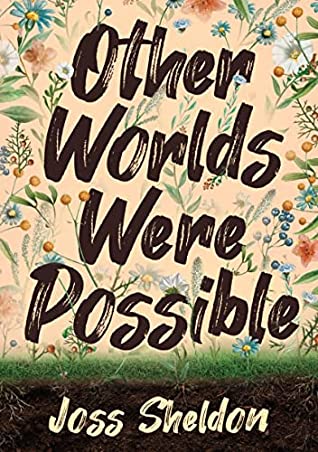
Book cover of Other Worlds Were Possible by Joss Sheldon

Sunny and his kinfolk were content with their way of life. During the dry season, their clan lived alone. They hunted whenever they chose, gathered an array of plants, told stories, and took part in debates. In the rainy season, they united with the rest of their tribe. They formed a temporary city, feasted, held dances and played games. They could have lived like this forever. But a strange and foreign people had ideas of their own…

Appearing out of nowhere, these aliens looked completely different. They smelled different. They even dressed differently. And they had the most peculiar set of habits.

These people did not live with the earth. They exploited the earth; imposing monocultures and intensive farming. They were not content with their lot. They were possessed by an insatiable desire to consume. And they had no sense of freedom. They were beholden to a never-ending list of outlandish concepts; things such as “Hierarchy”, “Patriarchy”, “Monarchy”, “Monogamy”, “God”, “Punishments”, “Ownership”, “Inequality”, “Money”, “Work” and “Tax”.

Sunny and his kinfolk faced the toughest decision in their history… They could wage war on these imposters. But their enemies were strong. They had already killed hundreds-of-thousands of indigenous people. They could flee. But these imperialists would surely follow. They would push them into the sea, the mountains or the desert. Their clan needed another solution. But what could it be? Could they negotiate with this violent foe? Could they form a pact? Could they create a kind of alliance?

Sunny had no idea. But he was compelled by a duty to find out. This was his time. And he was willing to risk his life, to save the people he loved…

Format: ebook (285 pages) Publisher: Rebel Books
Publication date: 30th January 2023 Genre: Historical Fiction, Political Fiction

Find Other Worlds Were Possible on Goodreads

Purchase Other Worlds Were Possible from Amazon UK (link provided for convenience not as part of an affiliate programme)


My Review

Joss Sheldon has a history of addressing important social issues in his fiction. His novel, Little Voice, explored society’s expectations of normality and the pressure to conform. His next book Money, Power, Love tackled the ‘nature versus nurture’ debate and exposed the excesses of capitalism. Individutopia presented a dystopian vision of a world in which there really is no such thing as society; in which people don’t collaborate, they only compete.

In this latest book, he dramatises the adverse effects of European imperialism on the lives of one clan living in an undisclosed location, possibly Africa (although the events that unfold could equally apply to the experiences of Aboriginal people or Native Americans). Although the time period is not specified, it’s probably the nineteenth century because of the ‘innovations’ the imperialists bring. The book has a strong enviromental message.

The Eagle Clan, of which Sunny is a member, follow a communal way of life, cooking and eating together each evening. Decisions are reached collectively following debate by all members of the clan. There is sexual freedom; monogamy is neither required nor even encouraged. Each member contributes what they can according to their skillset. Children have no formal education but learn and acquire skills through observation and experience, such as which plants are safe to eat and which are not. Although elders are respected for their wisdom, there is no hierarchy. Humility is lauded, so much so that anyone displaying pride in their own achievements is vilified. They have no concept of ownership of property and live off the land, never taking more than they need. They have no need to measure time, living from event to event and following the changing seasons.

When white imperialists (referred to by the clan as ‘Wogies’) arrive intent on colonising the land and exploiting its natural resources, the traditional lifestyle – and freedom – of Sunny’s clan is threatened, along with the environment in which they live. Initially the clan feel sorry for the Wogies who seem so ill-suited to their new surroundings. But as time goes on, Sunny and his kinfolk are shocked at seeing people chained together working vast fields of crops. They witness ancient forests, whose varied species have supported different flora and fauna, chopped down and replanted with a single species, forests which were also the clan’s sacred spaces. Their lives are threatened too with the arrival of diseases to which they have no natural immunity.

Alongside the imperialists come missionaries eager to convert the ‘pagan’ tribes to Christianity so that they might enter paradise. But, as one of the clan replies, ‘We’re already in paradise. Look around you! We’re surrounded by the people we love. We have a wonderful community, all the food we can eat, and all the time in the world. We have art, walks, conversations, stories, sport, music and sex.’

If the author does rather hammer home the anti-colonialism message, the story is leavened with humour. We witness the absurdity of the imperialists’ attempts to explain – and justify – concepts such as ownership, taxation and profit to people who have never had any need of those things. Sunny makes an engaging protagonist, initially tempted by the things offered by the Wogies but gradually realising the threat they pose and bravely attempting to do something about it. Unfortunately, history tells us he is doomed to failure.

Like all the author’s books, Other Worlds Were Possible is full of interesting ideas and definitely challenges the notion of what constitutes ‘progress’, portraying in stark terms the destructive impact of human activity on the environment. ‘Money this, money that. Only when they’ve cut down the last tree, poisoned the last river, and caught the last fish, will they realise they cannot eat their money.’

I received a digital review copy courtesy of the author.

Joss Sheldon’s latest book, Freedom: The Case For Open Borders, will be published on 29th February 2024 and is available for pre-order now. Addressing the very current issue of migration, it makes the historical, scientific, economic, cultural, political and philosophical cases for free movement.

In three words: Thought-provoking, imaginative, didactic
Try something similar: Things Fall Apart by Chinua Achebe


About the Author

Author Joss Sheldon

Joss Sheldon is a scruffy nomad, unchained free-thinker, and post-modernist radical. Born in 1982, he was brought up in one of the anonymous suburbs which wrap themselves around London’s beating heart. Then he escaped!

With a degree from the London School of Economics to his name, Sheldon had spells selling falafel at music festivals, being a ski-bum, and failing to turn the English Midlands into a haven of rugby league.

Then, in 2013, he stumbled upon McLeod Ganj; an Indian village which plays home to thousands of angry monkeys, hundreds of Tibetan refugees, and the Dalai Lama himself. It was there that Sheldon wrote his debut novel, Involution & Evolution.

Eleven years down the line, he’s penned eight titles in total, including two works of non-fiction: Democracy: A User’s Guide, and his latest release, Freedom: The Case For Open Borders. (Photo: Goodreads author page)

Connect with Joss
Website | Twitter/X | Facebook

#BookReview Kezia and Rosie by Rebecca Burns

Kezia and RosieAbout the Book

When sisters Kezia and Rosie arrive at their grandparents’ house in the summer of 1986 they aren’t sure when they’ll see their Mum and Dad again.

While her younger sister Rosie is content playing on the allotment gate and having picnics in the garden, Kezia begins to realise that things aren’t quite what they seem. While embraced in Granddad and Grandma’s loving care, it’s not long before seven-year old Kezia begins to notice strange looks between them, hushed whispers, and secret phone calls. She realises she must step into the frightening adult world if she is to make sense of her parent’s troubled marriage.

Format: Paperback (128 pages)       Publisher: Dahlia Publishing
Publication date: 26th March 2022 Genre: Historical Fiction

Find Kezia and Rosie on Goodreads

Purchase link
Amazon UK
Link provided for convenience only, not as part of an affiliate programme


My Review

Although described as a linked short story collection, I would characterise Kezia and Rosie as more like a novella.  There is a narrative thread that runs through the book which means that, in my opinion, the ‘stories’ are best read in sequence rather than dipping in and out in the way you might do with a short story collection.

Narrated from the point of view of seven-year old Kezia, the author really captures the experience of being at an age where you start to understand things you hear whilst not understanding others. In just one of the imaginative metaphors in the book, ‘Words give answers and are windows but sometimes the glass is glazed’. Her mind is full of questions: just why has their mother gone away, and to another country, why do her grandparents need to talk to Roy’s son, and why is their grandmother so antagonistic towards their father? There are also memories of an incident that she tries to push away.

As someone with a younger sister, whom of course I love, I could appreciate Kezia’s occasional frustration with her sister’s maddening antics and the way she is indulged by their grandparents. Sometimes a two year age gap can seem much more and the role of elder sibling can feel like an unwelcome burden especially when her grandfather reminds her ‘there are things that can’t be said around Rosie’. No wonder Kezia comes to think of the adult world as a ‘maze… a lattice of things that can and cannot be said’. Her frustration occasionally comes out in little acts of vandalism, such as the tearing to pieces of a flower.

The girls’ grandfather and grandmother are beautifully drawn characters. Although they find themselves in the unexpected position of looking after the two girls with their established domestic routine disrupted, their love and care for Kezia and Rosie is quite wonderful to witness. And, as we learn, they too have experienced sadness in their lives.

Whilst many scenes in the book are touching and funny, there’s a persistent sense of unease. Something not quite right has occurred in the family but for a long time we don’t know what. Kezia feels she has been thrust into an adult world she can’t understand. ‘The summer has been a mosaic of hints and overheard remarks. They gather around Kezia like stepping stones.’  However, whatever happens, Kezia and Rosie can rest assured they have the love and support of their grandparents. ‘For now, it’s enough to slip underneath Grandma’s arm and wedge into the warm space of her armpit, and elbow Rosie gently to tell her she loves her. And for Grandad to giggle to himself and head over to the allotment to fetch raspberries for tea.’

I really liked how the time period of the 1980s was evoked. Anyone old enough to remember that period will recognise the references to shopping in Fine Fare, or watching television programmes together such as The Generation Game, The Dukes of Hazzard or (Kezia and Rosie’s grandmother’s favourite) Wogan. Those of a certain age will experience a real sense of nostalgia and perhaps give a wry smile at the girls’ excitement at watching the wedding of Prince Andrew and Fergie.

I really enjoyed Kezia and Rosie. It’s a delightful, beautifully written book. My thanks to the author for my digital review copy.

In three words: Tender, insightful, heartwarming

Try something similarOnly May by Carol Lovekin

Follow this blog via Bloglovin


Rebecca BurnsAbout the Author

Rebecca Burns is an award-winning writer of short stories. Her story collections, Catching the Barramundi (2012) and The Settling Earth (2014) were both longlisted for the Edge Hill Short Story Award. Her debut novel, The Bishop’s Girl, was published by Odyssey Books in September 2016, followed by a third short story collection, Artefacts and Other Stories (2017). Beyond the Bay, a sequel to The Settling Earth, was published in 2018. Her first novella, Quilaq, was published by Next Chapter in 2020. (Photo: Author website)

Connect with Rebecca
Website | Twitter | Facebook