
About the Book
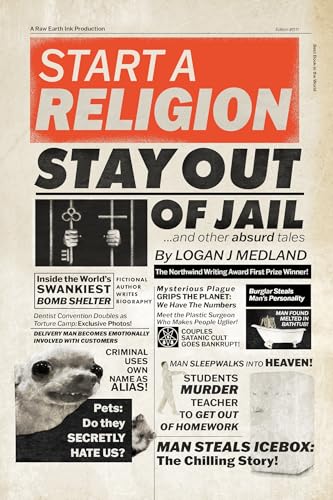
Pets: do they secretly hate us? Could starting a religion allow one to live one’s entire life as a tax write-off and are the cost-to-benefit ratios worth it? What if the donut shop around the corner stays open all through the sleepless nights and its only patrons were every person you’ve ever known? Could this indeed be heaven?
What happens when the delivery driver falls in love with one of his customers? Is there redemption for the students who planned and executed their teacher’s demise, just to get out of doing their homework? Would you survive the apocalypse if you built the world’s most well-planned bomb shelter? Is simply surviving enough, or would you need trustworthy companionship as well? Is cheese the most perfect food?
Find out answers to these questions and so much more…
Format: ebook (142 pages) Publisher: Raw Earth Ink
Publication date: 20th October 2024 Genre: Short Stories, Humour
Find Start a Religion, Stay Out of Jail and Other Absurd Tales on Goodreads
Purchase Start a Religion, Stay Out of Jail and Other Absurd Tales from Amazon UK
My Review
A short story collection is like a ‘pick and mix’. Some stories you’re instantly drawn to and others you take a chance on. Some leave you wondering what you’ve just read. Others may scare the living daylights out of you, leave you tearful or have you chuckling away to yourself. Some may involve familiar situations, others things that would never occur in real life. Or perhaps they could?
I think it’s fair to say the stories in this collection cover just about all the things I’ve listed above, with the emphasis on the absurd. Indeed the author invites you to ‘unmoor yourself from reality and drift where these stories take you’.
One of my favourite stories was ‘The Man Who Delivers Flowers’. It’s actually the tender and surprisingly moving tale of a flower delivery man. As he makes his deliveries, he ponders the different situations in which people send flowers and the message their choice of flowers sends. Orchids for ‘the daring’, gerbera for ‘the connoisseur’, ivy for ‘the pragmatic’, bleeding heart ‘only for the manic’. Declarations of love, cravings for forgiveness, expressions of sympathy, he delivers flowers that represent them all. ‘How many of you can say you experience this much exaltation, this much despair, and this many triumphs in one day on the job?’
Another story I enjoyed was ‘The Icebox’ in which a man who has previously seen no need for one purchases an icebox and it ignites in him an overwhelming desire to acquire possessions.
The story that gives the book its title sees two men invent a religion, along with all its trappings such as robes, ritual chants, ceremonial sacrifice and sacred works containing the teachings of an invented prophet, the great Zanthus. The contents of the latter the narrator freely admits he borrowed from Thus Spake Zarathustra and The Lord of the Rings. After initial success, it also goes downhill and the pair find themselves left with only ‘useless followers – the meek, the lame, the peacemakers’ and longing for their previous obscurity.
In ‘After The Bombs’, two friends retreat into a labyrinthine nuclear bunker they have constructed designed to provide them with everything they need to survive for forty years. An ‘underground ark’, it contains the means to sustain livestock and grow food. A vast library contains books to provide entertainment and spiritual wellbeing as well as of a practical nature: manuals on how to wield a pick axe, maintain a reactor, and shoot a deer with a bow and arrow. To while away the time they plan to master the fine cuisines of the world or learn to play the works of Stravinsky on the grand piano. It’s not long however before things begin to go wrong. They start to get on each other’s nerves and cordon bleu meals are replaced by convenience foods from the freezer. Our narrator starts a newspaper but soon most of the articles concern the failings of his friend. It’s downhill from thereon.
If you want absurd, how about the final story ‘The Cheeseman’ which features a superhero who proclaims cheese to be the only food in the universe that contains a single ingredient (you’ve guessed it, cheese) and whose powers include the ability to melt under extreme heat. Two children decide to put his claims to the test.
Start a Religion, Stay Out of Jail and Other Absurd Tales is an entertaining collection of stories.
My thanks to the author for my digital review copy.
In three words: Clever, witty, satirical
Try something similar: Normal Rules Don’t Apply by Kate Atkinson
About the Author

Logan Medland was born in Toronto and lives now in the East Village of New York. He makes his living as a music director, composer, lyricist, and librettist for the theatre. He is married to Brazilian artist and photographer Ana Cissa Pinto. (Photo: Amazon author page)
Connect with Logan
Website | Instagram | Facebook




 What Cathy Read Next...