
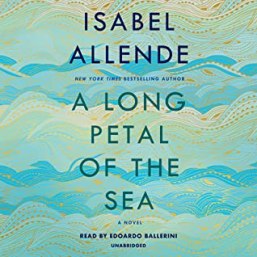
 About the Book
Victor Dalmau is a young doctor when he is caught up in the Spanish Civil War, a tragedy that leaves his life – and the fate of his country – forever changed. Together with his sister-in-law, he is forced out of his beloved Barcelona and into exile in Chile. There, they find themselves enmeshed in a rich web of characters who come together in love and tragedy over the course of four generations, destined to witness the battle between freedom and repression as it plays out across the world.
Format: Audiobook (9h 46m) Publisher: Bloomsbury
Publication date: 21st January 2020 Genre: Historical Fiction, Literary Fiction
Find A Long Petal of the Sea on Goodreads
Purchase links
Bookshop.org
Disclosure: If you buy a book via the above link, I may earn a commission from Bookshop.org, whose fees support independent bookshops
Hive | Amazon UK
Links provided for convenience only, not as part of an affiliate programme
My Review
I’m almost ashamed to admit that this is the first book I’ve read by Isabel Allende mainly because she’s known for her works of magic realism which is a genre I’ve been unable to get along with. However, when I saw the description of this book, especially that it was partly set during the Spanish Civil War and its aftermath, I thought this might be my opportunity to experience her writing. I listened to the audiobook version, skilfully narrated by Edoardo Ballerini.
The book, translated by Amanda Hopkinson and Nick Caistor, vividly recreates the chaos and confusion of the Spanish Civil War and its terrible toll on Spanish citizens, tearing apart families and communities, plunging others into homelessness, poverty and hunger, and forcing many into exile. Mixing historical events with both real and fictional characters, each chapter of the book opens with an excerpt from the works of renowned Chilean poet Pablo Neruda.
The book tells the story of Victor Dalmau, a young doctor who is caught up on the Republican side in the Spanish Civil War and is forced to flee to France with Roser, the wife of his brother who was killed fighting against the forces of Franco. Although I had heard of Pablo Neruda, I had no idea of his role in helping refugees from the conflict to emigrate to Chile, the country whose description as the ‘long petal of the sea’ inspires the book’s title.
There are vivid scenes aboard the SS Winnipeg, as Victor and Roser make the dangerous and uncomfortable voyage across the Atlantic, through the Panama canal, into the Pacific and their eventual arrival in Chile. There Victor pursues his ambition to become a doctor, alongside running a tavern (named Winnipeg in honour of the ship that carried them to safety), and Roser builds a career as a musician. Having entered into a ‘marriage of convenience’ in order to secure their entry into Chile, Victor and Roser pursue separate relationships whilst at the same time finding there remains a strong connection between them. Their past life in Spain is not completely left behind either despite the thousands of miles that divide them from their homeland and from people they believed lost forever.
Alongside the fIctional story of Victor and Roser’s new life in Chile, the book describes the political changes in that country from the end of the Second World War onwards, including the rise to power of Salvador Allende (a distant relative of the author), his subsequent overthrow and assassination, and the coming of the brutal Pinochet regime. I’ll admit that, at times, my attention wandered during this part of the book as it felt more like a history lesson – albeit one influenced by the author’s own heritage – than a story inspired by the characters she had created. However, the book was redeemed for me by the final section which charts, in the most powerful and emotional way possible, the final years of the lives of Victor and Roser.
Spanning decades and a number of generations, A Long Petal of the Sea is an epic family saga that vividly demonstrates the emotional turmoil and suffering caused by war but also serves as an insight into turbulent periods in the history of both Spain and Chile.
In three words: Powerful, eventful, epic
Try something similar: Those I Have Lost by Sharon Maas
Follow this blog via Bloglovin
 About the Author
Born in Peru and raised in Chile, Isabel Allende is the author of The House of the Spirits, Daughter of Fortune, Paula, My Invented Country and The Japanese Lover. Her books have been translated into more than 35 languages and have sold over 65 million copies worldwide. The Japanese Lover was an international and New York Times bestseller. She lives in California. (Photo credit: Publisher author page)
Connect with Isabel
Website

 About the Book
 About the Author
 What Cathy Read Next...