Blog Tour/Book Review: A Light of Her Own by Carrie Callaghan

I’m delighted to be hosting today’s stop on the blog tour for A Light of Her Own by Carrie Callaghan.  My grateful thanks to Amy at Historical Fiction Virtual Book Tours for inviting me to participate in the tour.

Visit the tour page to see the other great book bloggers taking part in the tour and links to their reviews and Q&As with the author. For residents of the US, there’s a giveaway with a chance to win one of two signed hardcover copies of A Light of Her Own.  Enter via the tour page where you can also find the terms and conditions of the giveaway.


A Light of Her OwnAbout the Book

In Holland 1633, a woman’s ambition has no place.

Judith is a painter, dodging the law and whispers of murder to try to become the first woman admitted to the Haarlem painters guild. Maria is a Catholic in a country where the faith is banned, hoping to absolve her sins by recovering a lost saint’s relic.

Both women’s destinies will be shaped by their ambitions, running counter to the city’s most powerful men, whose own plans spell disaster. A vivid portrait of a remarkable artist, A Light of Her Own is a richly-woven story of grit against the backdrop of Rembrandt and an uncompromising religion.

Format: Hardcover (320 pp.)    Publisher: Amberjack Publishing
Published: 13th November 2018   Genre: Historical Fiction

Purchase Links*
Amazon.co.uk  ǀ  Amazon.com  | Indiebound
*links provided for convenience, not as part of any affiliate programme

Find A Light of Her Own on Goodreads


My Review

I came to this book expecting it to focus mainly on the story of Judith and her struggle to be accepted by the male-dominated Guilds who governed the art world of the time.   I certainly got this and found her quest for independence and her determination to make the most of her artistic talent quite inspiring.  The book also gave me a fascinating insight into the operation of the art market at the time: the power of the Guilds to control the activities of artists, such as setting up a workshop, employing apprentices and even selling completed works.

The reader is left in no doubt how central the act of creating art is to Judith’s existence: ‘Every time she painted, she fell a little in love with her subject, snared by the crevices and shadows and twitches that made the person. Painting meant focusing on the details, much like love.  So each of her paintings became, in a way, an act of adoration.’  I really liked the way the author managed to convey Judith’s painterly eye for detail and composition, even as she goes about her daily tasks.  To Judith, everything and everyone is a potential subject. ‘Judith looked over at Freija Woutersooz. […] As she spoke, her mouth was tremendously expressive, twitching and curling, but the rest of her expression was calm.  There was something about the dichotomy that made Judith shiver.  She had no idea how she would paint that woman.’   Judith even manages to diffuse a potentially hostile situation at one point through artistic means!

Alongside Judith’s story, the reader witnesses the experiences of her friend, Maria (although it’s speculation on the author’s part that they ever met in real life).  Maria is also a talented painter but she is consumed by a sense of guilt about what she feels is her own sinful nature.  It is this, rather than prejudice, that prevents Maria from making the most of her talent and in fact leads her to take a course of action which will endanger herself and, ultimately, present her friend Judith with a difficult moral choice.   In addition, the author chooses to introduce a mystery element to the narrative, involving a sinister character and suggestions of corruption in high places…and maybe something worse.

Personally, I found Judith’s story sufficiently interesting without the need for the other story lines.    I also believe a glossary (there wasn’t one in my advance reading copy) would be a useful addition to the book in order to explain some of the Dutch words used such as references to currency and measurements.

A Light of Her Own is an engaging story based on the life of a remarkable woman, Judith Leyster, who sought to challenge the social norms and prejudices of the time in order to fulfil her talent for painting.  As the author admits in the Historical Notes section, there is limited contemporary documentation about Judith’s life so much of the book is necessarily a work of  imagination on her part.  I’ll admit that I had never heard of Judith Leyster before reading this book however, thanks to the author, I now know of Judith’s existence and her achievements. A Light of Her Own helps ensure that Judith’s life is no longer hidden in the darkness.

I received a advance reading copy courtesy of publishers, Amberjack Publishing, NetGalley and Historical Fiction Virtual Book Tours.

Follow my blog with Bloglovin

In three words: Fascinating, detailed, illuminating

Try something similar…The Optickal Illusion by Rachel Halliburton (read my review here)


03_Carrie CallaghanAbout the Author

Carrie Callaghan is a writer living in Maryland with her spouse, two young children, and two ridiculous cats. Her short fiction has appeared in Weave Magazine, The MacGuffin, Silk Road, Floodwall, and elsewhere. Carrie is also an editor and contributor with the Washington Independent Review of Books. She has a Master’s of Arts in International Affairs from the Johns Hopkins School of Advanced International Studies, and a bachelor’s degree from the University of North Carolina at Chapel Hill.

Connect with Carrie

Website  ǀ  Facebook  ǀ  Twitter  ǀ  Goodreads

04_A Light of Her Own Blog Tour Banner

Guest Post: ‘The Artist in Fiction’ by Arthur D. Hittner, author of Artist, Soldier, Lover, Muse

It’s so frustrating when authors contact you about fascinating sounding books and you know because of your already huge review pile it’s going to be quite a while until you can get to read them.  A case in point is Artist, Soldier, Lover, Muse by Arthur D. Hittner set in pre-war New York City.

However, I’m making amends by bringing you a fantastic guest post from Arthur about the challenge of capturing in words the inspiration that drives the creative process of an artist.  In his article, Arthur illustrates the approach he chose with two excerpts from the book and a wonderful painting by an artist definitely unknown to me.

If this has piqued your interest in Artist, Soldier, Lover, Muse, you can find purchase links below.

Follow my blog with Bloglovin


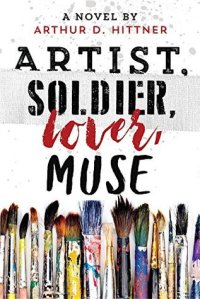
Artist Soldier Lover MuseAbout the Book

Freshly graduated from Yale in 1935, Henry J. Kapler parlays his talent, determination, and creative energy into a burgeoning art career in New York under the wing of artists such as Edward Hopper and Reginald Marsh.  The young artist first gains notoriety when his depiction of a symbolic, interracial handshake between ballplayers is attacked by a knife-wielding assailant at the Corcoran Gallery in Washington.

Yet even as his art star rises, his personal life turns precarious—and perilous—when his love for Fiona, a young WPA muralist, collides with his growing attraction to the exquisitely beautiful Alice, an ex-chorus girl who becomes his model and muse.  Alice is the girlfriend of Fiona’s cousin, Jake Powell, the hot-headed, hard-drinking outfielder for the New York Yankees whose jealousy explodes into abuse and rage, endangering the lives of all three.

While Henry wrestles with his complicated love life, he also struggles mightily to reconcile his pacifism with the rabid patriotism of his Jewish-Russian émigré father.  As war draws near, Henry faces two difficult choices, one of which could cost him his life.

Format: Paperback, ebook (301 pp.)    Publisher: Apple Ridge Fine Arts
Published: 5th December 2017              Genre: Historical Fiction, Art

Purchase Links*
Amazon.co.uk ǀ  Amazon.com
*links provided for convenience, not as part of any affiliate programme

Find Artist, Soldier, Lover, Muse on Goodreads


Guest Post: ‘The Artist in Fiction’ by Arthur D. Hittner, author of Artist, Soldier, Lover, Muse

I love art.  I’ve a particular affinity for the art of the Depression era, much of which is imbued with an emotional edge that reflects the perils of everyday existence during those difficult times.  In my debut novel Artist, Soldier, Lover, Muse I explore the creative mind of a struggling young painter in the New York City art world of the late 1930s.

How does a writer of historical fiction tap into the mind of an artist from another era?  I began by devouring the colorful accounts of the resourceful artists who practiced their craft in New York during the turbulent decade of the Thirties.  There can be no better source for the ambience of a time and place than the reminiscences of those who experienced it.  To further gauge the tenor of the times, I perused the Times—the historical database of The New York Times—whose articles offered a window into the events and controversies that shaped the lives of New Yorkers.  Armed with this knowledge, I could place my protagonist, the young artist Henry J. Kapler, in the midst of these events, as a participant, observer or commentator, as the story dictated.

But what of the creative act itself?  How do you capture on the written page the inspiration that drives the creative process?  In Artist, Soldier, Lover, Muse I utilized two distinct approaches to tap into the creative impulses of Henry Kapler.  One was to ponder an actual work of art and intuit the circumstances that may have brought it into being.  I’ll call this the Chevalier Method.  Tracy Chevalier created an entire novel from a single work of art in Girl With a Pearl Earring.  Consider, for example, the painting reproduced below.  It is the work of Harold J. Rabinovitz (1915-1944), a now obscure American artist whose life and work provided valuable inspiration for the fictional Henry Kapler.

Arthur Hittner Guest Post Image

The following excerpt reflects how I imagined Henry might have approached the subject of this poignant work of art:

The Seventh Avenue Express was the subway Henry knew best.  It stopped at Fourteenth Street, running north to Harlem and southeast to Brooklyn.  With his sketchbook and a pocket full of tokens, Henry descended into the bowels of the city.  He remained submerged for the better part of two weeks, riding from one end of the line to the other, observing and sketching.  Surfacing only to eat, sleep, and attend his morning classes at the League, Henry became as much a part of the screeching, grimy, often creepy world of the underground as the foot-long rats that scampered through the stations like frantic commuters.

The stark interior of a subway car was the setting for Henry’s opus.  Marsh had tackled a similar subject earlier in Why Not Use the “L”, portraying the indifference of passengers in documentary fashion.  Henry would go further, injecting social commentary by staging a morality play within the confines of his canvas.

Henry sifted through scores of sketches for the characters to inhabit his composition.  He roughed out a scene depicting two seated men on the near side of the car to the left, one with his head buried in a newspaper and the other looking blankly ahead; a third man barely awake across the aisle, his elbow resting against the seat back, his right hand propping up his weary head; and a young mother sitting beside him, straining to rein in her fidgety son.  One last figure would complete the composition and supply the narrative: a sightless young man in shirtsleeves and dark glasses proceeding down the aisle toward the viewer, his left hand limply grasping a walking cane, his right palm turned upward in supplication.  It was an all-too-familiar scene, variations of which he’d witnessed repeatedly during his self-banishment underground: a group of passengers, distracted by their own burdens, studiously ignoring the entreaties of a man less fortunate as he passes by seeking charity.’

The second (and diametrically opposite) entrée into the creative mind of my protagonist was through the developing plotline, trusting that the story would inform Henry who would, in turn, create an artwork derived purely from my own imagination.  In Artist, Soldier, Lover, Muse  Henry’s muse, Alice Woodley, is a beautiful ex-chorus girl involved in an abusive relationship with a professional athlete named Jake Powell.

Consider this excerpt from Chapter Twenty-Two:

‘For much of the next forty-eight hours, the portrait of Alice consumed him.  He realized that what he’d started to paint from life, he was now painting from deep within himself.  What she’d told him, and how she’d spoken and acted, were as much a part of what he was now creating as the actuality of her physical being.  He remembered the fist Kuniyoshi had placed on the table in the classroom, and the shadow it cast.  He’d captured the actuality of his model in their session two days earlier, but it took the succeeding couple days of laborious effort for the truth to emerge.  He studied the painting closely.  What had begun as a likeness of an extraordinarily beautiful young woman had evolved into a portrait of both beauty and vulnerability.  This was not the hardened, streetwise woman that had surprised and disappointed him at the automat, although that was certainly a part of what she’d become.  There was much more—and it thrilled him to discover it peering out from the canvas.

Waiting was the title he chose for the painting.  It made sense to him.  He perceived a young woman waiting to make sense of her life, to comprehend and reconcile the choices she’d made, to find a path forward.’

In the end, the writer’s means for divining the artistic vision of his protagonist shouldn’t matter.  What matters is that his character’s creative impulses feel genuine to the reader.  The paintings portrayed in the novelist’s narrative should be equally accessible in the reader’s mind, whether the artwork has an existence in the real world or solely in the writer’s imagination.  Whether I’ve succeeded in transporting you into the creative mind of Henry Kapler is something only you can judge.  I invite you to read Artist, Soldier, Lover, Muse to decide for yourself.                                  © Arthur D. Hittner, 2018


Arthur D HittnerAbout the Author

Arthur D. Hittner is the author of the historical novel Artist, Soldier, Lover, Muse and  Honus Wagner: The Life of Baseball’s ‘Flying Dutchman (McFarland, 1996), winner of the Seymour Medal awarded by the Society of American Baseball Research for the best book of baseball history or biography published in 1996.  Other books include At the Threshold of Brilliance:The Brief but Splendid Career of Harold J. Rabinovitz (The Rabinovitz Project, 2014), a biography and catalogue raisonne of a newly rediscovered master of American art of the Depression era and the irreverent travelogue, Cross-Country Chronicles: Road Trips Through the Art and Soul of America.

Mr. Hittner has also written about fine art subjects for Maine Antique Digest, Fine Art Connoisseur and Antiques & Fine Art and has served as a Trustee of the Danforth Museum of Art and the Tucson Museum of Art.

Connect with Arthur

Website ǀ  Goodreads