
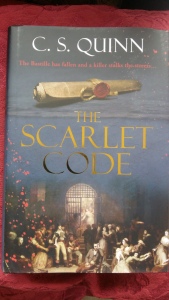
 About the Book
England’s best spy. France’s deadliest conspirator.
Paris, 1789. The Bastille has fallen and Parisians pick souvenirs from the rubble. A killer stalks the lawless streets. His victims are female aristocrats. His executions use the most terrible methods of the ancient regime.
English spy Attica Morgan is laying low in Paris, helping nobles escape. When her next charge falls victim to the killer’s twisted machinations, Attica realises she alone can unmask him. But now it seems his deadly sights are set on her.
As the city prisons empty and a mob mobilises to storm Versailles, finding a dangerous criminal is never going to be easy. Attica’s only hope is to enlist her old ally, reformed pirate Jemmy Avery, to track the killer though his revolutionary haunts. But even with a pirate and her fast knife, it seems Attica might not manage to stay alive.
Format: Hardcover (400 pages) Publisher: Corvus
Publication date: 6th August 2020 Genre: Historical Fiction, Mystery
Find The Scarlet Code on Goodreads
Purchase links*
Amazon UK | Hive (supporting UK bookshops)
*links provided for convenience not as part of an affiliate programme
My Review
The Scarlet Code is the second book in C. S. Quinn’s Revolutionary Spy series featuring female spy and trained assassin, Attica Morgan. It was published as an ebook on 4th June 2020 and is now also available in hardback. Although I wish I’d had time to read the first book in the series, The Bastille Spy, I’m pleased to say The Scarlet Code works perfectly well as a standalone read.
Attica Morgan makes a feisty and engaging heroine. She’s brave, smart, resourceful and is handy in a tight spot; not surprising when you’ve been trained as an assassin. And believe me, Attica gets herself into plenty of tight spots. Given her African heritage and keen sense of justice, Attica is passionately opposed to the slave trade and committed to doing whatever she can to end it. This includes rescuing abolitionists from the clutches of those whose wealth and power are threatened by the idea of equality for all. Despite her position in English society – she is, after all, Lady Morgan – Attica remains an outsider. “I do not fit anywhere. I am too dark to be English, too fair to be African.”
I really liked Attica’s friendship with dashing pirate Jemmy Avery, himself the product of “dockyard alliances and foreign flings“. It’s a partnership of equals based on mutual regard and fuelled by light-hearted banter with just a hint that something more than friendship could lie beneath the surface. He’s certainly the person who understands Attica best. “Some people are born to talk and flatter, others are bred for action.” No prizes for guessing which category Attica falls into.
Attica’s relationship with mentor and spy-master, Atherton, is equally intriguing. He’s a key figure in an organisation known as the Sealed Knot, “a partially legal hinterland of spies, crooks and thieves” which secretly pursues the interests of the British government at home and abroad. Atherton is an inventor of all sorts of gadgets useful for espionage; an 18th century version of ‘Q’ from Ian Fleming’s James Bond novels, if you like.
Set against the backdrop of revolutionary France, Attica finds herself beset by enemies on every side. Not just ruthless killers on the streets of Paris and those opposed to the abolition of slavery but an old adversary, none other than Robespierre himself. The contrast between the wealth and excesses of the nobility and the poverty of the citizens of Paris is stark, making for exciting scenes as the populace rise in protest. Add to the mix an evil villain described as “A hunter… a man who stalks by night“, plenty of narrow escapes and some fantastic set pieces in locations such as the Louvre and the Palace of Versailles and you have all the ingredients for an exciting page-turner. Or perhaps, on reflection, a white water ride might be a better description, with dangerous undercurrents and treacherous obstacles hidden beneath the surface.
Can Attica turn the tables on those out to thwart her? She’d not be worth her salt if she can’t. Perhaps, though, there is one enemy who knows her weaknesses better than she does herself. The trap is set. Will she swallow the bait? It’s going to be a battle of wits.
From its dramatic opening chapter, The Scarlet Code moves along at a terrific pace. A glorious mixture of intrigue and swashbuckling action worthy of a golden age Hollywood movie starring Errol Flynn, it will delight readers who like their historical fiction to come with a generous helping of adventure. As for me… I may just have found a new series to fall in love with.
My thanks to Corvus and Readers First for my advance review copy.
In three words: Action-packed, thrilling, adventure
Try something similar: Traitor (Mercia Blakewood #3) by David Hingley
Follow this blog via Bloglovin
 About the Author
C. S. Quinn is a travel and lifestyle journalist for The Times, the Guardian and the Mirror, alongside many other magazines. Prior to this, Quinn’s background in historic research won prestigious postgraduate funding from the British Art Council. Quinn combined this with her first-hand experiences in far-flung places to create her bestselling The Thief Taker series. The Scarlet Code is the second novel in her new Revolutionary Spy series featuring Attica Morgan. (Photo credit: author Twitter profile)
Connect with C. S. Quinn
Website | Facebook | Twitter | Instagram

 Welcome to today’s stop on the blog tour for Lionheart by Ben Kane, which will be published by Orion on 28th May 2020 but is available to pre-order now. My thanks to Virginia at Orion for inviting me to take part in the tour and for my proof copy.
 About the Book
 About the Author
 What Cathy Read Next...