#BookReview The Stasi Game (Karin Müller #6) by David Young @ZaffreBooks

About the Book The Stasi Game

A man’s body is found buried in concrete at a building site in the new town district. When People’s Police homicide captain Karin Müller arrives at the scene, she discovers that all of the body’s identifiable features have been removed – including its fingertips.

The deeper Müller digs, the more the Stasi begin to hamper her investigations. She soon realises that this crime is just one part of a clandestine battle between two secret services – the Stasi of East Germany and Britain’s MI6 – to control the truth behind one of the deadliest events of World War II.

Format: ebook (281 pages) Publisher: Zaffre
Publication date: 12th November 2020 Genre: Historical Fiction, Crime, Thriller

Find The Stasi Game (Karin Müller #6) on Goodreads

Pre-order/Purchase links*
Amazon UK | Hive (supporting UK bookshops)
*links provided for convenience not as part of an affiliate programme


My Review

I discovered David Young’s ‘Stasi’ series back in February when I read Stasi Winter, the fifth book featuring Karin Müller of the East German People’s Police. I enjoyed it so much that I made a plan – unfortunately as yet unfulfilled – to go back and read the earlier books ready for the next book in the series. Imagine my dismay therefore to read that The Stasi Game may be the last book in the series. Luckily for those of us who’ve not yet read the whole series, The Stasi Game has been designed as a standalone although there are brief references to events in previous books.

Opening in 1982 and set largely in Dresden, The Stasi Game begins with a dramatic prologue and then transports the reader back to events in the months leading up to it. There are occasional forays further back in time, to the period of the Second World War and a friendship between two young people the full relevance of which will only gradually be revealed. Central to these sections of the book is the still controversial firebombing of Dresden by the Allies in February 1945 which killed thousands and destroyed much of the city. The vivid first-hand account of the raids is one of the standout parts of the book.

From the very start of their investigation into the death of the man they refer to as ‘Concrete Man’, Karin Müller and her team find themselves playing a cat and mouse game with the Ministry of State Security, better known as the Stasi. No prizes for guessing which is the cat and which the mouse. In addition, Müller finds herself coming face to face with an old adversary and begins to wonder if, in fact, she has been set up to fail from the beginning.

As the case progresses, amongst all the twists and turns, some very dirty wartime secrets – as well as more recent ones – are unearthed. The book’s final climatic scenes continue where the prologue left off, leaving the reader to wonder what the future holds for Müller and her colleagues. If this is indeed the end of the series, then The Stasi Game is a lesson in how to go out on a high and leave the reader wanting more.

I received an advance review copy courtesy of Zaffre via NetGalley.

In three words: Gripping, compelling, assured

Try something similar: Hitler’s Secret by Rory Clements

Follow this blog via Bloglovin


David YoungAbout the Author

David Young was born near Hull and, after dropping out of a Bristol University science degree, studied Humanities at Bristol Polytechnic. Temporary jobs cleaning ferry toilets and driving a butcher’s van were followed by a career in journalism on provincial newspapers, a London news agency, and international radio and TV newsrooms. He now divides his time between Twickenham and a writing base on Syros in Greece, and in his spare time supports Hull City AFC. (Photo bio/ credit: author website)

Connect with David
Website | Twitter

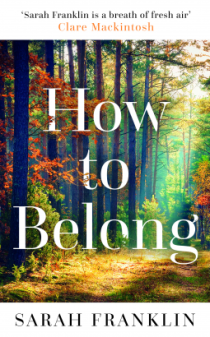
#BookReview How To Belong by Sarah Franklin @ZaffreBooks

How To BelongAbout the Book

Jo grew up in the Forest of Dean, but she was always the one destined to leave for a bigger, brighter future. When her parents retire from their butcher’s shop, she returns to her beloved community to save the family legacy, hoping also to save herself. But things are more complex than the rose-tinted version of life which sustained Jo from afar.

Tessa is a farrier, shoeing horses two miles and half a generation away from Jo, further into the Forest. Tessa’s experience of the community couldn’t be more different. Now she too has returned, in flight from a life she could have led, nursing a secret and a past filled with guilt and shame.

Compelled through circumstance to live together, these two women will be forced to confront their sense of identity, and reconsider the meaning of home.

Format: Hardcover (368 pages)               Publisher: Zaffre
Publication date: 12th November 2020 Genre: Contemporary Fiction

Find How to Belong on Goodreads

Purchase links*
Amazon UK | Hive (supporting UK bookshops)
*link provided for convenience not as part of an affiliate programme


My Review

I was initially drawn to Sarah Franklin’s first novel, Shelter, because it was set during World War Two which is one of my favourite periods for historical fiction. I was also intrigued by the choice of location, the Forest of Dean. I loved the book and it left me keen to read whatever Sarah came up with next.

In How To Belong the location is once more the Forest of Dean but this time we’re very much in the present day. However, there is a sense of the timelessness of the Forest, even if much around it has changed and is still changing. Not only a source of recreation and employment, and a haven for wildlife, the Forest acts as a place for contemplation and reflection. As one character puts it, “The trees will restore the mess“.

The book switches between the points of view of Jo and Tessa, two women who are very different in terms of their life experience and character. Tessa is by nature an introvert whose one attempt at reaching out and expressing her true self ended in rejection, disappointment and a sense of failure, for reasons the reader will gradually discover. Jo, on the other hand, has forged a life for herself away from the Forest, a life that had been successful in many ways but which has left her unfulfilled and with a desire to return to her roots.

Jo returns with big plans for the family butcher’s shop but is disappointed to find it more difficult than she expects to be absorbed back into the community. The friends she grew up with have built their own lives – married, started families – and talk about people she doesn’t know. “The group’s shifted. She doesn’t know who she is or where she fits in. There’s nowhere left for her to go.” In particular, Jo struggles to understand the change in her relationship with her childhood friend, Liam, with whom she was once so close. “She’s homesick for happy Liam, who doesn’t exist anymore; perhaps never did outside her own naive bubble… Most of all, she’s homesick for her old self.” What Jo comes to realise is that it’s possible to be the repository of others’ hopes and dreams, not just your own.

Tessa has become used to living a life socially distant from others. From childhood, she’s instinctively felt different from her peers for reasons she couldn’t initially explain. Traumatic incidents in her past have left her with a misplaced sense of guilt as well as worries about her future.

Thrown together by chance, Jo and Tessa slowly discover they have more in common than they may have thought and that each can help the other find a way to achieve the sense of belonging they both crave. Whether that’s feeling a part of a community or a family, having a sense of security, fulfilling a dream or simply being comfortable in your own skin.

How To Belong is an engrossing human drama that shows it’s never too late to start again, if you just give yourself the chance.

I received an advance review copy courtesy of Zaffre Books, NetGalley and Readers First.

In three words: Tender, insightful, intimate

Try something similar: Birdie & Jude by Phyllis H. Moore

Follow this blog via Bloglovin


Sarah FranklinAbout the Author

Sarah Franklin grew up in rural Gloucestershire and has lived in Austria, Germany, the USA and Ireland. She lectures in publishing at Oxford Brookes University and has written for the Guardian, the Irish TimesPsychologies magazine and The Pool. (Photo credit: Twitter profile)

Connect with Sarah
Twitter