
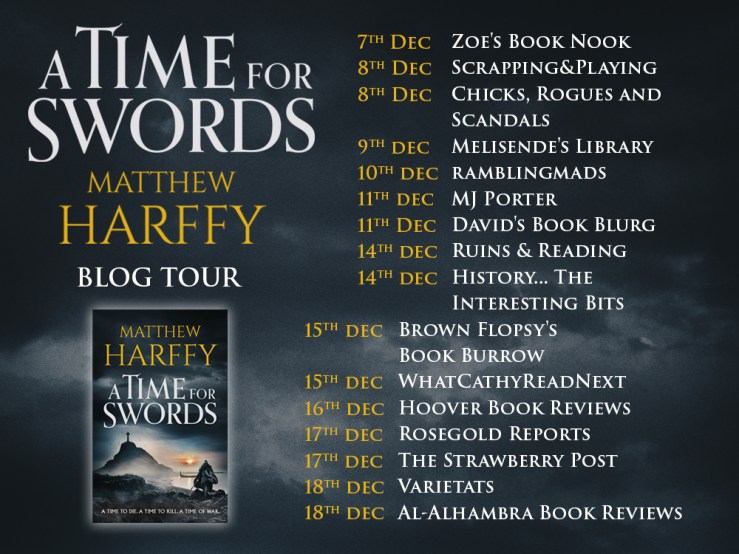
Welcome to today’s stop on the blog tour for A Time For Swords by Matthew Harffy, the first book in a brand new series set in the Viking age. My thanks to Jade at Head of Zeus for inviting me to take part in the tour and for my digital review copy via NetGalley. Do check out the post by my tour buddy for today, Sue at Brown Flopsy’s Book Burrow. Available now as an ebook, A Time for Swords will be published in hardback on 4th March 2021.
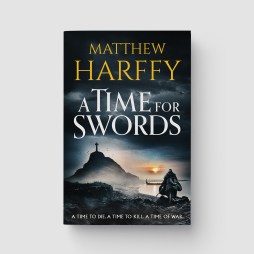 About the Book
Lindisfarne, AD793. There had been portents – famine, whirlwinds, lightning from clear skies, serpents seen flying through the air. But when the raiders came, no one was prepared. They came from the North, their dragon-prowed longships gliding out of the dawn mist as they descended on the kingdom’s most sacred site.
It is 8th June AD793, and with the pillage of the monastery on Lindisfarne, the Viking Age has begun. While his fellow monks flee before the Norse onslaught, one young novice stands his ground. He has been taught to turn the other cheek, but faced with the slaughter of his brothers and the pagan desecration of his church, forgiveness is impossible.
Hunlaf soon learns that there is a time for faith and prayer… and there is a time for swords.
Format: ebook (400 pages) Publisher: Head of Zeus
Publication date: 10th December 2020 Genre: Historical Fiction
Find A Time for Swords on Goodreads
Purchase links*
Amazon UK
*Link provided for convenience only, not as part of an affiliate programme
My Review
Matthew Harffy is best known for his Bernicia Chronicles series set in 7th century Northumbria of which Fortress of Fury is the latest instalment. Last year also saw publication of his standalone historical novel, Wolf of Wessex.
A Time for Swords takes place a century on from the exploits of Beobrand in the Bernicia Chronicles, transporting the reader to the time of the first Viking raids on the northeast of Britain. Our narrator is Hunlaf who, in old age, seeks to record the story of an eventful life. As he says, “I’ve seen things people wouldn’t believe. A Turkic ship on fire off the shore of Odessa. I’ve watched sunbeams glitter in the dark eyes of the Empress of Roma as we passed beneath Byzantion’s Golden Gate. I do not want all those moments to be lost in time like the winter snow when the rains of spring come.” (Is it just me or is that a subtle allusion to the ‘tears in rain’ speech by Rutger Hauer at the end of the film Bladerunner? If so, it will demonstrate the efforts of my MA English tutor to have me grasp the concept of intertextuality were not in vain.)
Hunlaf begins his story looking back to his time as a young novice at the minster of Werceworthe (modern day Warkworth in Northumberland). Despite his vocation, Hunlaf admits to being enthralled as a boy by the tales his father told him of Beobrand’s exploits against the Mercians (the subject of Fortress of Fury). As a neat in-joke, the author has Hunlaf observe, “I am sure now…that all such yarns have been embellished, for is that not the way of the storyteller, to make the tale more exciting than the simple truth?”
When he travels to Lindisfarne with his fellow monk, Brother Leofstan, Hunlaf has an unexpected reunion and, with echoes of The Name of the Rose, catches sight of a forbidden book in the monastery’s library. Both events will be significant for the future but, for the time being, are overshadowed by the arrival of three Viking warships. Murder, rape and pillage follow but, during the raid, Hunlaf discovers his instinct is to fight the attackers not flee. That action will result in the forging of an unlikely alliance and mark a change in the future path of his life. It will also leave him with long-lasting memories of the dreadful sights he witnessed. “A warrior’s scars are many, and not all of them leave their mark on the flesh.”
Knowing the Vikings are likely to target other vulnerable sites such as Werceworthe, Hunlaf joins the search for warriors willing to help defend the community. Six eventually become a warband of seven, each with their own particular skill with sword, axe or bow. By the way, if you’re thinking seven is a significant (even a magnificent) number you’re correct, as the author explains in his afterword. Each of the seven have their own personal reasons for wanting to fight, whether that’s to test themselves against the best, to protect the weak or a desire for revenge.
Like the inhabitants of Werceworthe, the reader anxiously awaits the return of the Norsemen, hoping that the crude defensive devices they have prepared and their carefully thought-out plans will be sufficient to protect the community. It will come as no surprise to readers of Matthew Harffy’s previous books that the action scenes are vividly described so you feel every thud of axe upon shield, hear the swift flight of arrows towards the enemy and smell the burning houses. Will Hunlaf take up his quill to record more of his adventures? If he does, it promises to be to tell of a quest to rival John Wayne’s in The Searchers.
A Time For Swords is a skillfully crafted and compelling introduction to what seems certain to be an addictive new series for fans of historical fiction.
In three words: Thrilling, action-packed, immersive
Try something similar: Wolf of Wessex by Matthew Harffy
Follow this blog via Bloglovin
 About the Author
Matthew grew up in Northumberland where the rugged terrain, ruined castles and rocky coastline had a huge impact on him. He now lives in Wiltshire, England with his wife and their two daughters.
Connect with Matthew
Website | Twitter

 About the Book
 About the Author
 What Cathy Read Next...