
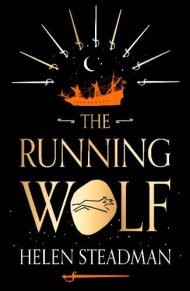
 About the Book
When a German smuggler is imprisoned in Morpeth Gaol in the winter of 1703, why does Queen Anne’s powerful right-hand man, The Earl of Nottingham, take such a keen interest?
At the end of the turbulent 17th century, the ties that bind men are fraying, turning neighbour against neighbour, friend against friend and brother against brother. Beneath a seething layer of religious intolerance, community suspicion and political intrigue, The Running Wolf takes us deep into the heart of rebel country in the run-up to the 1715 Jacobite uprising.
Hermann Mohll is a master sword maker from Solingen in Germany who risks his life by breaking his guild oaths and settling in England. While trying to save his family and neighbours from poverty, he is caught smuggling swords and finds himself in Morpeth Gaol facing charges of High Treason. Determined to hold his tongue and his nerve, Mohll finds himself at the mercy of the corrupt keeper, Robert Tipstaff. The keeper fancies he can persuade the truth out of Mohll and make him face the ultimate justice: hanging, drawing and quartering. But in this tangled web of secrets and lies, just who is telling the truth?
Format: Paperback (320 pages) Publisher: Impress Books
Publication date: 1st December 2020 Genre: Historical Fiction
Find The Running Wolf on Goodreads
Purchase links
Bookshop.org
Disclosure: If you buy a book via the above link, I may earn a commission from Bookshop.org, whose fees support independent bookshops
Hive | Amazon UK
Links provided for convenience only, not as part of an affiliate programme
My Review
The book’s clever structure alternates between Morpeth Gaol in 1703-4, with events narrated by its wily and dishonest keeper Robert Tipstaff, and the story of the Solingen swordmakers, focused on Herman Mohll and his family. Starting with their arrival in Shotley Bridge in 1687, gradually the two storylines come together as the reader learns chapter by chapter how Mohll comes to find himself a prisoner and facing a charge of high treason. Along the way, the reader discovers much about the art of swordmaking, as Mohll instructs his apprentice in the various stages, and also about the risk of injury presented by the work and its dangerous long-term effects on health.
I particularly enjoyed the way the author introduced into the story themes which have contemporary resonance. For example, the Solingen swordmakers are essentially economic migrants, driven to move to England because that is where the best market for their products exists and the most favourable economic future for their families. The mention of duties and tariffs on the high quality steel imported from Germany had me thinking (unfortunately) of Brexit. Other issues touched on are the power of the Guilds in the swordmakers’ native Germany and the value from an intellectual property point of view of the Solingen swordmakers’ knowledge of the secret of making their famous blades.
Perhaps one of the most interesting themes is that of identity. Some of the Solingen swordmakers are anxious to hold on to their sense of being German – to create “a little Solingen” in Shotley Bridge – whilst others, including Hermann, see the necessity, indeed the inevitability, of integration with their English neighbours. As he observes, “Air must take on the scent and taste of whatever it touched, moving around the earth, the wind whipping along from country to country. It would be better to be like the air, carrying a little of whatever he’d touched but constantly moving and blending in”. In particular, when it comes to his young daughter Liesl, Hermann recognizes he can’t ‘insulate’ her from England and pretend she still lives in Germany. Readers will be pleased to know, however, the Mohlls don’t ditch all of their German customs, as the splendid description of their Christmas celebrations demonstrates.
The Mohlls are Lutheran but, ironically, Hermann is suspected of smuggling arms to aid the Jacobite cause. At one point he muses, “If only men the world over could accept there was a single Creator but many ways of praising Him, the world might be a happier place and mankind might stop tearing itself apart“. This from a man who makes swords for a living and regrets the commercial impact on their replacement by guns in modern warfare.
 As with Helen Steadman’s previous books, Widdershins and Sunwise (both of which I can recommend), her research is clearly extensive. For example, she reveals in her afterword that, in the course of her research into the Shotley Bridge swordmakers, she discovered archive documents that shed new light on a three hundred year-old mystery. I was also interested to learn that one of the characters in the book – the ‘madman’ Ralph Maddison – whom I initially regarded as a bit farfetched, did exist in real life and was very likely a near neighbour of the Shotley Bridge swordmakers. Well, they do say truth is stranger than fiction! You can find out more about Helen’s research for the book, which included learning the art of swordmaking, on her website.
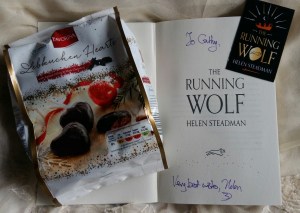
The Running Wolf is an example of the kind of historical fiction I love. It’s a finely honed blend of historical fact and the author’s imagination; a work of creativity to match one of Herman Mohll’s swords you could say. I received a personally inscribed advance review copy (along with some lovely goodies) courtesy of the author and Impress Books.

In three words: Fascinating, well-researched, immersive
Try something similar: The Blue by Nancy Bilyeau
Follow this blog via Bloglovin
 About the Author
Helen Steadman’s bestselling first novel, Widdershins and its sequel, Sunwise were inspired by the Newcastle witch trials. Helen recently completed a PhD in English at the University of Aberdeen and is now working on her fourth novel.
Connect with Helen
Website | Twitter | Facebook | Instagram


 What Cathy Read Next...