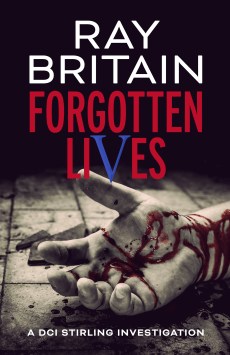
#BookReview Forgotten Lives (DCI Doug Stirling 2) by Ray Britain @ray_britain

Forgotten LivesAbout the Book

A man is murdered with quiet efficiency on his doorstep. A strange emblem left behind suggests a gang killing but when more bodies are found with the same emblem, and one of them a cop, DCI Doug Stirling’s investigation takes a sinister turn. But what linked the victims in life, and now in death?

When more deaths are uncovered, miles away and years ago, all with the same emblem left behind, pressure mounts on Stirling. Is it the work of the same person? If so, why are they killing again, and why here? One thing is clear, the killer is highly skilled, ruthless, and always one step ahead of the investigation. Is someone feeding information to them?

Working in a crippling heatwave with too few investigators, too many questions and not enough answers, when wild media speculation of a vigilante at work sparks copycat attacks, demonstrations for justice and with politicians fearing riots, Stirling needs a result – fast!

Meanwhile, Stirling’s private life is falling apart, not helped when Lena Novak of the National Crime Agency is assigned to his team. But is she all that she seems?

Things could not get worse. Stirling takes a call from a retired cop. Things just got worse! When Stirling closes in on the killer he finds the killer’s trademark inside his home – he is being targeted.

Format: ebook (422 pages)                   Publisher:
Publication date: 10th January 2021 Genre: Crime

Find Forgotten Lives on Goodreads

Purchase links
Amazon UK
Links provided for convenience only, not as part of an affiliate programme


My Review

I was fortunate enough to have the opportunity to read Ray Britain’s first novel, The Last Thread, so was delighted when he contacted me to let me know the next book in the DCI Stirling series was due to be published on 10th January 2021.

Given the author’s background, Forgotten Lives is, like its predecessor, incredibly strong on the detail of police procedure – securing a crime scene, conducting house to house enquiries, logging and cross-referencing information on police databases, and so on. It also vividly conveys the realities of modern day policing – budget cuts, resource constraints, interminable paperwork as well as the constant scrutiny, both internal and external, of investigative decisions. Although modern technology, such as drones equipped with thermal imaging now plays a part in an investigation, it’s clear that when it comes to solving crime there’s still no substitute for attention to detail and experience. Indeed Stirling’s mantra is ABC: accept nothing, believe no-one, check everything.

As in the first book, there are elements of Stirling’s past that remain a mystery, even to his closest friends. What is behind the door of that locked room in his house, for instance? As if the long and unsocial hours that come with his job wasn’t enough, he has a history of failed relationships and a reluctance to enter into long-term commitments. I certainly felt sympathy for Stirling’s current partner, Ayesha, as she wonders if they have a future together or whether she’s about to join the long list of his ex-girlfriends.

The author employs the crime novelist’s weapons of choice – misdirection, red herrings and subtle clues that only the incredibly observant are likely to spot – in an effort to wrong-foot the reader. He certainly succeeded with this one who was convinced she had spotted the perpetrator, erroneously as it turned out. As the scope of the investigation widens, the story ventures beyond the realm of the police procedural and into thriller territory with dramatic scenes as he and the team close in on what turns out to be an extremely formidable individual.

Forgotten Lives is a chunkier read than the stated page count would suggest, requiring a staying power from the reader similar to that demanded of the investigation team. However, I’m sure crime fans who enjoy immersing themselves in the nitty gritty of a complex investigation will find the investment of time amply repaid.

My thanks to the author for my digital review copy of Forgotten Lives.

In three words: Realistic, gritty, immersive

Try something similar: Payback by R.C. Bridgestock

Follow this blog via Bloglovin


Ray BritainAbout the Author

As a Senior Investigating Officer (SIO) Ray Britain led many specialist investigations. He was also a Hostage & Crisis Intervention Negotiator, a voluntary role that saw him involved in hostage situations, many firearms operations and numerous suicide interventions, not all of which ended happily. In those specialist roles he supported national counter-terrorism capabilities and travelled to the USA, India, Europe, Australia and elsewhere. He received several commendations for his work. He also worked with the Serious Fraud Office and the Home Office, London, and the Economic Crime Directorate of the City of London Police.

His second novel Forgotten Lives follows publication of The Last Thread in 2017. Ray’s real-world experience gives an authentic edge to his stories, immersing the reader in the grim realities, uncertainties and frustrations of crime investigation, and of human nature. If not writing Ray might be found mountain hiking, watching rugby, skiing, reading, sailing or in the gym.

Connect with Ray
Website | Twitter | Instagram | Facebook

#BookReview Game of the Gods by Paolo Maurensig @WorldEdBooks @RandomTTours

Game of the Gods BT Poster One

Welcome to today’s stop on the blog tour for Game of the Gods by Paolo Maurensig, translated by Anne Milano Appel. My thanks to Anne at Random Things Tours for inviting me to participate in the tour and to World Editions for my advance review copy.


Game of the GodsAbout the Book

In 1930s British India, a humble servant learns the art of chaturanga, the ancient Eastern ancestor of chess. His natural talent soon catches the attention of the maharaja, who introduces him to the Western version of the game. Brought to England as the prince’s pawn, Malik becomes a chess legend, winning the world championship and humiliating the British colonists. His skills as a refined strategist eventually drag him into a strange game of warfare with far-reaching consequences.

Inspired by the unlikely true story of chess master Malik Mir Sultan Khan, Game of the Gods is a fascinating tale of karma and destiny, by the author of the multimillion-copy bestseller The Lüneburg Variation.

Format: Paperback (256 pages)           Publisher: World Editions
Publication date: 12th January 2020 Genre: Historical Fiction

Find Game of the Gods on Goodreads

Purchase links
Bookshop.org
Disclosure: If you buy a book via the above link, I may earn a commission from Bookshop.org, whose fees support independent bookshops

Hive | Amazon UK
Links provided for convenience only, not as part of an affiliate programme


My Review

I had the opportunity to read Paolo Maurensig’s novella A Devil Comes To Town (also translated by Anne Milano Appel) in 2019. At the time I wasn’t aware of the extent of the author’s interest in chess but have subsequently discovered it’s the subject of a number of his novels including his debut The Lüneburg Variation and the prize-winning Theory of Shadows.

Described by the publishers as ‘the story of a lowly servant who, for an instant, becomes a king’, in Game of the Gods the author takes actual facts about the life of chess master Malik Mir Sultan Khan and, using the framing device of extracts from the notebooks of a fictional reporter for the Washington Post, adds elements from his own imagination.

The book begins with Noman La Motta having tracked down the reclusive Malik Mir Sultan Khan to the mission where he is spending his declining years.  La Motta gains a rare interview with him thanks to his own boyhood interest in chess. Malik recounts the story of his childhood, including being taught the art of chaturanga, the Eastern ancestor of chess, by his father.

A hunt for a marauding tiger which has been attacking the village attracts the attention of the sport- loving maharaja, Sir Umar Khan, the largest landowner in the Punjab. Impressed by young Malik’s precocious skill at chaturanga, Sir Umar takes him into his household and arranges for him to be coached in the Western rules of chess. The author’s depicts Sir Umar Khan as a colourful character with, as Malik observes, “a natural penchant for provoking others, but…with such civility as to make the other party doubt whether he had understood correctly“.

The book includes fascinating information about chaturanga. Describing it as ‘on a mental level…as close to war as one could imagine’, Malik explains that chaturanga is not just a game but “a philosophical text [that] embraced the arts, the trades, the religious hierarchy, the social order, and the division into castes”. Importantly for later events, it can teach a warrior or commander when to attack and when to retreat, in fact how to predict the fate of any battle.

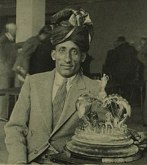
Malik Mir Sultan KhanEventually Sir Umar Khan takes Malik to Europe where he wins championship after championship, defeating the best chess players of the day. However, he is constantly perturbed at being treated as ‘a freak of nature, a curious phenomenon’ suspecting that his ethnic background makes people unwilling to recognise him as a genuine master of the game. In books of this type it can be difficult to spot where fiction parts company with historical fact. Thanks to Wikipedia, I can advise prospective readers that Malik’s brilliant chess victories are based on fact and it is only in the second half of the book that the author’s imagination comes to the fore.

In this fictional version of Malik’s life, the outbreak of World War II sees his remarkable strategic insight put to use in the service of the Allies. In fact, so amazing is his ability to predict the outcome of field operations, it brings him under suspicion. As a result, he flees to New York where he variously works as a kitchen-hand in a Chinese restaurant, a Manhattan newsboy, a sandwich-board man and a taxi driver. It’s while employed in the latter role that Malik has a fateful (perhaps, fated) encounter that results in him forming a touching relationship with an elderly lady.  She provides him with the cultural education he lacks as well as introducing him to famous figures of the day. As he observes, “I had once again risen from the dust to enter a gilded world”.

Game of the Gods is an inventive and entertaining reimagining of the life of a little-known luminary of the chess world that I’m sure will appeal to readers regardless of their knowledge of, or interest in, the game of chess.

A final word about the publishers, World Editions, who do so much to champion translated literature. What I especially like about their books is that, not only do they include biographical information about the author, but about the translator as well. Another nice touch is the inclusion of details about the typography and cover designs because, after all, publishing a book is a team effort.

In three words: Imaginative, touching, fascinating

Follow this blog via Bloglovin


Paolo Maurensig

About the Author

Paolo Maurensig was born in Gorizo and lives in Udine, Italy. Now a bestselling author, he debuted in 1993 with The Lüneburg Variation, translated into over twenty languages. His novels include Canone Inverso, The Guardian of Dreams, and The Archangel of Chess. He won the Bagutta Prize for his novel Theory of Shadows. A Devil Comes to Town, previously published by World Editions, is a brilliant, satirical novella about literary publishing. Game of the Gods is Maurensig’s latest novel and was awarded the prestigious Premio Scanno 2019 Literary Award.

About the Translator

Anne Milano Appel has translated works by a number of leading Italian authors for a variety of publishers in the US and UK. Her awards include the Italian Prose in Translation Award, the John Florio Prize for Italian Translation, and the Northern California Book Award for Translation. Translating professionally since 1996, she is a former library administrator, and has a doctorate in Romance Languages.