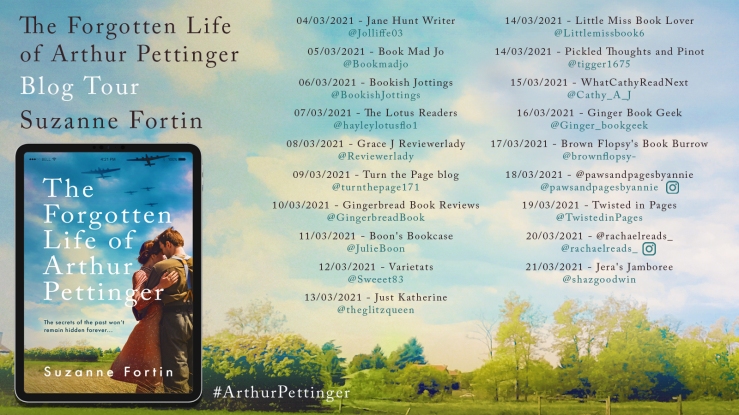
#BookReview The Forgotten Life of Arthur Pettinger by Suzanne Fortin @Aria_Fiction

Arthur Pettinger Blog Tour

Welcome to today’s stop on the blog tour for The Forgotten Life of Arthur Pettinger by Suzanne Fortin. My thanks to Vicky Joss at Head of Zeus for inviting me to take part in the tour and for my limited edition proof copy. The Forgotten Life of Arthur Pettinger was published as an ebook on 4th March and will be available in paperback on 10th June 2021.
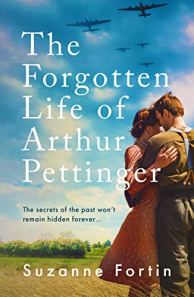

The Forgotten Life of Arthur PettingerAbout the Book

Sometimes the past won’t stay hidden, it demands to be uncovered…

Arthur Pettinger’s memory isn’t what it used to be. He can’t always remember the names of his grandchildren, where he lives or which way round his slippers go. He does remember Maryse though, a woman he hasn’t seen for decades, but whose face he will never forget.

When Arthur’s granddaughter, Maddy moves in along with her daughter Esther, it’s her first step towards pulling her life back together. But when Esther makes a video with Arthur, the hunt for the mysterious Maryse goes viral.

There’s only one person who can help Maddy track down this woman – the one that got away, Joe. Their quest takes them to France, and into the heart of the French Resistance.

When the only way to move forwards is to look back, will this family finally be able to?

Format: ebook (379 pages)           Publisher: Aria
Publication date: 4th March 2021 Genre: Historical Fiction, Contemporary Fiction, Romance

Find The Forgotten Life of Arthur Pettinger on Goodreads

Purchase links
Hive | Amazon UK
Links provided for convenience only, not as part of an affiliate programme


My Review

The Forgotten Life of Arthur Pettinger is one of those books that offers something for just about every reader:  there are elements of domestic drama, such as the family tensions caused by caring responsibilities; scenes of wartime adventure and romance; and a search for a long lost love.

I loved the touching and very natural relationship that develops between Maddy’s daughter, Esther, and her great-grandfather, even if Arthur does occasionally struggle to recall Esther’s name (although he never seems to forget that his favourite biscuits are digestives).  It’s a neat echo of the close relationship Maddy remembers having with Arthur herself when she was younger.  As it turns out, affection for Arthur is not the only thing Esther has inherited.  She also has the same inquisitive nature and independent instincts as her mother.

The book eloquently conveys the challenges of caring for someone with dementia, although Maddy’s sympathetic response and greater understanding of Arthur’s need for routine proves much more successful than that of her half-sister, Hazel, who previously cared for him.  (Arthur privately christened Hazel ‘Moaning Minnie’). Although Maddy recognises the role photographs and music can play in provoking what memories are left, she knows it’s only a matter of time before Alzheimer’s claims Arthur completely. I’m sure many readers can empathize with Maddy when she thinks, “It was so cruel, so painful this long goodbye, watching her grandfather slowly disappear in front of her…”.

The author finds imaginative ways to allow the reader inside the mind of Arthur and witness his own frustration at his declining memory. “It was all muddled up in his mind like a heap of spaghetti and he didn’t know where the strands of thought started.  They were a jumbled mess of words and images, fragments of memory and snatches of thought – all knotted up together.”

The details of Maddy’s search for Maryse, assisted by investigator and ex-boyfriend, Joe, and the difficult moral dilemmas thrown up along the way, will be familiar to fans of TV programmes such as Heir Hunters or Long Lost Family. Trust me, as the book nears its conclusion, you’ll find yourself in complete agreement with Arthur as he thinks, “He wished he knew how his story ended and what happened to those he loved”.

For me, the ending, although bittersweet, was the perfect conclusion to the story. After all, there’s more than one way to be reunited.

In three words: Touching, emotional, poignant

Try something similar: Endless Skies by Jane Cable

Follow this blog via Bloglovin
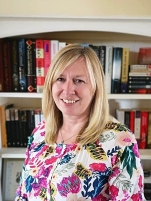

Sue Fortin July 20 a - Sue FortinAbout the Author

Suzanne Fortin is a USA Today and Amazon UK & USA best selling author, with The Girl Who Lied and Sister Sister both reaching #1 in the Amazon UK Kindle chart in 2016 and 2017 respectively. Her books have sold over a million copies and translation rights for her novels have been sold worldwide. She was born in Hertfordshire but had a nomadic childhood, moving often with her family, before eventually settling in West Sussex where she now lives with her husband and family.

Connect with Suzanne
Website | Twitter | Facebook | Instagram

#BookReview How Beautiful We Were by Imbolo Mbue

How Beautiful We WereAbout the Book

Set in the fictional African village of Kosawa, How Beautiful We Were tells the story of a people living in fear amidst environmental degradation wrought by an American oil company. Pipeline spills have rendered farmlands infertile. Children are dying from drinking toxic water. Promises of clean-up and financial reparations to the villagers are made – and ignored. The country’s government, led by a brazen dictator, exists to serve its own interest only. Left with few choices, the people of Kosawa decide to fight back. But their fight will come at a steep price, one which generation after generation will have to pay.

Told through the perspective of a generation of children and the family of a girl named Thula, How Beautiful We Were is a masterful exploration of what happens when the reckless drive for profit, coupled with the ghost of colonialism, comes up against one community’s determination to hold onto its ancestral land and a young woman’s willingness to sacrifice everything for the sake of her people’s freedom.

Format: Hardcover (368 pages)       Publisher: Canongate
Publication date: 11th March 2021 Genre: Literary Fiction

Find How Beautiful We Were on Goodreads

Purchase links
Bookshop.org
Disclosure: If you buy a book via the above link, I may earn a commission from Bookshop.org, whose fees support independent bookshops

Hive | Amazon UK
Links provided for convenience only, not as part of an affiliate programme


My Review

The story is told from multiple points of view, including a group of children, ‘age-mates’ born in the same year, who act rather like the Chorus in a Greek play. This structure allows the reader to see the story from a number of different perspectives, reflecting the varying experiences and attitudes of young and old, male and female. It also gave a sense of the oral storytelling tradition.

I was less a fan of the frequently shifting timelines meaning that the story goes back and forth in time. One moment a character is dead, the next moment they are still in prison. I confess I found this both confusing and distracting. I was grateful when I reached the section told from the point of view of Thula’s grandmother, Yaya, not just because it revealed the history of the injustices visited on the people of Kosawa over many generations – slavery, forced labour on rubber plantations, the destruction of their land by the construction of oil pipelines – but because it was narrated in a largely linear fashion, placing into some order the events featured in previous sections.

The book conveys a strong sense of the traditional beliefs and customs that form the backbone of life in the village. How its inhabitants see themselves as different from, even distrustful of, those who live in the towns; tribal and family ties being more important than nationality. The villagers of Kosawa gain strength from their belief that the spirits of their ancestors guide and protect them, as represented in the village anthem: “Sons of the leopard, daughters of the leopard, beware all who dare wrong us, never will our roar be silenced.”

The reader learns about what is a strongly patriarchal society, in which women’s role is largely confined to cooking, cleaning and child-rearing and women who lose their husbands are unable to remarry. ‘You can be alone, the men say to us. You’re a woman, you’re built to endure.’ However, it’s also a community that comes together to mark events such as births, the passage into manhood, marriages and deaths. Sadly, the village witnesses many of the latter.

The spirit of resistance is most clearly represented by Thula who is described as having ever since the day she was born ‘wanted what she wanted’. I’m always drawn to characters who demonstrate a love of books and reading so it’s no surprise I warmed to Thula for whom, as her mother Sahel observes, books become ‘her pillow and her blanket, her plate of food and the water that quenched her thirst’. Thula’s education takes her away, first from her village, and then from her country to America. However, Kosawa and its plight remains forever in her thoughts, and in her heart.  She becomes both an enabler and catalyst for action against the oil company, Pexton, and later a figurehead for much wider change.

One of the last sections of the book, narrated from the point of view of Thula’s brother, Juba, was less compelling than I’d hoped. For me, it got rather bogged down in the details of negotiations, court cases and preparations for the campaign led by Thula.  It also included a brief return to the back and forth in time that I’ve mentioned earlier, and there were some parts I felt were redundant.

Although I may have had some reservations about the structure and pace of the book, I had no doubts about the quality of the writing. If you can get past what, for me, was the book’s rather convoluted structure – and I’m conscious other readers may find it imaginative rather than distracting – How Beautiful We Were is a powerful story about the fight against injustice, corruption and environmental destruction.

I received an advance review copy courtesy of Canongate via NetGalley.

In three words: Powerful, emotional, authentic

Try something similar: Wake Me When I’m Gone by Odafe Atogun

Follow this blog via Bloglovin


Imbolo MbueAbout the Author

Imbolo Mbue is the author of the New York Times bestseller Behold the Dreamers, which won the PEN/Faulkner Award for Fiction and was an Oprah’s Book Club selection. The novel has been translated into eleven languages, adapted into an opera and a stage play, and optioned for a mini-series. A native of Limbe, Cameroon, and a graduate of Rutgers and Columbia Universities, Mbue lives in New York. (Photo credit: Goodreads author page)

Connect with Imbolo
Website | Facebook | Goodreads