#BookReview The Baby is Mine by Oyinkan Braithwaite #QuickReads @readingagency @MidasPR

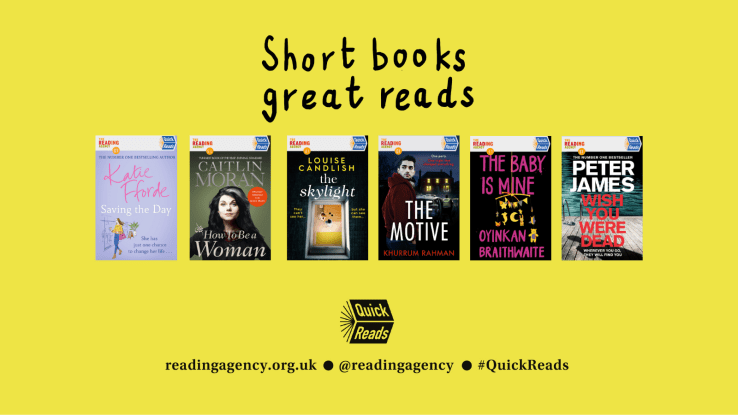
Quick Reads social media banner 2021

I’m delighted to be helping to celebrate the 15th anniversary today of The Reading Agency‘s Quick Reads programme and its vital role in tackling the adult literacy crisis. For those of us who cannot imagine life without books, it’s easy to forget that one in six adults in the UK – approximately 9 million people – find reading difficult, and that one in three people do not regularly read for pleasure. The aim of Quick Reads is to address those shocking statistics by inspiring emergent readers, as well as those with little time or who have fallen out of the reading habit, with entertaining and accessible writing from the very best contemporary authors.

In the fifteen years since its inception over five million Quick Reads have been distributed. From 2020 to 2022, the initiative is supported by a philanthropic gift from bestselling author, Jojo Moyes. This year, for every Quick Read bought up to 31 July 2021, another copy will be gifted to help someone discover the joy of reading.

I’d like to thank Hannah at Midas PR for offering me the opportunity to get involved in the celebrations and to read one of the fantastic books in this year’s selection. Having recently read Oyinkan Braithwaite’s Booker nominated debut My Sister, the Serial Killer, it was a simple choice for me. You can read my thoughts on The Baby Is Mine below.

The Baby Is MineAbout the Book

When his girlfriend throws him out during the pandemic, Bambi has to go to his Uncle’s house in lock-down Lagos. He arrives during a blackout, and is surprised to find his Aunty Bidemi sitting in a candlelit room with another woman. They both claim to be the mother of the baby boy, fast asleep in his crib.

At night Bambi is kept awake by the baby’s cries, and during the days he is disturbed by a cockerel that stalks the garden. There is sand in the rice. A blood stain appears on the wall. Someone scores tribal markings into the baby’s cheeks. Who is lying and who is telling the truth?

Format: Paperback (128 pages)    Publisher: Atlantic Books
Publication date: 27th May 2021 Genre: Contemporary Fiction

Find The Baby is Mine on Goodreads

Purchase links
Bookshop.org
Disclosure: If you buy a book via the above link, I may earn a commission from Bookshop.org, whose fees support independent bookshops

Hive | Amazon UK
Links provided for convenience only, not as part of an affiliate programme


My Review

Set in lockdown Lagos, The Baby Is Mine has the same touches of humour that made My Sister, the Serial Killer such an entertaining read. For example, Bambi’s parenting skills initially seem doubtful when his reaction to being shown the baby is that it looks like a baked potato. Talking of which, the central role that food plays in Nigerian life is once again evident, whether as a communal act, an important element of hospitality or proof of sincere affection. As Bambi’s Aunt Bidemi remarks dismissively of Esohe, the young woman who claims the baby is hers and was also her rival for Bidemi’s late husband’s affections, “What kind of love is that? Do you know she cannot even make his favourite soup?

Bambi, Bidemi and Esohe are forced to sit out lockdown together until such time as a test can take place to confirm to which of the women the baby belongs. Bambi’s sister is no help either, prevented from coming to his assistance by the lockdown restrictions. And his brother-in-law is not much better but after all, as Bambi ruefully observes, what can you expect from an Arsenal supporter? In the meantime, Bambi is stuck in a house with a crying baby who requires frequent nappy changes, a cockerel that crows all night, intermittent power cuts and two feuding women. How was your lockdown?

At around one hundred pages (if you exclude the extract from My Sister, the Serial Killer and the acknowledgements), The Baby Is Mine definitely lives up to its description as a “quick read”. It would make a great introduction to the writing of Oyinkan Braithwaite or to Nigerian literature in general.

In three words: Lively, funny, engaging

Try something similar: My Sister, the Serial Killer by Oyinkan Braithwaite

Follow this blog via Bloglovin


Oyinkan BraithwaiteAbout the Author

Oyinkan Braithwaite gained a degree in Creative Writing and Law at Kingston University. Following her degree, she worked as an assistant editor at Kachifo, a Nigerian publishing house, and has been freelancing as a writer and editor since. In 2014, she was shortlisted as a top-ten spoken-word artist in the Eko Poetry Slam, and in 2016 she was a finalist for the Commonwealth Short Story Prize.

Her first book, My Sister, the Serial Killer, was a number one bestseller. It was shortlisted for the 2019 Women’s Prize and was on the longlist for the 2019 Booker Prize.  She lives in Lagos, Nigeria. (Photo credit: Goodreads author page)

Connect with Oyinkan
Website | Twitter

#BookReview The Wolf Den by Elodie Harper @HoZ_Books

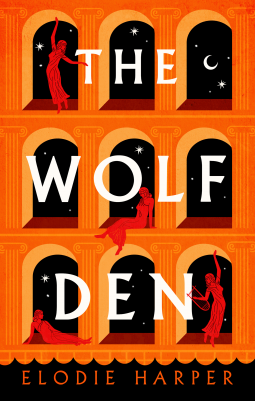
The Wolf DenAbout the Book

Sold by her mother. Enslaved in Pompeii’s brothel. Determined to survive. Her name is Amara. Welcome to the Wolf Den…

Amara was once a beloved daughter, until her father’s death plunged her family into penury. Now she is a slave in Pompeii’s infamous brothel, owned by a man she despises. Sharp, clever and resourceful, Amara is forced to hide her talents. For as a she-wolf, her only value lies in the desire she can stir in others.

But Amara’s spirit is far from broken.

By day, she walks the streets with her fellow she-wolves, finding comfort in the laughter and dreams they share. For the streets of Pompeii are alive with opportunity. Out here, even the lowest slave can secure a reversal in fortune. Amara has learnt that everything in this city has its price. But how much is her freedom going to cost her?

Format: Hardcover (464 pages)    Publisher: Head of Zeus
Publication date: 13th May 2021 Genre: Historical Fiction

Find The Wolf Den on Goodreads

Purchase links
Bookshop.org
Disclosure: If you buy a book via the above link, I may earn a commission from Bookshop.org, whose fees support independent bookshops

Hive | Amazon UK
Links provided for convenience only, not as part of an affiliate programme


My Review

As swiftly becomes clear, the women of the Wolf Den are nothing more than business assets – and perishable ones at that – destined to be discarded once their beauty or sexual allure no longer generates sufficient profit for brothel owner and pimp, Felix.

Set in AD74, the book vivdly conjures up the vibrant atmosphere of daily life in Pompeii – its bustling streets and market places lined with vendors, its bath houses, temples and taverns. On festival days, such as Vinalia, its streets become more crowded than ever as citizens vie for the best view of processions. Other scenes in the book bring to life the excitement of the Games with their gladiatorial combats and beast hunts, or visits to the theatre to see the latest play. Probably best though to steer clear of the honey-glazed dormouse served at dinner or the rigorous beauty regime Amara and her fellow She Wolves have to undergo, including tweezering out the hair under their arms and slathering their legs with with waxy resin then scraping them until they are smooth. Other neat touches in the book are the chapter headings consisting of fragments of graffiti or lines from poems and plays, as well as a role for a real-life figure, Pliny the Elder.

The diverse backgrounds of the She-Wolves whose lives the book follows – Amara, Dido, Victoria, Cressa and Beronice – illustrate the various ways in which women could find themselves slaves: being left an orphan, captured during a raid by slave traders or, most shocking of all, sold off by families who have nothing else left of value to sell. Whatever has brought them to the Wolf Den, they demonstrate a sisterly solidarity finding pleasure where they can in their rare time off from servicing clients. There’s bawdy humour in the book such as when, gathered in their favourite tavern, The Sparrow, Amara observes, “Here we all are… Four penniless slaves, sucking off idiots for bread and olives. What a life”. Of course, what none of them knows is that within a few years the eruption of Mount Vesuvius will change the life of everyone in Pompeii, rich or poor.

In addition to loss of freedom, slavery also brings a loss of identity. On being acquired by Felix, the She Wolves are given new names, can no longer speak in their native tongues and have to converse in Latin instead. Paradoxically, they are often ‘marketed’ to potential customers based on their racial background in order to lend them an air of exoticism. Whether to share their real names with others is one of the few things they can decide for themselves, which is why it’s an act of such significance when Amara decides to do so. And, as she is reminded, “even slaves own their happiness.  Feelings are the only things we do own.”

I doubt any reader can fail to admire Amara’s spirit. As she says, “Either we choose to stay alive or we give up. And if it’s living we choose, then we do whatever it takes.” Resourceful and determined to make the best of her situation in order to one day earn her freedom, Amara’s not afraid to offer Felix suggestions about ways to enhance the income of the Wolf Den or his money-lending business. What she doesn’t realize is just what a cut-throat world he operates in and the consequences that may follow from him taking her advice. As he remarks, “What do you think it takes to survive in Pompeii?”  By the end of the book, Amara has discovered exactly what it takes to survive in Pompeii, forced to make a choice between love and freedom.

The Wolf Den is an illuminating portrait of the lives of women determined to cling to what little control they have over their lives, even if that’s only expressing their disdain for their clients via disparaging graffiti daubed on the walls of their cells. If nothing else, it acts as a record of their existence. As the author notes on her Pompeii blog, the remains of the Lupanar is one of the most visited buildings in Pompeii, a place that visitors remember for “its erotic frescoes and for the small cells with their stone beds, left almost as if the women and their clients might return at any moment”. I can testify to this having been fortunate enough to visit Pompeii some years ago during a holiday in Italy. The Wolf Den would be the perfect preparation for a first or return visit.  

I received an advance review copy courtesy of Head of Zeus via NetGalley.

In three words: Immersive, emotional, assured

Try something similar: The Silence of the Girls by Pat Barker

Follow this blog via Bloglovin


Elodie HarperAbout the Author

Elodie Harper is a journalist and prize winning short story writer. Her story ‘Wild Swimming’ won the 2016 Bazaar of Bad Dreams short story competition, run by The Guardian and Hodder & Stoughton and judged by Stephen King.

She is currently a reporter and presenter at ITV News Anglia, and before that worked as a producer for Channel 4 News. (Photo credit: Twitter profile)

Connect with Elodie
Website | Twitter | Instagram