
 Welcome to today’s stop on the blog tour for The Fort by Adrian Goldsworthy, the first book in a brand new trilogy set in the Roman empire. My thanks to Vicky Joss and Lauren Tavella at Head of Zeus for inviting me to take part in the tour and for my review copy.
And I think they deserve extra points for cleverly including a particular quote in the accompanying press release information!
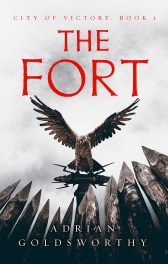 About the Book
Dacia, AD 105. The Dacian kingdom and Rome are at peace, but no one thinks that it will last. Sent to command an isolated fort beyond the Danube, centurion Flavius Ferox can sense that war is coming, but also knows that enemies may be closer to home.
Many of the Brigantes under his command are former rebels and convicts, as likely to kill him as obey an order.
And then there is Hadrian, the emperor’s cousin, and a man with plans of his own.
Format: Hardcover (496 pages) Publisher: Head of Zeus
Publication date: 10th June 2021 Genre: Historical Fiction
Find The Fort (City of Victory #1) on Goodreads
Purchase links
Bookshop.org
Disclosure: If you buy a book via the above link, I may earn a commission from Bookshop.org, whose fees support independent bookshops
Hive | Amazon UK
Links provided for convenience only, not as part of an affiliate programme
My Review
My first experience of Adrian Goldsworthy’s novels was reading Vindolanda which I enjoyed very much. But of course you already know that if you’ve perused the press release shown above. (Unfortunately, its follow-up The Encircling Sea has been languishing in my TBR pile for quite a while.) Vindolanda was also the book that first introduced readers to Roman centurion, Flavius Ferox.
Although The Fort is the first in a new series, it once again features Flavius Ferox as well as some of the characters from the Vindolanda series. For example, Ferox’s friend Vindex and some of Ferox’s household staff. It appears to follow on directly from events in the final book in the Vindolanda trilogy, Brigantia. However, for the benefit of readers (like me) who haven’t read Brigantia, or indeed those who haven’t read any of the Vindolanda trilogy, the author provides subtle details about key events and characters from the earlier books.
Ferox’s current posting is to a remote fort on the border with Dacia (part of what is now Romania) during a period of uneasy and, in all likelihood, short-lived peace between that nation and the Roman Empire. He’s accompanied by a force of fierce Brigantes (Celtic Britons from the north of England) some of whom have vowed to kill him in revenge for an act of that they view as murder.
Like Ferox, the reader may wonder just why ‘this ragbag of rebels, bandits, deserters and rival tribesman’ has been sent to Piroboridava. In fact, as Ferox admits himself, he’s a bit of a ragbag, ‘a good Silurian boy turned Roman centurion’. But, ever practical, he sets about getting the rather rundown garrison into shape in order to have a better chance of defending a Dacian attack should it come, as his gut tells him is likely. This also serves to provide a focus for the disparate group of six hundred soldiers he finds himself responsible for and a way of dispelling the boredom that might otherwise bubble over into violence.
The story switches briefly to Rome where the reader is introduced to the Emperor Trajan’s cousin, the senator Hadrian who has recently been appointed legatus of the Minervia legion, some of whose soldiers have been deployed to Piroboridava. I knew very little about Hadrian before reading this book apart from the fact he later became emperor himself and built a famous wall in the north of England. The author gives a little nod to this by including a scene in which Hadrian shows a keen interest in the process of building design and construction. The Hadrian the reader is presented with here is intelligent, wily and ambitious although with a private life that leaves him open to manipulation by others.
Talking of private lives, the book was enlivened for me by the arrival at the fort of the feisty Claudia Enica, Queen of the Brigantes, and two young warriors, Bran and Miruna. All three have been trained in warfare by a woman known as ‘the Mother’. She trained them well as it turns out. From time to time a third point of view takes over, that of a young warrior, Brasus, placed in command of an advance guard of the Dacian army. His narrative is infused with the rituals associated with his tribe’s religious customs, giving it a mythical quality.
I confess the multiplicity of storylines left me rather confused to begin with but gradually things became clearer especially once many of the characters find themselves gathered together. Not so much Casablanca‘s ‘Of all the gin joints in all the towns in all the world she walks into mine’ as ‘Of all the forts in all the Empire they ride up to the gates of mine’!
The book contains the sort of authentic detail – of weaponry, Roman army procedures, social and religious customs – you would expect from a historian of the author’s reputation. There is also an extensive glossary for those of us who can’t tell our gladius from our spatha. My fabulous hardcover edition also included a map of the region and a plan of the Piroboridava fort. As the author explains in his fascinating historical note at the end of the book, the fort’s location is fictional but is based on a Roman garrison of the same name situated closer to the mouth of the Danube.
For those who like plenty of full-on action in their historical fiction, there are only skirmishes to begin with. However, stick with it because there are scenes later in the book that will definitely not disappoint. The book’s final few chapters see some story lines resolved but others carefully set up as ‘to be continued’ plot lines to whet the appetite for subsequent books in the series. Consider my appetite well and truly whetted!
In three words: Authentic, pacy, action-packed
Try something similar: Fortress of Fury by Matthew Harffy
Follow this blog via Bloglovin
 About the Author
Adrian Goldsworthy studied at Oxford, where his doctoral thesis examined the Roman army. He went on to become an acclaimed historian of Ancient Rome. He is the author of numerous works of non-fiction, including Caesar, Pax Romana, Hadrian’s Wall and Philip and Alexander. He is also the author of the Vindolanda series, set in Roman Britain, which first introduced readers to Flavius Ferox.
Connect with Adrian
Website


 About the Book
 About the Author

 What Cathy Read Next...